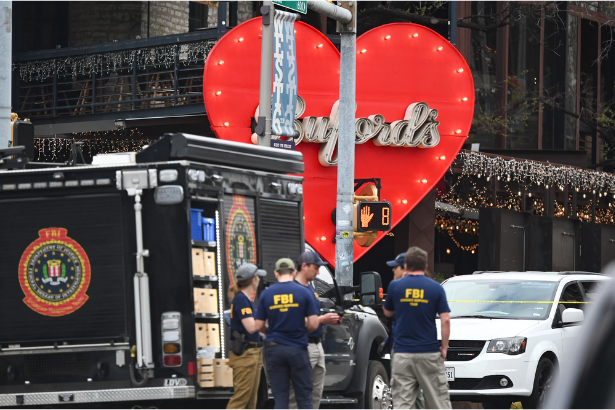
Suspect Ndiaga Diagne, 53, wore “Property of Allah” sweatshirt and Iranian flag shirt, fired from SUV then rifle on West Sixth Street — officers killed gunman within minutes of 1:59 a.m. attack
Introduction
Austin shooting updates dominated U.S. search trends Sunday, March 1, 2026, after a deadly attack in downtown Austin, Texas left two civilians dead and 14 others injured, prompting the FBI to investigate a potential terrorism connection. The suspect — 53-year-old Ndiaga Diagne, a naturalized U.S. citizen from Senegal who lived in Pflugerville — was fatally shot by Austin police officers shortly after the attack began.
The shooting occurred just before 2:00 a.m. Sunday outside Buford’s Backyard Beer Garden along West Sixth Street, one of Austin’s busiest nightlife corridors. Diagne wore a sweatshirt that read “Property of Allah” and a T-shirt underneath with an Iranian flag emblem, according to multiple law enforcement officials who spoke to the Associated Press, PBS, and other outlets. The FBI is investigating “indicators on the suspect and in his vehicle” that suggest a “potential nexus to terrorism,” Acting Special Agent in Charge Alex Doran said at a Sunday morning press conference.
Austin Police Chief Lisa Davis said Diagne drove around the block several times in a large SUV, activated his hazard lights, and began firing a pistol at customers on Buford’s outdoor patio without ever entering the bar. He then drove west on West Sixth Street, parked on nearby Wood Street, exited his vehicle with a rifle, and continued shooting at pedestrians walking along Sixth Street. Officers who were stationed nearby as part of a weekend entertainment district patrol program confronted the suspect and returned fire, killing him at an intersection near East Sixth Street.
Background and Context
Austin has historically maintained a reputation as one of Texas’s safer large cities, despite statewide increases in gun violence over the past decade. West Sixth Street is heavily patrolled during weekend hours due to high foot traffic from bars, restaurants, and live music venues. The area is popular with University of Texas students and is located just blocks from Austin’s historic East Sixth Street entertainment district.
In recent years, Austin Police Department and Austin-Travis County EMS have significantly increased their presence in nightlife districts, embedding paramedics with police teams during peak entertainment hours. This program, which allows medical personnel to arrive within seconds of an incident, is credited by officials with saving lives during Sunday’s attack.
Mass shootings in nightlife districts have become a recurring pattern in major U.S. cities, raising ongoing questions about crowd security, firearm access, and rapid law enforcement response. Sunday’s attack comes amid heightened security concerns following recent American-Israeli military strikes in Iran, which Texas Governor Greg Abbott referenced in his response to the shooting.
Latest Update: What Authorities Have Confirmed
Here is what authorities have confirmed based on verified reporting from KUT Radio, FOX 7 Austin, KVUE, PBS NewsHour, Axios, KSAT, ABC13, and other outlets:
Death Toll and Injuries:
- Three people died at the scene: Two civilians and the suspect
- 14 additional victims hospitalized: Three were in critical condition as of Sunday morning
- Total patients: 17 (including the three who died)
Timeline:
- 1:59 a.m.: Austin-Travis County EMS received the call
- 57 seconds later: Paramedics and officers were on scene treating patients
- 24 minutes: All critical patients transported from scene
- 47 minutes: All remaining patients off the scene
Suspect Identity and Actions:
- Name: Ndiaga Diagne, 53 years old
- Residence: Pflugerville, Texas (suburb northeast of Austin)
- Citizenship: Naturalized U.S. citizen, originally from Senegal
- Clothing: Wore a sweatshirt reading “Property of Allah” and a T-shirt with an Iranian flag design
- Weapons: A pistol and a rifle (both recovered at the scene)
- Vehicle: Large SUV (searched for explosives, none found)
Attack Sequence:
Austin Police Chief Lisa Davis provided the following timeline at a Sunday morning press conference:
- Driving phase: Diagne drove around the block multiple times in his SUV
- First shooting: He stopped, activated his hazard lights, rolled down his windows, and fired a pistol at customers on Buford’s outdoor patio and in front of the bar without ever entering the business
- Relocation: He drove west on West Sixth Street and parked on nearby Wood Street
- Second shooting: He exited his vehicle with a rifle and shot at pedestrians walking along Sixth Street as he walked eastbound
- Confrontation: Officers stationed nearby confronted him at an intersection near East Sixth Street
- Conclusion: Officers returned fire and killed the suspect
FBI Terrorism Investigation:
Acting Special Agent in Charge Alex Doran of the FBI’s San Antonio Field Office said:
“While the investigation remains ongoing, there were indicators on the suspect and in his vehicle suggesting a potential nexus to terrorism. In terms of specifically what type of terrorism, we’re just at this point prepared to say that it was potentially an act of terrorism.”
Doran declined to provide specific details about what those indicators were, but multiple law enforcement officials confirmed to the Associated Press and other outlets that Diagne was wearing clothing with Islamic references and an Iranian flag emblem.
Law enforcement said they are investigating this as a lone wolf incident rather than a larger plot. Authorities are also looking into the suspect’s mental health history.
No Explosives Found:
After identifying Diagne’s SUV, authorities conducted a bomb sweep and quickly cleared the vehicle, finding no explosives. An explosives team was called in to evaluate the vehicle after investigators found concerning items inside, but the threat was determined to be minimal.
Blood Donation Response:
South Texas Blood & Tissue officials said 20 units of O-negative blood were sent to Austin overnight and the Blood Emergency Readiness Corps (BERC) was activated. An additional 140 units, including O-negative and O-positive, were dispatched from other blood centers across Texas.
Expert Insights or Analysis
Rapid Response Likely Prevented Additional Casualties
Security experts note that rapid response likely prevented additional fatalities. The presence of pre-positioned officers in high-density entertainment districts has become standard practice in major metropolitan areas. Austin’s program of embedding paramedics with police teams during peak entertainment hours proved critical in this case.
Austin Mayor Kirk Watson emphasized this point at Sunday’s press conference: “There is no question in my mind that the quick response of the police officers and of our EMS personnel and those professionals made a difference and saved lives. That is an important thing for us to keep in mind as we go through this and we go both the trauma of this and the investigation and that is the very professional, extremely competent and quick response of our police and our other our EMS personnel saving lives under these circumstances.”
Counterterrorism Context
Counterterrorism analysts caution against premature conclusions. In similar past cases, early speculation has sometimes proven inaccurate once full digital forensics and behavioral analysis are completed.
Criminal justice researchers point out that lone-actor violence often blends personal grievance, mental instability, and online radicalization rather than formal ties to organized extremist groups. The fact that authorities described this as a “lone wolf” investigation suggests they do not currently believe Diagne was part of a coordinated attack or had direct ties to terrorist organizations.
Governor Abbott’s Iran/Middle East Comments
Texas Governor Greg Abbott drew a link to the Middle East conflict in a Sunday statement, though FBI officials have not confirmed any such connection:
“To anyone who thinks about using the current conflict in the Middle East to threaten Texans or our critical infrastructure, understand this clearly: Texas will respond with decisive and overwhelming force to protect our state.”
Abbott’s statement referenced recent American-Israeli military strikes in Iran and announced that he had already increased security at sensitive locations statewide in response to that conflict. He also directed the Texas Department of Public Safety and Texas National Guard to intensify patrols and surveillance along Sixth Street during weekends.
However, FBI officials have not publicly linked Diagne’s attack to any international terrorist organization, the Iran conflict, or coordinated terrorism planning. The investigation remains ongoing.
Broader Implications
Public Safety Strategy:
The Austin shooting will likely prompt reassessment of:
- Nightlife security coordination between police, EMS, and businesses
- Surveillance deployment in entertainment districts
- Crowd monitoring technologies including cameras and sensors
- Emergency medical response times and embedded paramedic programs
- Vehicle access controls around pedestrian-heavy nightlife areas
Austin’s West Sixth Street and East Sixth Street districts are now among the most heavily patrolled entertainment zones in Texas. Sunday’s attack will likely lead to further security enhancements.
Federal-State Coordination:
The FBI’s immediate involvement underscores the threshold at which incidents transition from local criminal investigation to federal national security review. The presence of potential terrorism indicators — clothing, vehicle contents, possible ideological motivations — triggered the FBI’s participation within hours of the shooting.
This reflects post-9/11 protocols where any mass violence incident with potential terrorism connections receives immediate federal scrutiny.
Technology and Monitoring:
Digital footprint analysis now plays a central role in investigations. Authorities routinely examine:
- Social media history and posts
- Encrypted messaging apps (Signal, Telegram, WhatsApp)
- Search patterns and browsing history
- Financial records and transactions
- Travel history and associations
- Purchase records for weapons, supplies, or materials
The case reflects how law enforcement increasingly relies on data-driven threat assessment to determine whether attacks are acts of terrorism, ideologically motivated violence, or criminal actions driven by personal grievances.
Mental Health Considerations:
Law enforcement officials said they are investigating the suspect’s mental health history. This dual-track approach — examining both terrorism indicators and mental health — has become standard in mass violence cases where motivations may be complex and multifaceted.
Related History or Comparable Incidents
Austin has experienced prior mass casualty shootings, though not all have carried potential terrorism indicators. The city has seen periodic violence in entertainment districts, leading to increased security measures in recent years.
Nationally, attacks in nightlife districts have occurred in cities including:
- Orlando, Florida (Pulse nightclub, 2016): 49 killed in a mass shooting that the FBI investigated as terrorism
- Dayton, Ohio (Oregon District, 2019): 9 killed and 27 injured in a nightlife district shooting
- Kansas City, Missouri (multiple incidents): Entertainment district shootings in recent years
Each case prompted renewed debates about firearm legislation, mental health resources, law enforcement preparedness, and the intersection of terrorism and mental health in mass violence incidents.
The Austin shooting differs from some prior attacks in that the suspect never entered the establishment — he fired from his vehicle and then on foot outside, suggesting a different tactical approach than indoor active shooter situations.
What Happens Next
Ongoing Investigation:
Investigators will focus on:
- Digital forensic analysis of the suspect’s devices (phones, computers, tablets)
- Review of travel history and associations to determine if he had connections to extremist groups
- Examination of manifesto-style writings, if any, or social media posts indicating ideology
- Interviews with acquaintances and family members to understand his background, beliefs, and recent behavior
- Financial records analysis to identify weapon purchases, travel, or other relevant transactions
Federal authorities will determine whether the case qualifies legally as domestic terrorism, international terrorism, or remains categorized as mass homicide. This determination affects federal charges (if posthumously relevant), investigative resources, and public messaging.
Victim Identification and Condition Updates:
Authorities are working to notify families before releasing victim identities. Condition updates on the 14 hospitalized victims are expected as families are notified and medical assessments progress.
Three victims remained in critical condition as of Sunday morning. Their survival may depend on the severity of gunshot wounds and the speed of trauma care, which officials credit as likely life-saving in this case.
Security Enhancements:
Governor Abbott announced:
- Increased DPS and Texas National Guard patrols along Sixth Street during weekends
- Intensified surveillance in Austin entertainment districts
- Heightened security at sensitive locations statewide given Middle East conflict tensions
Austin Mayor Kirk Watson and Police Chief Lisa Davis may announce additional local security measures in coming days.
Community Support:
UT Austin President Jim Davis (no relation to Police Chief Lisa Davis) said in a statement that he was “deeply saddened by the shooting. Our prayers are with the victims and all those impacted, including members of our Longhorn family, and my heart goes out to their families, friends, classmates, professors, and loved ones.”
Community vigils and support services are expected to be organized for victims, witnesses, and affected community members.
People seeking information about loved ones should call Austin Police Department’s victim services unit at 512-974-5037. Anonymous tips can be submitted through the Capital Area Crime Stoppers Program at 512-472-8477 or online.
Conclusion
The Austin shooting represents another tragic episode in America’s ongoing struggle with mass violence. While authorities investigate possible ideological motives, the immediate priority remains supporting victims and ensuring public safety.
The rapid response by Austin police officers and embedded paramedics — arriving within 57 seconds and evacuating all critical patients within 24 minutes — likely prevented additional deaths. This reflects the effectiveness of proactive security strategies in entertainment districts, even as the frequency of mass violence incidents continues to challenge American cities.
As federal and local agencies continue their joint investigation, further updates are expected in the coming days regarding the suspect’s motivations, digital footprint, and any potential connections to extremist ideologies or organizations.
For now, Austin mourns two civilians killed and 14 injured in an attack that turned a Saturday night out into a national tragedy.
FAQ
Q1: How many people were killed in the Austin shooting? Two civilians were killed at the scene. The suspect, 53-year-old Ndiaga Diagne, was also killed by responding Austin police officers, bringing the total death toll to three.
Q2: How many people were injured? Fourteen individuals were transported to hospitals with injuries. Three were in critical condition as of Sunday morning. Several victims suffered gunshot wounds, while others were injured during the chaos of the attack.
Q3: Is the FBI investigating terrorism? Yes. Acting Special Agent in Charge Alex Doran said there were “indicators on the suspect and in his vehicle” suggesting a “potential nexus to terrorism.” However, no final determination has been made, and authorities described this as a “lone wolf” investigation rather than a coordinated plot.
Q4: Where did the shooting occur? The shooting occurred on West Sixth Street in downtown Austin, Texas, beginning outside Buford’s Backyard Beer Garden at the intersection of West Sixth and Rio Grande streets just before 2:00 a.m. Sunday, March 1, 2026.
Q5: Who was the suspect? The suspect was identified as Ndiaga Diagne, a 53-year-old naturalized U.S. citizen originally from Senegal who lived in Pflugerville, Texas. He was wearing a sweatshirt reading “Property of Allah” and a T-shirt with an Iranian flag emblem during the attack. He was fatally shot by Austin police officers.
Sources and References
KUT Radio: 3 dead, 14 hospitalized in potential act of terrorism in downtown Austin, FBI says https://www.kut.org/crime-justice/2026-03-01/austin-tx-sixth-street-shooting-suspect-police-injuries-deaths
KVUE: FBI investigating ‘potential nexus to terrorism’ in 6th Street shooting https://www.kvue.com/article/news/local/austin-mass-shooting/active-attack-reported-in-downtown-austin/269-1a19c462-1416-4316-8dba-732c395fbfcf
Associated Press: FBI investigates Texas bar shooting for possible terrorism https://apnews.com/article/austin-texas-bar-shooting-7690f931ba00f950c1828cef25399bb6
PBS NewsHour: Suspect in Texas bar shooting wore ‘Property of Allah’ clothing and Iranian flag emblem https://www.pbs.org/newshour/nation/suspect-in-texas-bar-shooting-wore-property-of-allah-clothing-and-iranian-flag-emblem-according-to-ap-source