Amazon is putting another $1.9 billion into its Delivery Service Partner program while expanding AI routing, surround-view cameras, dynamic hazard alerts and smart glasses for delivery drivers.
Amazon delivery technology is entering a new phase as the company combines a major investment in its Delivery Service Partner program with a wider rollout of artificial intelligence, computer vision and wearable technology.
Amazon announced on September 21 that it will invest another $1.9 billion in its Delivery Service Partner program in 2027, bringing its total investment in the program to $21.7 billion over eight years. The company says the new funding will help delivery partners raise average Delivery Associate earnings to nearly $24 per hour while supporting new safety and operational technology.
At the same time, Amazon is rolling out surround-view cameras, AI-powered routing, dynamic hazard alerts and its Smart Delivery Glasses. The company expects more than 20,000 of the wearable devices to be in the field by the end of 2027.
The result is a logistics strategy in which AI is moving beyond warehouses and software dashboards and directly into the final mile.
Background and Context
Amazon’s delivery operation is enormous, and the final mile is one of the most complicated parts of the entire logistics chain.
A package can move efficiently through fulfillment centers and still encounter delays once it reaches the neighborhood. Drivers have to deal with traffic, construction, weather, apartment buildings, parking shortages, pedestrians, cyclists, unfamiliar addresses and constantly changing road conditions.
Amazon is now trying to use technology to reduce some of that friction.
The company’s Delivery Service Partner program works with independent businesses that operate delivery fleets and employ drivers. Amazon says it has invested more than $543 million in safety initiatives, programs and technology for DSP owners and their teams since 2022. The company also says serious vehicle crashes across its network fell more than 23% last year.
The latest announcement expands that technology stack.
Instead of relying on a single navigation application, Amazon is building a connected system involving:
- Computer vision
- AI-based routing
- Generative AI mapping
- Surround-view cameras
- Dynamic hazard alerts
- Wearable smart glasses
- Driver safety analytics
- Delivery simulations
The broader goal is to make the delivery process safer while reducing the amount of time drivers spend dealing with friction at each stop.
Latest Update: Amazon Expands AI-Powered Delivery Technology


5
The latest Amazon announcement contains several separate technology upgrades.
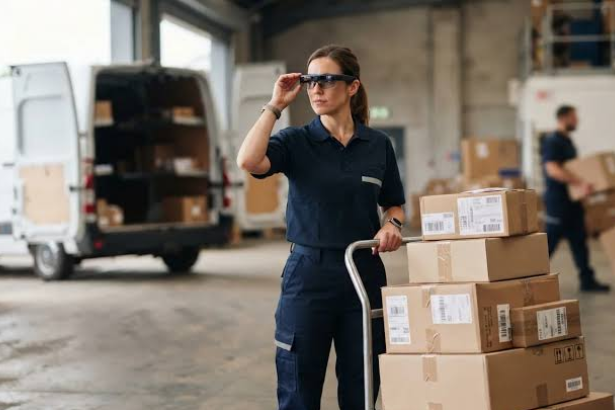
The most visible is the expansion of Smart Delivery Glasses.
Amazon says the glasses use computer vision to display navigation suggestions and delivery information directly in the driver’s field of view. New features include an LED headlamp, hands-free package scanning and proactive address verification.
The company expects more than 20,000 devices to be in the field by the end of 2027.
Amazon is also deploying new surround-view cameras that can identify vehicles, cyclists and pedestrians from different directions and alert drivers.
By the end of 2026, Amazon expects the technology to be installed in 50% of its Rivian electric delivery vehicles across its network.
Meanwhile, new dynamic hazard alerts in the Amazon Delivery app will notify drivers about accidents, road closures and construction ahead.
The routing system can also automatically adjust a driver’s route when it detects hazards or difficult weather conditions.
This is a significant change in how navigation works.
Instead of giving drivers a static route and expecting them to respond manually when conditions change, Amazon is attempting to make the route itself more dynamic.
Amazon Delivery Technology Moves Into the Driver’s Field of View
The Smart Delivery Glasses are arguably the most interesting part of the announcement.
Amazon first introduced the concept in 2025 as a hands-free system designed specifically for Delivery Associates.
The glasses combine AI-powered sensing, computer vision and cameras to provide information without requiring drivers to constantly look at a smartphone. Amazon says drivers can use them for package scanning, walking directions and proof of delivery.
The newest version expands those capabilities.
The system is designed to help drivers complete several tasks while keeping their attention closer to their surroundings.
That could matter during the most time-sensitive part of a delivery.
Consider a typical apartment delivery.
A driver may need to:
- Park the vehicle.
- Find the correct package.
- Locate the building entrance.
- Determine which direction to walk.
- Find the correct unit.
- Confirm the address.
- Deliver the package.
- Record proof of delivery.
- Return to the vehicle.
Amazon’s technology is aimed at reducing the amount of manual interaction involved in those steps.
That does not eliminate the work.
It changes how the driver interacts with the information needed to perform it.
Wellspring Is Building an AI Map of the Physical World
Another major component of Amazon’s logistics technology is Wellspring, the company’s generative AI mapping technology.
Amazon says Wellspring learns from delivery trips and builds increasingly detailed models of physical locations.
Since 2024, the company says the system has identified:
- 202 million parking locations
- 2.8 million building entrances
- 85,000 mailrooms and lockers
The information is intended to help delivery partners navigate difficult locations more efficiently and accurately.
This illustrates an important shift in logistics software.
Traditional navigation largely answers a simple question:
How do I get from point A to point B?
Amazon’s logistics systems are trying to answer a more detailed question:
How does a delivery worker physically complete the final 100 feet of the trip?
That distinction matters.
A navigation system can guide a van to an apartment complex, but it may not tell the driver where to park, which entrance is correct or where a package locker is located.
Amazon is trying to build that missing layer of information.
AI Routing Is Becoming More Context-Aware
Amazon is also expanding AI-based routing technology.
The company says its system can account for real-world conditions such as reduced visibility after sunset and additional time required to find parking in busy downtown areas.
That is different from simply calculating the shortest route.
The fastest theoretical route is not always the fastest operational route.
A downtown delivery may be only a few blocks away but take longer because the driver has to find parking.
An apartment complex may be geographically close but require significant walking time.
Bad weather can also change how quickly a driver can safely move between stops.
AI routing gives Amazon a way to incorporate those variables into delivery planning.
The $1.9 Billion Investment Is Also About Drivers
The technology story is only half of Amazon’s announcement.
The company is also putting another $1.9 billion into the Delivery Service Partner program for 2027.
Amazon says the investment is expected to help DSP owners raise Delivery Associate pay to a national average of nearly $24 per hour. It estimates that investments over the past three years will have helped DSPs increase driver pay by an average of 16% nationwide, with average earnings rising by roughly another dollar.
The actual pay and benefits vary because DSP owners are independent employers.
Amazon says all DSPs provide healthcare coverage and paid time off for full-time Delivery Associates, while many also provide benefits such as 401(k) plans and tuition reimbursement.
The investment therefore has two objectives:
Technology: make deliveries safer and more efficient.
Labor: help DSPs attract and retain drivers.
Those objectives are closely connected.
A more efficient delivery operation still needs enough drivers to execute the final-mile network.
Amazon’s Safety Technology Gets More Sophisticated
Safety is another major focus.
Amazon says the new surround-view cameras can identify vehicles, cyclists and pedestrians from multiple directions.
The company is also applying AI to driver behavior data.
Amazon says its systems can identify driving trends that are more likely to result in accidents and provide those insights to DSP owners, allowing them to coach drivers earlier.
That creates a shift from reactive safety toward predictive safety.
Instead of only investigating an accident after it happens, the system attempts to identify patterns that could precede an accident.
Amazon says this effort builds on existing Netradyne camera technology already used by DSP owners.
FreightWaves reports that Amazon has invested more than $543 million in safety initiatives for independent delivery businesses and that the company says serious vehicle crashes fell more than 23% last year.
Those figures are Amazon’s reported results and should be understood in that context.
Dynamic Hazard Alerts Could Change Last-Mile Routing
Another relatively small feature could have a significant operational effect.
Amazon is adding dynamic hazard alerts to its Delivery app.
Drivers can receive real-time information about:
- Accidents
- Road closures
- Construction
- Severe weather-related conditions
- Other route hazards
The navigation system can then automatically adjust the route.
For a delivery network operating at enormous scale, even small improvements in route efficiency can compound.
If a driver loses five minutes at one stop, that delay can affect subsequent deliveries.
If a routing system prevents that delay across thousands of routes, the aggregate effect becomes much larger.
This is where AI becomes less about flashy demonstrations and more about operational mathematics.
What Amazon Is Trying to Solve in the Last Mile
The last mile has several recurring problems.
Parking
Drivers may reach the correct neighborhood but struggle to find a legal or practical parking location.
Wellspring’s mapping system is designed to account for parking information.
Building Access
Apartment buildings and large residential complexes can consume significant time.
Mapping entrances, mailrooms and lockers gives Amazon more data about these environments.
Weather
Rain, snow, extreme heat and poor visibility can change how quickly drivers can complete routes.
Amazon says its routing technology can adapt to inclement weather and other conditions.
Address Accuracy
A package can be delivered to the wrong location even when the street address appears correct.
Amazon’s Smart Delivery Glasses now include proactive address verification.
Driver Attention
Constantly switching between a smartphone, packages and the physical environment can create distractions.
The glasses are designed to reduce some of that interaction.
Together, these technologies target different sources of friction in the same process.
Expert Insights and Industry Analysis
The significance of Amazon’s announcement extends beyond the company’s own fleet.
FreightWaves described the move as an expansion of safety technology and driver support, highlighting the combination of surround-view cameras, computer-vision glasses and AI-powered routing.
The broader logistics industry is increasingly focused on using AI to improve the economics of the final mile.
That makes sense because the last mile is where delivery complexity tends to increase.
A truck moving between distribution centers operates along predictable routes.
A residential delivery network operates across thousands or millions of individual destinations.
Each stop can be different.
AI is particularly useful when the problem involves large amounts of changing information.
Amazon Delivery Technology and the Economics of Every Stop
The real test for these technologies will be whether they improve measurable logistics outcomes.
Several metrics will matter:
- Time per delivery
- Miles driven per route
- Failed delivery rate
- Incorrect delivery rate
- Driver safety incidents
- Package scanning time
- Parking time
- Customer delivery accuracy
- Driver retention
- Cost per package
Amazon has not disclosed a complete set of performance figures for the new Smart Delivery Glasses or the latest camera rollout.
That means it is too early to quantify the full financial impact of the technology.
What is clear is that Amazon is scaling the technology rather than treating it as a small experiment.
The planned deployment of more than 20,000 Smart Delivery Glasses by the end of 2027 is considerably larger than a limited pilot.
Privacy and Worker-Technology Questions
Wearable cameras and AI systems also create questions that go beyond logistics efficiency.
Smart glasses and vehicle cameras can capture information about roads, homes, people and delivery locations.
Amazon says its Smart Delivery Glasses are designed to help drivers work hands-free, while their use is voluntary for DSP owners and their teams of Delivery Associates.
The wider technology industry is simultaneously dealing with concerns about privacy, recording and AI-enabled wearables.
Reuters recently reported that companies developing AI-powered glasses and other wearable devices are facing increasing scrutiny over privacy and potential recording of people without clear consent.
For Amazon, that means scaling wearable technology will involve not only technical questions but also questions about policies, data handling, worker acceptance and public expectations.
Broader Implications for Logistics
Amazon’s latest announcement points toward a larger change in the logistics industry.
The traditional delivery vehicle is becoming a connected computing platform.
The driver is increasingly surrounded by software.
The route is dynamic.
The vehicle can see its surroundings.
The mapping system learns from previous deliveries.
The wearable device can provide instructions directly in the driver’s field of view.
That creates a logistics system where physical operations and AI software increasingly operate together.
The Delivery Van Becomes a Sensor
Surround-view cameras give the vehicle a much richer understanding of its surroundings.
That information can be used for safety alerts and potentially for broader operational intelligence.
The Driver Becomes Connected to the Route
Smart glasses and dynamic routing connect the driver more directly to Amazon’s software systems.
The driver does not have to independently interpret every change.
The system can provide updated information as conditions change.
The Map Becomes More Detailed
Wellspring is building a map that goes beyond roads.
Parking spaces, entrances, mailrooms and lockers become part of the delivery map.
That creates a much more operationally useful representation of the physical world.
For technology and logistics readers, this is where The Tech Marketer’s business and technology coverage can provide additional context on the growing intersection between AI, automation and physical operations.
Amazon’s Logistics Strategy Is Bigger Than Smart Glasses
It would be easy to treat the announcement as simply a smart-glasses story.
The larger picture is more significant.
Amazon is combining:
AI mapping
with
AI routing
with
computer vision
with
vehicle safety systems
with
wearable computing
with
driver compensation
That is a much broader logistics architecture.
The smart glasses are one interface inside that system.
The cameras are another.
The routing software is another.
Wellspring is another.
Together, they create a technology layer around the delivery process.
Related History and Comparable Technologies
Amazon has been investing in delivery technology for years.
The company has explored robotics, automation, mapping, routing systems, delivery vehicles and wearable technology as part of its broader logistics infrastructure.
Its smart-glasses program builds on that pattern.
The company’s earlier description of the technology emphasized hands-free delivery, navigation and hazard awareness.
The latest announcement shows the concept moving toward larger deployment.
This progression is typical of enterprise technology.
First comes experimentation.
Then comes a limited pilot.
Then companies measure whether the system improves operations.
Finally, successful systems are integrated into larger workflows.
Amazon’s plan for more than 20,000 Smart Delivery Glasses by the end of 2027 suggests the company is moving deeper into that third and fourth stage for this particular technology.
What Happens Next?
Several developments will be worth watching over the next 12 to 18 months.
1. Smart Glasses Deployment
Amazon expects more than 20,000 devices to be in the field by the end of 2027.
The important question will be how broadly DSPs adopt them and what measurable improvements result.
2. Rivian Camera Rollout
Amazon expects the new surround-view technology to reach 50% of Rivian electric delivery vehicles by the end of 2026.
3. Driver Pay
The new investment is expected to help raise average Delivery Associate earnings to nearly $24 per hour nationally, although actual compensation varies by DSP and geography.
4. AI Routing
Amazon will continue expanding routing systems that respond to weather, parking conditions and other real-world variables.
5. Safety Results
The company will need to demonstrate whether the newer technology can sustain or improve the safety gains it has reported.
6. Community Logistics
Amazon is also committing $70 million over five years to community initiatives led by DSP owners. The company says its Local Good program delivered more than 8 million essential items and more than 4 million meals in 2025.
Google Trends: Amazon Delivery Technology
The current trend story is closely connected to the growing interest in Amazon’s delivery operations, AI and driver technology.
For an SEO-focused article, the trend angle can be expanded around searches related to Amazon delivery drivers, smart glasses, delivery technology, AI logistics and Amazon’s $1.9 billion investment.
Suggested Google Trends Image
Title: Amazon Delivery Technology Search Trends
Alt Text: Amazon delivery technology search interest following $1.9 billion logistics investment
Caption: Interest in Amazon delivery technology is rising as the company expands AI safety systems, smart glasses and driver investments.
Trend Keywords
- Amazon delivery technology
- Amazon delivery drivers
- Amazon smart glasses
- Amazon delivery
- Amazon logistics
- Amazon AI
- AI delivery technology
- Amazon $1.9 billion
- Amazon DSP
- last-mile delivery
- delivery driver technology
- AI logistics
Exactly 3 Reference Links
- Amazon: $1.9B Delivery Service Partner Investment
- FreightWaves: Amazon Rolls Out Safety Tech and Pay Bump
- Amazon: Smart Delivery Glasses Technology
Conclusion
Amazon is making a major bet that the future of last-mile logistics will be increasingly software-defined.
The company plans to invest another $1.9 billion in its Delivery Service Partner program in 2027, while expanding AI-powered routing, generative AI mapping, surround-view cameras, dynamic hazard alerts and Smart Delivery Glasses.
The Smart Delivery Glasses are expected to exceed 20,000 devices in the field by the end of 2027, while new surround-view cameras are scheduled to reach half of Amazon’s Rivian electric delivery fleet by the end of 2026.
The technology is designed to solve practical problems: finding parking, navigating complex buildings, identifying hazards, verifying addresses and keeping drivers from repeatedly looking down at a phone.
But the technology alone will not determine whether the strategy works.
The important measures will be operational.
Can Amazon reduce delivery time?
Can it improve safety?
Can it reduce incorrect deliveries?
Can it help DSPs retain drivers?
Can it lower the cost of completing each stop?
Those are the questions that will determine whether Amazon’s latest delivery technology investment becomes a meaningful transformation of last-mile logistics.
For now, the direction is clear.
Amazon is bringing AI closer to the street, closer to the vehicle and increasingly closer to the driver’s own field of view.
FAQ
1. What is Amazon’s latest delivery technology investment?
Amazon is investing another $1.9 billion in its Delivery Service Partner program in 2027, alongside new safety systems, AI routing, mapping technology and wearable devices.
2. What are Amazon Smart Delivery Glasses?
Amazon Smart Delivery Glasses are AI-powered wearable devices designed to provide delivery drivers with navigation information, delivery details and other assistance directly in their field of view.
3. How many Amazon Smart Delivery Glasses will be deployed?
Amazon expects to have more than 20,000 devices in the field by the end of 2027.
4. What is Wellspring?
Wellspring is Amazon’s generative AI mapping technology. Amazon says it learns from delivery trips and has identified 202 million parking locations, 2.8 million building entrances and 85,000 mailrooms and lockers since 2024.
5. How much will Amazon delivery drivers earn?
Amazon says its latest investment will help DSPs raise Delivery Associate earnings to a national average of nearly $24 per hour. Actual pay varies by Delivery Service Partner and geography.
6. What do Amazon’s new delivery cameras do?
The new surround-view cameras are designed to identify vehicles, cyclists and pedestrians from different directions and notify drivers. Amazon expects the technology to be installed in 50% of Rivian electric delivery vehicles across its network by the end of 2026.
7. How is AI being used in Amazon logistics?
Amazon uses AI for mapping, route optimization, driver safety analysis, hazard alerts and wearable delivery technology. Its systems are designed to respond to real-world factors such as weather, visibility and parking conditions.
8. Why is Amazon investing so heavily in last-mile delivery?
Last-mile delivery involves complex variables that can change from stop to stop. Amazon is using AI and connected hardware to improve safety, routing, delivery accuracy and operational efficiency.
SOURCES & REFERENCES
- Amazon: Amazon Invests Another $1.9 Billion in the Delivery Service Partner Program with New Safety Initiatives and AI-Powered Technology
- FreightWaves: Amazon Rolls Out Safety Tech, Pay Bump for Delivery Providers
- Amazon: Amazon’s Delivery Glasses, the Newest Innovation Designed to Enhance the Delivery Experience
- PYMNTS: Amazon Invests $1.9 Billion in Delivery Safety and Pay
- Yahoo Finance: Amazon Takes Wearable AI Deeper Into Logistics