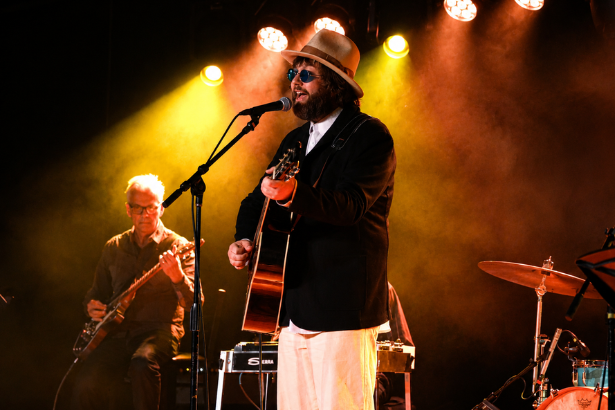
The Aaron Lee Tasjan concert walkout at a July 12, 2026 show in Galveston, Texas has gone viral after the Nashville singer-songwriter shared an unusually thoughtful public response to what he described as eight concertgoers leaving near the end of his song “I Love America Better Than You.” Tasjan performed a solo set at the historic 1859 St. Joseph’s Church in Galveston, hosted by the Galveston Historical Foundation, and confirmed in posts across both Threads and Facebook that the departures were clearly connected to the song’s lyrical content rather than logistical reasons. His response focused not on criticizing the audience members who left but on defending the purpose of uncomfortable art and inviting continued reflection from everyone in the room.
What Happened at the Galveston Show
The walkout occurred during the final portion of “I Love America Better Than You,” a track that appeared on Tasjan’s 2024 album Stellar Evolution and which he has described in previous interviews as an examination of America’s complexities, contradictions, and hard truths. The venue, the 1859 St. Joseph’s Church in Galveston, is a historic landmark operated by the Galveston Historical Foundation, adding a particular resonance to a performance about American identity and its tensions.
Tasjan wrote on Threads: “Towards the end of ‘I Love America Better Than You’ during my show Sunday night, 8 people who were very clearly put off by the messages in the song got up and walked out.” He did not frame the departures as a protest or a confrontation, and was careful not to characterize the incident as a larger audience reaction. The eight who left represented a small portion of the total audience at the intimate church venue, and Tasjan’s public statement treated the moment as an occasion for broader reflection rather than a controversy to be managed.
Tasjan’s Full Response: Free Will, Truth, and Discomfort
Rather than criticizing the eight who left, Tasjan used the incident as a platform to articulate his philosophy of what music is supposed to accomplish. His response, shared across both Facebook and Threads, drew a clear line between art designed to comfort and confirm and art designed to challenge and expand.
He wrote: “For artists, I think it’s very important to remember that our job is not simply to sell tickets and t-shirts and receive applause. To me, the main part of what we do is to create works that affect the listener.”
He expanded on the purpose of truth-telling in song: “I believe in the power of medicinal properties in songs. I think songs can serve the function of healing, reminding, and comforting, but most importantly, telling the truth. The truth itself is a noble pursuit. But the reality of its complicated nature may leave you uncomfortable, bewildered, exhausted, or even angry. The truth asks more of us. It asks us to sit with discomfort. It asks us to expand our thinking.”
Tasjan specifically said he respected the decision of those who left. He said he appreciated the eight individuals because they were exercising their free will. At the same time he made clear that he views walking away from discomfort as its own kind of cost: “If we choose only to walk away from that which makes us uncomfortable, we subject ourselves to an imbittered stagnation or worse, a descent into fracture.”
What “I Love America Better Than You” Is Actually About
Understanding the walkout requires understanding the song at its center. “I Love America Better Than You” was originally released in 2016 and reappeared on Tasjan’s 2024 album Stellar Evolution. The lyrics engage directly with the contradictions of American patriotism, referencing wealth disparity, celebrity culture, and the gap between the nation’s stated ideals and its lived realities. The song’s hook reads: “I love America better than you. Her dirty money and her hotdogs, too. Rich celebrities, wealth disparity. I love America better than you.”
Tasjan has previously explained to Paste Magazine that the song reflects his complicated relationship with patriotism as a queer artist from the American South, and that he designed the track to be conversational rather than accusatory, creating something that could continue resonating beyond a single political moment. He has also explained that the song reflects his complicated relationship with patriotism as a queer artist from the American South.
In his post-walkout statement, Tasjan was consistent with that framing: “It doesn’t point fingers, it states plainly what is and leaves room for questions. And we should absolutely have questions. Always.” He added that the song is about everyone, not a specific group, and characterized its purpose as illumination rather than criticism.
The Broader Argument Tasjan Made
Beyond defending the specific song, Tasjan’s response articulated a position about the role of art in a polarized cultural environment that has drawn significant attention from music journalists and fans across political perspectives. His central argument is that discomfort is not a signal to leave but an invitation to reflect, and that the collective cost of consistently avoiding uncomfortable ideas is a society less capable of addressing its genuine problems.
He wrote: “These days not a one of us can afford the privilege of having arrived at a place from which we are immune to the harm caused to the least of us.” He framed the walkout not as a failure of communication but as evidence of exactly the tension the song is designed to surface.
Tasjan also addressed the question of individual responsibility in a politically divided country without assigning blame to any specific group or ideology: “It’s not about blaming yourself. It’s about accepting the idea that there is further to go.” That framing is consistent with a songwriter who has spent his career working in the space between country music’s traditional patriotic conventions and a more critical examination of what those conventions contain.
Who Is Aaron Lee Tasjan?
Aaron Lee Tasjan is a Nashville-based singer-songwriter who occupies a distinctive position in American roots music, blending country, folk, and rock with lyrical content that frequently engages with social and political themes in ways that set him apart from mainstream country radio. He released his debut album in 2015 and has built a devoted following across multiple subsequent projects. His 2024 album Stellar Evolution received strong reviews from outlets including Paste Magazine and No Depression, with “I Love America Better Than You” frequently cited as one of its most distinctive and challenging tracks.
He has spoken publicly about his identity as a queer artist working within a genre that has not always been welcoming to that identity, and his music consistently reflects the tension between affection for American culture and a clear-eyed view of its contradictions. The Galveston walkout is not the first time his work has generated strong reactions from audiences, but it is the incident that has most widely introduced his music and his perspective to listeners outside his existing fanbase.
Latest Updates
The walkout occurred on July 12, 2026 at the 1859 St. Joseph’s Church in Galveston, Texas, during a solo performance hosted by the Galveston Historical Foundation. Tasjan first addressed the incident publicly on Facebook, then on Threads, with both posts generating widespread sharing and discussion. Syracuse.com reported on Tasjan’s statement that fans were “clearly put off” by the song’s messages. Enstarz confirmed Tasjan’s full Threads post, the Galveston Historical Foundation venue details, and Tasjan’s description of the song’s intent from his prior Paste Magazine interview. Suggest.com confirmed Tasjan’s Facebook post in full, including his extended argument about the role of discomfort in art, the function of truth-telling in music, and his respect for the free will of those who left.
Sources: Syracuse.com | Enstarz | Suggest.com
Broader Implications
The Aaron Lee Tasjan concert walkout sits at the intersection of several ongoing conversations in American music and culture: the role of political content in live performance, the expectations audiences bring to country and roots music spaces, and the question of what artists owe their audiences versus what they owe their own creative vision. None of those conversations have simple answers, and Tasjan’s response to the walkout reflects his awareness that the incident is bigger than eight people leaving a church in Galveston.
What makes the story notable is not the walkout itself, which involved a small number of people at an intimate venue, but the quality of the public response it generated. Tasjan’s statement is a model of how an artist can defend their work without dismissing the audience members who rejected it, acknowledge the discomfort the work produced without apologizing for producing it, and frame a politically charged moment in terms of shared human values rather than partisan positions. Whether his audience agrees with his politics or not, his response is the kind of public communication that invites continued engagement rather than closing the conversation down. For more entertainment and culture coverage, visit thetechmarketer.com.
3. FREQUENTLY ASKED QUESTIONS
- What happened at Aaron Lee Tasjan’s Galveston concert walkout?
Eight concertgoers walked out near the end of Aaron Lee Tasjan’s performance of “I Love America Better Than You” at the 1859 St. Joseph’s Church in Galveston, Texas on July 12, 2026. Tasjan confirmed in posts on Threads and Facebook that the eight were visibly put off by the song’s messages, and responded publicly with a statement defending the role of uncomfortable art.
- What is “I Love America Better Than You” about?
“I Love America Better Than You” is a track from Aaron Lee Tasjan’s 2024 album Stellar Evolution that examines American patriotism through the lens of wealth disparity, celebrity culture, and the gap between national ideals and lived realities. Tasjan has described the song as a conversational examination of America’s complexities and contradictions, designed to ask questions rather than assign blame.
- How did Aaron Lee Tasjan respond to the concert walkout?
Tasjan posted a lengthy response on both Threads and Facebook in which he said he respected the eight who left for exercising their free will, while arguing that avoiding discomfort carries its own cost. He described the purpose of his music as truth-telling rather than comfort, and encouraged all listeners to continue reflecting on their own values and the harm experienced by the most vulnerable members of society.
- Did Aaron Lee Tasjan criticize the fans who walked out?
No. Tasjan explicitly said he appreciated the eight concertgoers for exercising their free will and did not characterize the walkout as a protest or attack. His response focused on the broader purpose of art and the value of sitting with discomfort, rather than criticizing the individuals who chose to leave.
- Who is Aaron Lee Tasjan?
Aaron Lee Tasjan is a Nashville-based singer-songwriter who blends country, folk, and rock with lyrically ambitious content that frequently engages with social and political themes. He released his debut album in 2015 and his 2024 album Stellar Evolution to strong critical reviews. He has spoken publicly about his identity as a queer artist working within American roots music traditions.
4. SOURCES AND REFERENCES
- Syracuse.com: Country Singer Says Fans Walked Out of Show Over Song About America: ‘Clearly Put Off’
- Enstarz: Aaron Lee Tasjan Responds After Eight Concertgoers Walk Out During ‘I Love America Better Than You’
- Suggest.com: Country Music Artist Speaks Out After Fans Walk Out of His Concert