Introduction
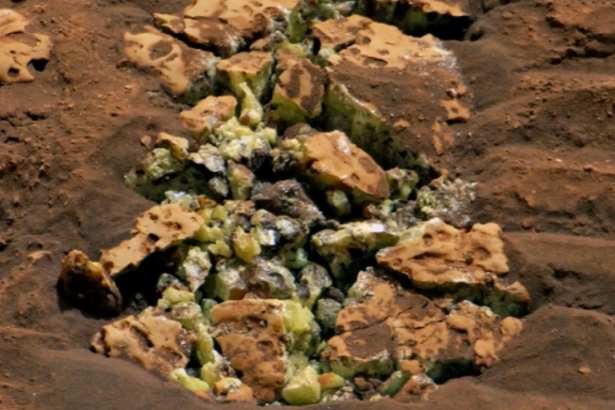
The latest NASA Curiosity rover Mars discovery is giving planetary scientists a fascinating new look at the geological history of the Red Planet. An ordinary-looking rock, accidentally crushed beneath NASA’s Curiosity rover in 2024, revealed something extraordinary: bright yellow crystals of nearly pure elemental sulfur.
The discovery happened in the Gediz Vallis Channel, inside Gale Crater, where Curiosity has been investigating ancient geological formations and evidence of Mars’ watery past.
At first, scientists struggled to explain how such deposits could have formed. Sulfur-containing minerals are relatively common on Mars, but pure elemental sulfur is different. Its presence suggests that geological and chemical processes occurred under conditions scientists had not previously associated with this region.
Now, two studies published in 2026 have proposed possible explanations. One suggests that ancient volcanic gases may have produced sulfur deposits beneath the Martian surface. Another demonstrates that chemical reactions involving dissolved sulfide and chlorate can produce elemental sulfur without requiring high temperatures or biological activity.
The findings have generated renewed interest in Mars research, with Google Trends showing a significant increase in searches for “Mars” in the supplied November 17 screenshot.
The discovery does not establish that life existed on Mars. Instead, it provides an important new piece of evidence about how the planet evolved and how its ancient environment supported complex chemical processes.
Background and Context: How Curiosity Accidentally Discovered Pure Sulfur on Mars
Curiosity rover finds signs of pure sulfur crystals
The discovery dates back to May 30, 2024, when NASA’s Curiosity rover was exploring the Gediz Vallis Channel in Gale Crater.
Curiosity was not specifically searching for sulfur crystals. It was travelling across a rocky landscape when its approximately 899-kilogram body rolled over an ordinary-looking rock.
The rock fractured under the rover’s weight.
Inside were pale yellow crystals that immediately attracted the attention of the mission team.
Scientists used the rover’s instruments to investigate the material. The Alpha Particle X-ray Spectrometer, mounted on Curiosity’s robotic arm, helped identify the composition as elemental sulfur.
This was a significant milestone.
Scientists had already discovered sulfur-containing minerals on Mars, particularly sulfates. However, the 2024 finding represented the first confirmed discovery of sulfur in its pure elemental form on the planet.
NASA subsequently identified a wider field of similar bright rocks in the surrounding landscape.
The discovery was documented in NASA’s official report, NASA’s Curiosity Rover Discovers a Surprise in a Martian Rock.
Why the discovery surprised scientists
Sulfur is an important chemical element found throughout the Solar System.
On Earth, large deposits of elemental sulfur are often associated with volcanic activity, hydrothermal systems and other geological processes.
But the conditions needed to explain the Martian deposits were not immediately obvious in Gediz Vallis.
Scientists therefore faced an unusual question: how did such large quantities of nearly pure sulfur end up scattered across this particular landscape?
That question became the starting point for two important research efforts published in 2026.
Latest Update: Two New Studies Offer Explanations for Mars’ Yellow Sulfur Rocks
Curiosity Views Sulfur Crystals Within a Crushed Rock – NASA Science
NASA’s Curiosity Rover Discovers a Surprise in a Martian Rock | NASA Jet Propulsion Laboratory (JPL)
The biggest development in November 2026 is that researchers now have two scientifically supported mechanisms that could explain the mysterious sulfur deposits.
Neither study conclusively establishes the exact formation process.
However, together they provide a much clearer picture of the chemical and geological possibilities.
Study 1: Ancient volcanic gases may have created the sulfur deposits
The first study, published in Science in 2026, was led by planetary scientist Scott VanBommel of Washington University in St. Louis, alongside Jeff Berger and an international research team.
The paper, titled A Native Sulfur Deposit in Gale Crater, Mars, examined Curiosity’s observations and chemical measurements.
The researchers confirmed that the sulfur-rich rocks covered an area of approximately 2,100 square metres.
That is important because the discovery was not limited to one unusual rock. It represented an extensive geological deposit.
The research also provided evidence that the fragile sulfur-rich rocks probably formed close to where Curiosity found them, rather than being transported over long distances.
The researchers proposed a possible geological sequence:
- Ancient volcanic activity released sulfur-bearing gases.
- The gases moved into the subsurface environment.
- As temperatures dropped, some gases may have become trapped within ice-like structures known as clathrates.
- Over geological time, erosion carved out the Gediz Vallis Channel.
- The resulting reduction in pressure allowed the trapped gases to escape.
- Chemical reactions involving those gases may have produced deposits of elemental sulfur.
The researchers estimate that the deposit formed approximately 3.1 to 2.8 billion years ago.
This is particularly interesting because it suggests that ancient Mars experienced geological processes more complex than previously recognised.
The study’s findings were also discussed by Washington University’s McDonnell Center for the Space Sciences.
Study 2: Chemical reactions could create sulfur without high temperatures
The second study offers a different explanation.
Published in Geophysical Research Letters on July 21, 2026, the research was led by atmospheric scientist Jiawei Wang of Cornell University.
Its title is Oxidation of Aqueous Sulfide by Chlorate: Implications for Native Sulfur Formation on Mars.
Rather than studying the Martian rocks alone, the team conducted controlled laboratory experiments to investigate whether chemical reactions could produce elemental sulfur under conditions relevant to ancient Mars.
The researchers combined dissolved sulfide with chlorate in acidic water at approximately 22°C.
The experiments continued for 54 days.
The results were significant: the chemical reaction produced both elemental sulfur and sulfate.
One particularly interesting finding involved the concentration of chlorate.
Lower concentrations favoured the formation of elemental sulfur, while higher concentrations produced more sulfate.
The experiments demonstrated that pure sulfur can form through non-biological chemical reactions without requiring the high temperatures normally associated with some sulfur deposits on Earth.
However, the crystals produced in the laboratory were microscopic.
The researchers suggest that similar reactions operating over much longer geological periods could potentially contribute to larger deposits.
The research is important because it demonstrates that biological activity is not necessary to explain how elemental sulfur could have formed on ancient Mars.
How the two studies fit together
The two studies approach the same mystery from different directions.
| Research | Main explanation | Key finding |
|---|---|---|
| VanBommel et al., Science | Ancient volcanic gases and subsurface processes | Explains a possible geological origin for the extensive sulfur deposit |
| Wang et al., Geophysical Research Letters | Sulfide reacting with chlorate in acidic water | Demonstrates an abiotic chemical pathway that produces elemental sulfur |
An especially interesting possibility is that the two mechanisms could be connected.
The first study proposes ancient underground sulfur-bearing gas reservoirs. The second shows how hydrogen sulfide and chlorate could participate in chemical reactions that produce elemental sulfur.
However, researchers have not demonstrated that both mechanisms operated together at Gediz Vallis.
For now, they remain possible explanations that need further investigation.
Expert Analysis: Why Pure Sulfur Is So Important to Mars Science
NASA’s Curiosity Rover Discovers Surprise Clues to Ancient Water on Mars
The importance of this discovery extends beyond the appearance of unusual yellow crystals.
Sulfur is a fundamental element in planetary chemistry and biology.
Its presence can help scientists reconstruct the environmental conditions that existed billions of years ago.
1. Sulfur reveals the chemical history of ancient Mars
Scientists use minerals to understand how planetary environments change over time.
Sulfates, for example, can form when water containing dissolved minerals evaporates.
Their presence can therefore provide evidence of ancient water activity.
Elemental sulfur offers a different kind of information.
Its formation requires specific chemical conditions, meaning its presence can reveal details about the oxidation and reduction processes that occurred within ancient Martian environments.
These processes help scientists reconstruct how water, gases, minerals and volcanic activity interacted.
2. The discovery expands our understanding of Mars’ geology
The sulfur deposits appear to have formed under geological conditions that were not previously expected in this location.
The proposed volcanic-gas explanation suggests that ancient Mars may have experienced more complicated subsurface chemical activity than scientists had realised.
The findings also highlight how erosion can expose geological material that would otherwise remain hidden beneath the surface.
3. Sulfur is important for understanding habitability
Sulfur is essential for life as we know it.
Living organisms use sulfur-containing compounds in biological processes, including the production of amino acids needed to build proteins.
The presence of sulfur-bearing chemistry on Mars is therefore relevant to studies of ancient habitability.
However, there is an important distinction.
Finding an element that life requires is not the same as finding evidence of life.
The laboratory experiments demonstrate that elemental sulfur can form without biological activity.
Consequently, the discovery cannot be treated as proof of ancient Martian organisms.
It is evidence of interesting chemistry, not a biological discovery.
Broader Implications: What the Mars Sulfur Discovery Means for Space Exploration
The NASA Curiosity rover Mars discovery has implications for several areas of planetary science.
Understanding how habitable environments develop
One of the biggest goals of Mars exploration is determining whether the planet once supported environments suitable for life.
Scientists already know that ancient Mars had rivers, lakes and other environments where liquid water existed.
The sulfur discovery adds another layer to that picture.
It suggests that ancient Mars supported chemical reactions involving different forms of sulfur, potentially creating environments with interesting chemical energy sources.
These conditions could have been relevant to microbial life, although no evidence of organisms has been found in the sulfur deposits.
Improving future Mars exploration missions
The discovery also demonstrates the value of robotic exploration.
Curiosity was not specifically sent to find pure sulfur. Its wheels accidentally exposed material that might otherwise have remained hidden.
This highlights why future missions need multiple scientific instruments capable of investigating unexpected discoveries.
The combination of imaging, chemical analysis and geological observations can turn an ordinary-looking rock into a major scientific finding.
Why studying Mars helps scientists understand Earth
Mars offers an unusual opportunity to investigate geological processes that occurred billions of years ago.
Earth’s geological history is complicated by plate tectonics, erosion, biological activity and continuous recycling of its crust.
Mars has preserved many geological features that provide a comparatively undisturbed record of its ancient past.
Studying its minerals can therefore help scientists understand how planetary environments evolve and how chemical processes operate under different conditions.
Related History: Curiosity’s Other Important Discoveries on Mars
NASA’s Curiosity Rover Discovers Surprise Clues to Ancient Water on Mars
View of Yellowknife Bay Formation, with Drilling Sites – NASA Science
7
The sulfur discovery is part of a much larger scientific investigation that began when Curiosity landed on Mars in August 2012.
The rover’s mission is to determine whether Gale Crater once offered environmental conditions suitable for microbial life.
Several discoveries have helped build that picture.
1. Evidence of ancient lakes and rivers
Curiosity found geological evidence of ancient streams and lake environments inside Gale Crater.
These discoveries demonstrated that liquid water once existed on the Martian surface for extended periods.
The sediments provided evidence of environments that could potentially have supported microbial organisms.
2. Organic molecules in Martian rocks
Curiosity has detected organic molecules in ancient sedimentary rocks.
Organic molecules contain carbon and can be produced through biological and non-biological processes.
Their presence is scientifically interesting, but it does not establish that life existed on Mars.
3. Methane observations
Curiosity has also measured fluctuations in methane concentrations within the Martian atmosphere.
On Earth, methane can originate from biological processes, geological activity and other chemical reactions.
Scientists are still investigating the origins and behaviour of methane on Mars.
4. The Gediz Vallis geological discoveries
The sulfur discovery is particularly important because it occurred in a region that preserves evidence of ancient water and geological activity.
NASA believes the channel was shaped by major flows of water and debris, while some of its deposits may have formed through landslides.
The sulfur rocks provide another opportunity to reconstruct the chemical history of this region.
Together, these discoveries demonstrate why Curiosity remains one of the most important robotic science missions ever sent to another planet.
What Happens Next: The Future of NASA’s Mars Research
The two new sulfur studies have created several important research questions.
Scientists will need additional evidence before they can determine exactly how the deposits formed.
1. More detailed geological modelling
Researchers can use the observations collected by Curiosity to build better models of ancient sulfur movement, subsurface gases and erosion.
These models may help determine which formation mechanism best matches the conditions in Gediz Vallis.
2. Investigating sulfur-bearing minerals
Future analysis of Martian rocks could reveal additional information about the relationship between elemental sulfur, sulfides and sulfates.
Understanding these relationships is essential to reconstructing the planet’s ancient sulfur cycle.
3. Laboratory experiments
The chlorate research provides a starting point for additional experiments.
Scientists can investigate how changes in acidity, temperature and chemical concentration influence sulfur formation.
More experiments could help establish whether the proposed reactions were realistic under early Martian conditions.
4. Future Mars missions
NASA’s continuing Mars exploration efforts, together with international missions, may reveal additional locations containing unusual minerals.
The long-term goal is to understand whether environments suitable for life existed and whether any evidence of ancient biological activity has survived.
Future sample-return research would also be valuable, although the timing and plans for bringing Martian samples to Earth remain subject to mission development and funding decisions.
For now, Curiosity’s observations remain a crucial part of the investigation.
Conclusion: A Broken Martian Rock Reveals a Billion-Year-Old Mystery
The NASA Curiosity rover Mars discovery demonstrates how an unexpected event can transform our understanding of another planet.
When Curiosity accidentally crushed a rock in Gediz Vallis in May 2024, it revealed yellow crystals of pure elemental sulfur that scientists had never previously identified on Mars.
Two studies published in 2026 have now provided possible explanations.
One proposes that ancient volcanic gases and subsurface processes created the deposits. The other demonstrates that chemical reactions involving sulfide and chlorate can produce elemental sulfur without biological activity.
Neither explanation has been conclusively established as the actual origin of the Martian deposit.
But both studies provide important insights into the chemistry and geology of ancient Mars.
Perhaps the most fascinating part is that the discovery does not require an extraordinary event to explain it. A rover following its planned route happened to drive over the right rock at the right moment.
That accidental discovery has opened a new scientific investigation into a planet that continues to surprise us.
And as Curiosity and future exploration missions continue examining the Red Planet, scientists may uncover even more evidence about the conditions that shaped Mars billions of years ago.
Frequently Asked Questions
1. What did NASA’s Curiosity rover discover on Mars?
NASA’s Curiosity rover discovered rocks containing nearly pure elemental sulfur in the Gediz Vallis Channel inside Gale Crater. The first rock was accidentally crushed by the rover in May 2024, exposing yellow crystals.
2. Why is pure sulfur on Mars such an important discovery?
It was the first confirmed detection of elemental sulfur in its pure form on Mars. The discovery provides new clues about the planet’s ancient geological and chemical processes.
3. How did Curiosity find the yellow sulfur crystals?
Curiosity accidentally drove over a fragile rock on May 30, 2024. The rock broke open, revealing yellow crystals that scientists later identified using the rover’s scientific instruments.
4. Where did NASA discover the sulfur rocks?
The discovery occurred in the Gediz Vallis Channel, located within Gale Crater on Mars.
5. How old are the sulfur deposits on Mars?
The 2026 research led by Scott VanBommel suggests that the deposits formed approximately 3.1 to 2.8 billion years ago.
6. How could volcanic activity have created sulfur on Mars?
One proposed explanation involves sulfur-bearing gases released by ancient volcanic activity. These gases may have become trapped beneath the Martian surface and later escaped as erosion reduced underground pressure, allowing chemical reactions to create elemental sulfur.
7. What did the second sulfur study discover?
The second study demonstrated that dissolved sulfide can react with chlorate in acidic water to produce elemental sulfur and sulfate without biological activity or high temperatures.
8. Does the sulfur discovery prove that life existed on Mars?
No. Sulfur is essential for life, but it can also form through non-biological chemical reactions. The discovery does not provide proof of ancient Martian life.
9. What is the difference between sulfur and sulfate?
Elemental sulfur consists of sulfur atoms alone. Sulfates are chemical compounds containing sulfur and oxygen. Sulfates have previously been identified on Mars, but the discovery of pure elemental sulfur was new.
10. Why is Curiosity important for Mars exploration?
Curiosity investigates Martian geology, ancient water environments, organic chemistry and potential past habitability. Its observations help scientists understand how Mars evolved and whether it once offered conditions suitable for microbial life.
Sources & References
1. ScienceAlert: NASA’s Curiosity Rover Burst Open a Rock on Mars And Found a Big Surprise. November 17, 2026.
2. The Economic Times: NASA Curiosity Gediz Vallis Discovery: What Do the Yellow Crystals Found by Curiosity on Mars Tell Us About the Planet’s Ancient History?. November 2026.
3. Around Prague: How Did a Field of Pure Sulfur Rocks End Up on Mars? Two New Studies Offer Answers. November 16, 2026.
4. NASA: NASA’s Curiosity Rover Discovers a Surprise in a Martian Rock. July 18, 2024.
5. Science Journal: A Native Sulfur Deposit in Gale Crater, Mars. 2026.
6. Geophysical Research Letters: Oxidation of Aqueous Sulfide by Chlorate: Implications for Native Sulfur Formation on Mars. July 21, 2026.
7. Washington University in St. Louis: Pristine Sulfur Preserves a Snapshot of Ancient Mars. August 20, 2026.