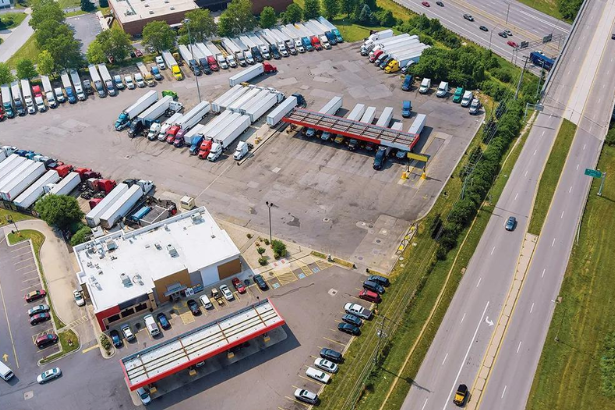
The US truck parking crisis is getting a significant federal investment. On October 14, 2026, the US Department of Transportation (USDOT) announced $200 million in funding for 14 commercial truck-parking projects across 12 states. The projects include new parking facilities, expanded highway rest areas and improvements near major freight gateways.

US Department of Transportation
The announcement comes as truck drivers continue to report difficulty finding safe, available parking during required rest periods. According to SupplyChainBrain’s October 16 report, USDOT estimates that 98% of truck drivers regularly experience parking problems. The American Transportation Research Institute (ATRI) estimates that drivers lose an average of 56 minutes of driving time each day while searching for safe parking, costing them more than $6,800 in lost wages annually.
SupplyChainBrain
The new funding is intended to help close that gap. But the announcement is a starting point, not an immediate fix. Projects still need to progress through development and construction before drivers can use the additional spaces.
For trucking companies, fleet managers, logistics providers and retailers, the issue extends beyond parking. It affects how efficiently freight moves, how drivers manage rest breaks and how reliably goods reach warehouses, stores and customers.
Background and Context: Why Truck Parking Has Become a Logistics Problem
Truck parking is a basic piece of freight infrastructure, but demand can outstrip supply along busy highways, at ports and near major distribution centers.
Long-haul drivers need safe places to park when taking required rest breaks. When designated spaces are full, drivers may spend time searching for alternatives or end up stopping in unsafe locations, including highway shoulders and exit ramps.
The Federal Highway Administration’s truck-parking resource identifies the shortage as a national safety concern. It notes that inadequate parking can encourage tired drivers to continue driving or park in unsuitable locations when official spaces are unavailable.

FHWA Freight Management and Operations
The consequences spread across the logistics network:
- Driver safety: Searching for parking at the end of a long shift can increase fatigue and expose drivers to dangerous roadside conditions.
- Freight efficiency: Time spent looking for a parking space is time not spent moving freight.
- Delivery reliability: Parking uncertainty can complicate route planning and the management of delivery appointments.
- Operating costs: Lost driving time can affect driver earnings and the productivity of vehicles and fleets.
- Infrastructure pressure: Ports, industrial areas and highway corridors need parking capacity that matches freight activity.
This is why truck parking is not simply a convenience for drivers. It is part of the infrastructure that keeps freight moving safely and predictably.
Latest Update: USDOT Announces $200 Million for 14 Truck-Parking Projects
The funding was announced by Transportation Secretary Sean P. Duffy on October 14 through the department’s Nationally Significant Multimodal Freight & Highway Projects (INFRA) program. The stated objectives include expanding public truck parking, reducing fatigue-related risks and improving freight movement.
US Department of Transportation
Where the money is going
The federal announcement includes several projects that illustrate how the funding will be used.
| Project | Federal Funding | Planned Improvement |
|---|---|---|
| Georgia Ports Authority, Garden City, Georgia | $11.95 million | New commercial motor vehicle parking area near the Port of Savannah, with approximately 275 spaces |
| Iowa Department of Transportation | $24.5 million | Expansion and modernization of parking at six public rest areas along I-80 |
| North Carolina State Ports Authority | $6 million | Approximately 140 dedicated truck-parking spaces and 50 container-staging positions at the Port of Wilmington |
| City of Fort Worth, Texas | $5 million | Approximately 100 new commercial truck-parking spaces at the Pilot Travel Center along I-35 |
| Cameron County, Texas | $9 million | Access improvements for a planned parking facility near the Los Indios Port of Entry, including approximately 305 truck spaces |
| Wisconsin Department of Transportation | $15 million | Approximately 106 additional spaces across two safety rest areas along I-41 |
These figures and planned capacities come from the official USDOT announcement. They represent selected projects, not a complete list of all 14 awards.
US Department of Transportation
The locations are significant because they include major ports, interstate highways and freight corridors where parking demand can be closely connected to commercial activity.
Why the Port of Savannah project matters
The Georgia Ports Authority is receiving nearly $12 million to develop a parking area near the Port of Savannah. The planned facility is intended to provide approximately 275 commercial vehicle spaces.
Port-related truck parking can help drivers manage the timing of freight pickups and deliveries. When parking is inadequate near a freight gateway, drivers may face additional circulation, waiting and scheduling challenges.
A dedicated facility could improve access to safe parking in the surrounding area. Its ultimate impact will depend on when it opens, how it operates and how effectively its capacity matches demand.
Iowa’s I-80 rest areas are another key investment
Iowa is receiving $24.5 million to expand and modernize truck parking at six public rest areas along Interstate 80.
Interstate 80 is an important east-west freight corridor. Improving parking along the route could help drivers plan rest stops more reliably and reduce pressure on existing facilities.
Modernization matters as well as expansion. The practical value of a rest area depends on the number of usable spaces, safe access, traffic flow and the ability of facilities to accommodate commercial vehicles.
Texas projects target freight and border access
The funding includes a project in Cameron County to provide access to a planned truck-parking facility near the Los Indios Port of Entry, with approximately 305 dedicated spaces.
Fort Worth is also receiving $5 million for approximately 100 new spaces at a Pilot Travel Center along I-35.
Together, these projects illustrate two different infrastructure needs: access to parking near an international border crossing and additional capacity along a major interstate corridor.
What the $200 million does not mean
The funding announcement does not mean all the new parking spaces are already available. The awards support projects that must still move through their respective development and construction processes.
Nor does the announcement establish that the national shortage will be eliminated. The investment is intended to add capacity and improve safety, but its effect will depend on how many spaces are ultimately delivered and where they are located.
For drivers and fleet operators, the next meaningful milestone will be completed projects that provide accessible, safe and usable parking.
Expert Insights and Analysis: Can More Truck Parking Improve Freight Efficiency?
1. Less time searching could mean more predictable operations
ATRI’s estimate that drivers lose an average of 56 minutes each day searching for safe parking helps explain why the problem matters to fleet operators. That time can disrupt route plans, rest schedules and delivery appointments.
SupplyChainBrain
+1
Adding parking in the right locations could reduce some of that uncertainty. Drivers may be able to plan rest breaks more confidently, while dispatchers could have fewer last-minute adjustments to make around unavailable parking.
However, the effect will not be uniform. A new facility helps most when it is located where drivers actually need to stop, has adequate capacity at peak times and is easy to access from the freight route.
2. Driver safety is central to the investment
The federal government has framed the funding as a way to reduce dangerous roadside parking and help drivers obtain the rest they need.
The Federal Highway Administration has long identified inadequate truck parking as a safety concern. When legal spaces are unavailable, drivers can face a difficult choice between spending more time searching or stopping somewhere that was not designed for commercial vehicle parking.
FHWA Freight Management and Operations
More designated spaces can reduce that pressure, but parking capacity is only one part of the solution. Drivers also need accurate information about available spaces, safe facilities and routes that make it possible to reach a rest area before they run out of available driving time.
3. Parking shortages create costs beyond the truck cab
The direct impact of a parking shortage is felt by drivers, but the wider logistics chain can also absorb the consequences.
A delayed truck can miss a warehouse appointment. A driver who spends extra time searching for parking may have less flexibility in the following day’s schedule. Fleet planners may need to allow additional time or adjust routes to account for limited parking options.
These are operational risks rather than guaranteed outcomes for every shipment. Their severity depends on route design, delivery windows, congestion, parking availability and the ability of dispatch teams to respond.
The new funding could help ease those pressures where projects add useful capacity. The size of the benefit will become clearer only after the facilities open and their use can be assessed.
4. Technology can complement new parking infrastructure
Building new spaces is one approach. Better information about existing spaces can also help drivers and dispatchers make decisions.
Parking-availability systems, connected fleet platforms and route-planning software can help identify suitable stopping locations and reduce unnecessary searching when accurate, timely data is available.
But technology cannot fully solve a physical capacity shortage. If every suitable parking space is occupied, a better map can tell a driver where the problem is, but it cannot create an empty space.
The strongest approach combines additional capacity with reliable information, practical access and facilities placed along the routes where demand is highest.
Broader Implications: What the Funding Means for the US Supply Chain
The $200 million investment highlights a basic reality about modern logistics: freight infrastructure includes more than highways and warehouses. Truck parking is part of the system that allows drivers, vehicles and freight to operate within real-world time and safety constraints.
For carriers, better parking availability could improve route planning and reduce time spent searching for a suitable place to rest. For shippers and retailers, more predictable driver schedules may help support delivery planning. For ports and distribution centers, nearby parking could ease some of the operational pressure around freight arrivals and departures.
The funding also highlights the importance of matching infrastructure investment to freight demand. A facility in the wrong location, or one that fills quickly every night, may deliver less practical value than its headline capacity suggests.
Fleet managers should therefore track more than the total number of announced spaces. Relevant measures include:
- Where the new parking is located relative to freight routes and customer facilities.
- When each project is expected to open.
- Whether spaces are publicly accessible and suitable for the vehicles using them.
- Whether parking availability improves during the hours when drivers need it most.
- Whether drivers report fewer unsafe stops and less time spent searching.
The long-term test is whether the new facilities become useful parts of the freight network, rather than simply completed construction projects.
For related reporting on freight operations, transportation technology and logistics trends, consider an internal link to The Tech Marketer’s technology and logistics coverage.
Related History: The Long-Running US Truck Parking Shortage
The US truck-parking shortage predates the latest funding announcement. Federal transportation agencies have treated it as a national infrastructure and safety issue for years.
The Federal Highway Administration’s truck-parking resources discuss the shortage’s relationship to driver rest, highway safety and the need for coordinated action between government agencies, industry stakeholders and parking operators. The agency also references Jason’s Law, which established a national priority around improving commercial vehicle parking and assessing parking needs.
FHWA Freight Management and Operations
The broader lesson is that infrastructure gaps can persist even when the roads themselves are operational. Drivers need suitable places to stop, and those places need to exist where freight traffic and rest requirements create demand.
The latest INFRA awards add to the federal government’s recent efforts to expand parking capacity. USDOT says it has invested more than $300 million in truck-parking grants since April 2025, including a separate $62 million allocation through the BUILD program in July 2026.
US Department of Transportation
That context makes the October announcement part of a continuing infrastructure effort, rather than a standalone solution.
What Happens Next?
The practical impact of the funding will depend on how the projects move from awards to completed facilities.
The next developments to watch include:
- Project schedules: When each state, port authority or local government expects construction to begin and finish.
- Actual spaces delivered: Whether the planned capacity is completed as announced.
- Location-specific impact: Whether facilities add meaningful capacity near the freight corridors and ports where drivers need it.
- Driver experience: Whether the additional parking reduces time spent searching and unsafe roadside stops.
- Operational data: Whether parking use, occupancy and availability can be measured consistently.
- Further investment: Whether additional federal, state or private funding is needed to address remaining shortages.
For logistics companies, the immediate response should be to monitor project locations and consider how new facilities may eventually affect routes and driver rest planning. They should not assume the spaces are already available.
For policymakers, the task is to ensure that funding translates into safe, accessible parking where it is most needed. For drivers, the most important outcome is straightforward: a reliable place to rest at the end of a shift.
Conclusion
The US truck parking crisis is a longstanding challenge with consequences for driver safety, freight efficiency and delivery planning. USDOT’s $200 million investment across 14 projects in 12 states is a concrete attempt to expand capacity near major freight corridors, rest areas and ports.
The planned improvements in Georgia, Iowa, North Carolina, Texas and Wisconsin show how the funding targets different parts of the logistics network. They also underline why location matters: a parking space only helps if it is accessible and available when a driver needs it.
The announcement is an important step, but it is not the finish line. The real measure of success will be the number of usable spaces delivered, whether drivers can find them when required, and whether the added capacity improves safety and the reliability of freight movement.
For America’s trucking industry, that is the difference between an infrastructure announcement and a change drivers can actually feel on the road.
FAQ
1. What is the US truck parking crisis?
The US truck parking crisis refers to the shortage of safe, accessible parking spaces for commercial truck drivers. When designated facilities are full, drivers may spend time searching for alternatives or park in unsafe locations, creating problems for rest schedules and highway safety.
2. How much money has USDOT announced for truck parking?
USDOT announced $200 million on October 14, 2026, for 14 truck-parking projects across 12 states through its INFRA program. The investment is intended to expand public parking capacity and improve freight safety and efficiency.
US Department of Transportation
3. Which states will benefit from the truck parking funding?
The projects cover 12 states. Announced examples include parking improvements in Georgia, Iowa, North Carolina, Texas and Wisconsin, with projects located near ports, highway rest areas, interstate corridors and a border crossing.
4. How much time do truck drivers lose searching for parking?
ATRI estimates that the average truck driver loses 56 minutes of driving time each day while searching for safe parking. SupplyChainBrain reports that ATRI estimates the annual cost to drivers at more than $6,800 in lost wages.
SupplyChainBrain
5. Will the $200 million funding solve the truck parking shortage?
Not by itself. The investment will add capacity through specific projects, but the nationwide shortage depends on parking demand, location, access and the availability of existing facilities. The long-term impact will become clearer after the funded projects are completed.
6. How does truck parking affect supply chain efficiency?
Parking shortages can make it harder for drivers to plan rest breaks, meet delivery appointments and maintain predictable routes. Additional parking may reduce some of that uncertainty, particularly near major freight corridors and ports.
7. When will the new truck parking spaces be available?
The funding announcement covers projects that still need to progress through development and construction. The announcement does not mean all planned spaces are already open. Drivers should rely on official facility information for current availability.
8. Can technology solve the truck parking shortage?
Technology can help drivers find available spaces and plan routes more efficiently when accurate availability data exists. It cannot replace the need for sufficient physical parking capacity in high-demand locations.
Sources & References
- USDOT Announces $200M in Funding for Commercial Truck Parking, SupplyChainBrain, October 16, 2026.
- Trump’s Transportation Secretary Sean P. Duffy Delivers $200 Million Truck Parking Expansion Across the Country, US Department of Transportation, October 14, 2026.
- Truck Parking: Freight Management and Operations, Federal Highway Administration.
- USDOT Awards $200 Million Boost for Truck Parking, Transport Topics, October 15, 2026.
- DOT Awards $200 Million for Truck Parking Projects in 12 States, TheTrucker.com, October 14, 2026.