By using this site, you agree to the Privacy Policy and Terms of Use.
Accept
The Tech MarketerThe Tech MarketerThe Tech Marketer
  • Home
  • Technology
  • Entertainment
    • Memes
    • Quiz
  • Marketing
  • Politics
  • Visionary Vault
    • Whitepaper
Reading: Rethink What’s Possible Pushing Computer Vision Boundaries Beyond 4K
Share
Notification Show More
Font ResizerAa
The Tech MarketerThe Tech Marketer
Font ResizerAa
  • Home
  • Technology
  • Entertainment
  • Marketing
  • Politics
  • Visionary Vault
  • Home
  • Technology
  • Entertainment
    • Memes
    • Quiz
  • Marketing
  • Politics
  • Visionary Vault
    • Whitepaper
Have an existing account? Sign In
Follow US
© The Tech Marketer. All Rights Reserved.
The Tech Marketer > Blog > White Paper > Rethink What’s Possible Pushing Computer Vision Boundaries Beyond 4K
White Paper

Rethink What’s Possible Pushing Computer Vision Boundaries Beyond 4K

Last updated:
3 years ago
Share
SHARE

Computer vision and image processing algorithms are increasingly common to commercial and research-related
applications. These high resolution models perform complex computations to process image data in real-time and require rapid processing to yield analysis and results.

Contents
SURPASS THE LIMITS OF THE GPUADDING MORE GPUS ISN’T THE ANSWERTRAIN LARGE COMPUTER VISION MODELS WITH HIGH-RESOLUTION IMAGESOh hi there 👋It’s nice to meet you.Sign up to receive awesome content in your inbox, every week.

In the context of machine learning image processing and analysis, resolution is everything. An image’s resolution can enable a more detailed, meaningful analysis that results in greater understanding. To this end, a high-resolution image will contain more information and detail than a low-resolution image of the very same subject.

Today, higher-resolution image processing requires significant computational capabilities. So much so, in fact, that training models to use these high-resolution images have rendered current state-of-the-art
technologies unusable.

When it comes to high-resolution processing, legacy architecture constraints are holding back research and technology advances across numerous use cases, including in areas such as autonomous driving, oil and gas exploration, medical imaging, anti-viral research, astronomy, and more.

SURPASS THE LIMITS OF THE GPU

SambaNova Systems has been working with industry to develop an optimized solution for training computer vision models with increasingly growing levels of resolution – without compromising high accuracy levels. We take a “clean sheet” complete systems approach to enable native support for high-resolution images. Co-designing across our complete stack of so!ware and hardware provides the freedom and flexibility from legacy GPU architecture constraints and legacy spatial partitioning methods.

ADDING MORE GPUS ISN’T THE ANSWER

If you consider images in the context of AI/ML training data, the richer and more expansive your training information (i.e., images), the more accurate your results can be.

Using a single GPU to train high-resolution computer vision models predictably results in “Out of Memory” errors. On the other hand, clustering multiple GPUs brings all the challenges of disaggregation of the computational workflows onto each individual GPU in the cluster to aggregate GPU memory.

In this case, this is not merely clustering a few GPUs in a single system, but aggregating hundreds, if not thousands of GPU devices. In addition, conventional data parallel techniques that slice the input image into independent tiles deliver less accurate results than training on the original image.

TRAIN LARGE COMPUTER VISION MODELS WITH HIGH-RESOLUTION IMAGES

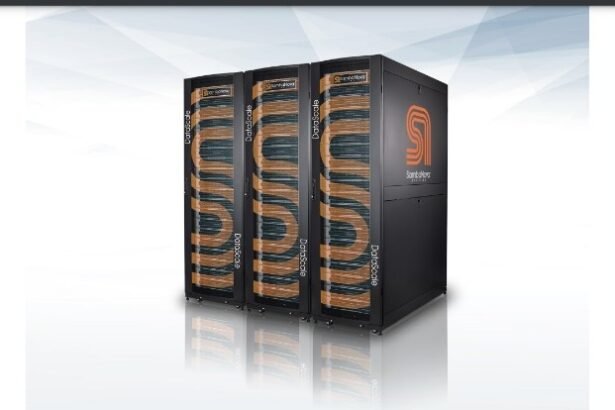
Massive Data: A single SambaNova DataScale™

Learn More

Oh hi there 👋
It’s nice to meet you.

Sign up to receive awesome content in your inbox, every week.

We don’t spam! Read our privacy policy for more info.

Check your inbox or spam folder to confirm your subscription.

You Might Also Like

Augment Your Agentforce with Prompt Builder Salesforce

Zukunftssicher und effizient: Generative KI transformiert die Bankenwelt Salesforce

The Future of Banking with Trusted Generative AI – Salesforce

The Journey to AI-Powered CRM Forrester Consulting – Salesforce

Trends in AI for CRM Salesforce

Share This Article
Facebook LinkedIn Email Copy Link Print
Share
What do you think?
Love0
Sad0
Happy0
Sleepy0
Angry0
Dead0
Wink0
Previous Article Accelerated-Computing-with-a Reconfigurable-Data-flow-Architecture
Next Article Samba-Flow-A-Software-First-Approach
Leave a comment

Leave a Reply Cancel reply

Your email address will not be published. Required fields are marked *

Latest News

  • Why Microsoft’s war on Windows’ Control Panel is taking so long

    Microsoft first started trying to get rid of the Control Panel in 2012, with the launch of Windows 8. More than a decade later, it's still working on migrating all the old Control Panel items into the modern Settings app in Windows 11. While there have been hints that the Control Panel might finally go

  • Nothing’s noise-canceling CMF Buds 2A are down to $19.99 for the rest of today

    It’s not every day you find a decent pair of wireless earbuds with active noise cancellation, a transparency mode, and app support for less than $20, which is why the current lighting deal on the CMF Buds 2A stands out. Now through 11:15PM ET today, April 7th, Nothing’s budget earbuds are available on Amazon in

  • Amazon is ending support for older Kindles and Kindle Fires

    Amazon has announced that starting on May 20th, 2026, Kindle e-readers and Kindle Fire devices released in 2012 and earlier will "no longer be able to purchase, borrow, or download new content via the Kindle Store," Amazon spokesperson Jackie Burke wrote in an email to The Verge. Users will still be able to read books

  • Spotify’s Prompted Playlists can help you find new podcasts to listen to

    On Tuesday, Spotify expanded its Prompted Playlists feature to include podcasts, an update that could make it easier for Premium users to find new shows to listen to. Prompted Playlists were originally launched as a beta feature in December, but previously only worked for music. You can use the feature to effectively generate customized Discover

  • You can now turn 2D apps into 3D while using the Galaxy XR headset

    Android XR is getting a new feature that turns 2D apps, websites, images, and videos into "3D experiences." The feature, which Google calls "auto-spatialization," was initially announced last year, and it's launching on Tuesday as an experimental feature for Samsung Galaxy XR headsets. Here's a video from Google that gives you an idea about how

- Advertisement -
about us

We influence 20 million users and is the number one business and technology news network on the planet.

Advertise

  • Advertise With Us
  • Newsletters
  • Partnerships
  • Brand Collaborations
  • Press Enquiries

Top Categories

  • Artificial Intelligence
  • Technology
  • Bussiness
  • Politics
  • Marketing
  • Science
  • Sports
  • White Paper

Legal

  • About Us
  • Contact Us
  • Privacy Policy
  • Affiliate Disclaimer
  • Legal

Find Us on Socials

The Tech MarketerThe Tech Marketer
© The Tech Marketer. All Rights Reserved.
Welcome Back!

Sign in to your account

Lost your password?