Introduction
Reducing maverick spending has become an important priority for procurement and supply chain leaders trying to protect margins without slowing down day-to-day operations. When employees purchase goods outside approved contracts, suppliers, or procurement processes, companies can lose visibility into spending, miss negotiated pricing, and create unnecessary administrative work.
The problem is especially challenging in industrial environments. A maintenance technician who needs a replacement sensor to restart a production line may not have time to navigate a complicated purchasing workflow. If the approved system is difficult to use, an unapproved supplier or company purchasing card can look like the fastest solution.
That decision may seem harmless when a single item costs only a few dollars. Across multiple facilities, however, repeated purchases can make supplier spending harder to manage and procurement policies harder to enforce.
In its October 14, 2026, article, SDI examines the difference between general ERP systems and purpose-built procurement platforms. The article focuses on indirect procurement, maintenance, repair, and operations supplies, commonly known as MRO, and the difficulty of managing frequent, unpredictable purchases through conventional enterprise workflows.
The broader lesson for procurement leaders is straightforward: purchasing controls work best when they support the way employees actually operate.
Organizations do not necessarily need to replace their existing ERP systems to improve compliance. They may instead need cleaner purchasing data, easier catalog search, faster approvals, clearer supplier choices, and better integration between procurement tools and financial systems.
This article explores why maverick spending happens, how to identify its root causes, and which practical steps can help businesses regain control without creating more friction for their teams.
Background and Context: What Is Maverick Spending?
Maverick spending, sometimes called rogue or off-contract spending, occurs when an employee purchases goods or services outside an organization’s approved procurement policies, suppliers, contracts, or purchasing channels.
It is important to distinguish maverick spending from legitimate emergency procurement. A purchase may be operationally necessary but still fall outside the approved process. Conversely, an unusual purchase may be fully authorized if the organization has documented an appropriate exception.
The central issue is not simply whether an employee bought something the company needed. It is whether the transaction followed the purchasing controls designed to manage cost, supplier risk, contractual commitments, and financial reporting.
Consider a manufacturing facility that has negotiated prices with a preferred supplier for electrical components. A technician needs a replacement part to restore equipment. The preferred catalog is difficult to search, the part description is unclear, and the approval process takes too long.
The technician orders the component from a local distributor instead.
The immediate problem may be solved, but the transaction could introduce several downstream issues:
- The company may pay more than its negotiated contract price.
- Procurement may lose visibility into supplier activity.
- The purchase may not be associated with an existing contract.
- Finance may have to reconcile a card transaction or invoice manually.
- The same component may already be available at another company location.
- The transaction may not update the organization’s inventory records correctly.
One purchase does not necessarily create a major financial problem. The difficulty emerges when similar decisions happen repeatedly across teams, sites, and suppliers.
Maverick Spending Versus Tail Spending
The two terms are related, but they describe different things.
Maverick spending describes how a purchase was made. It refers to a transaction that bypasses an approved process or agreement.
Tail spending describes a portion of an organization’s purchasing activity, typically involving many relatively small transactions spread across a large number of suppliers.
The categories overlap because low-value, infrequent purchases can be difficult to monitor. However, not all tail spending is unauthorized, and not all maverick spending is low value.
Understanding this distinction helps procurement teams design more effective reporting and controls.
For additional context, Amazon Business’s guide to identifying and controlling maverick spend explains how off-contract purchases can arise from urgency, catalog gaps, unclear policies, and decentralized buying.
Latest Update: General ERPs Versus Purpose-Built Procurement Platforms
SDI’s October 14, 2026, article explores a common technology challenge: enterprise resource planning systems are designed to support broad business operations, while industrial maintenance teams often need a faster, more specialized way to purchase replacement parts.
An ERP can play a central role in accounting, financial reporting, inventory records, supplier information, and purchasing approvals. However, the quality of the purchasing experience also matters.
A system may technically support a procurement policy while still making it difficult for employees to follow that policy in practice.
1. Why Conventional ERP Workflows Can Create Friction
Industrial purchasing often differs from planned procurement for direct production materials.
A manufacturer may forecast the raw materials needed for a production run well in advance. Maintenance teams, by contrast, may need an unfamiliar replacement component after a machine fails.
These purchases can involve:
- Unplanned demand and urgent requirements.
- Technical part numbers that employees may not recognize.
- Several suppliers carrying similar products.
- Low-value items that still require formal processing.
- Equipment-specific compatibility requirements.
- Approval processes that differ by purchase value or department.
When the approved purchasing route is cumbersome, employees may look for alternatives.
The important point is that procurement compliance is partly a workflow-design problem. Tightening policies without addressing usability may create more frustration without solving the underlying cause.
2. Specialized Procurement Platforms Can Complement an ERP
Purpose-built eProcurement tools focus on the buying experience. Depending on the product, they may provide searchable supplier catalogs, guided purchasing, automated approval routing, catalog management, and integration with existing enterprise systems.
These capabilities can make the approved process easier to navigate.
For example, a maintenance technician might search for a component by a common name instead of relying on an exact inventory description. The system could present approved supplier options and route the request to the appropriate approver.
If the purchase is urgent, predefined approval rules may help the request move quickly without removing the required financial controls.
Specialized procurement platforms are not automatic solutions, however. Their effectiveness depends on the quality of the underlying data, the suitability of the workflow, system integration, and whether employees actually use the tool.
3. Integration Matters More Than Adding Another Dashboard
Adding a new procurement application without connecting it properly to existing systems can create a different problem.
Finance may need to reconcile separate data sets. Inventory records may become inconsistent. Employees may have to enter the same information more than once.
A better implementation connects the purchasing experience with the organization’s existing financial and operational processes.
The precise integration requirements depend on the organization’s ERP, procurement architecture, supplier systems, and data standards.
The objective is to make purchasing easier for employees while preserving the controls and records required by procurement and finance.
4. Clean Data Is a Prerequisite for Better Purchasing
A procurement platform cannot reliably guide buyers if its product records are inaccurate or incomplete.
Industrial inventory databases often contain duplicate items, inconsistent descriptions, legacy part numbers, and different naming conventions for the same component.
For example, a bearing may be recorded by a technical part number in one system and a plain-language description in another. A buyer searching for one description may not find the approved item.
If the employee assumes the item is unavailable, an unnecessary off-contract purchase may follow.
Before deploying new procurement technology, organizations should review catalog quality, standardize descriptions, map alternate part numbers, and remove duplicate records where appropriate.
Technology can make accurate information easier to use. It cannot compensate indefinitely for unreliable source data.
Expert Analysis: Why Employees Bypass Procurement Systems
Reducing maverick spending requires organizations to understand why employees choose alternative purchasing routes.
A policy violation does not always indicate deliberate misconduct. In many operational environments, employees are trying to resolve an immediate problem using the tools available to them.
That distinction matters because the response should match the cause.
Cause 1: The Approved Process Takes Too Long
An employee responsible for restoring equipment may see downtime as the most immediate concern. If an ordinary purchasing request requires multiple steps and long approval delays, the employee may prioritize speed over compliance.
Procurement leaders should map the purchasing journey from the initial request through approval, ordering, delivery, and invoice processing.
Measure how long each step takes. Identify where requests wait unnecessarily and determine which approvals genuinely reduce risk.
The goal is not to remove controls indiscriminately. It is to eliminate avoidable delays while preserving appropriate authorization.
Cause 2: Employees Cannot Find the Right Product
Poor search and inconsistent item descriptions can push buyers toward familiar suppliers or local alternatives.
Catalog usability is especially important when purchasing involves specialized industrial parts.
Useful improvements include:
- Standardized product descriptions.
- Manufacturer part numbers and cross-references.
- Clear specifications and compatibility information.
- Approved supplier catalogs.
- Product images where they help identify items.
- Search terms that reflect how employees describe parts in practice.
A good catalog helps employees identify the right item and understand which supplier or contract should be used.
Cause 3: Approved Suppliers Do Not Cover Every Need
An approved supplier may not carry a particular part, may have a long lead time, or may not be able to fulfill an urgent order.
If procurement policies do not provide a clear route for legitimate exceptions, employees may make their own arrangements.
Companies should establish documented exception procedures for cases where an approved contract cannot meet operational requirements.
The process should record why an exception was needed, who approved it, which supplier was selected, and whether the issue reveals a gap in the existing supplier network.
Cause 4: Purchasing Policies Are Difficult to Understand
A policy may be comprehensive but still fail if employees cannot determine what it means for a particular transaction.
Employees need practical guidance at the point of purchase.
For example, the procurement system should make it clear which supplier is preferred, which contract applies, when approval is required, and what to do if the requested item is unavailable.
Short, role-specific guidance can be more effective than expecting every employee to interpret a lengthy procurement manual.
Cause 5: Procurement Data Is Fragmented
Large organizations may operate multiple facilities, warehouses, financial systems, purchasing-card programs, and supplier databases.
If the data remains fragmented, procurement leaders may struggle to determine where money is going and which purchases bypassed approved arrangements.
Combining purchase orders, invoices, card transactions, supplier records, contracts, and approval information can provide a more complete view.
The data needs to be standardized and reconciled before conclusions are drawn. Otherwise, duplicate suppliers or incomplete contract records can create misleading results.
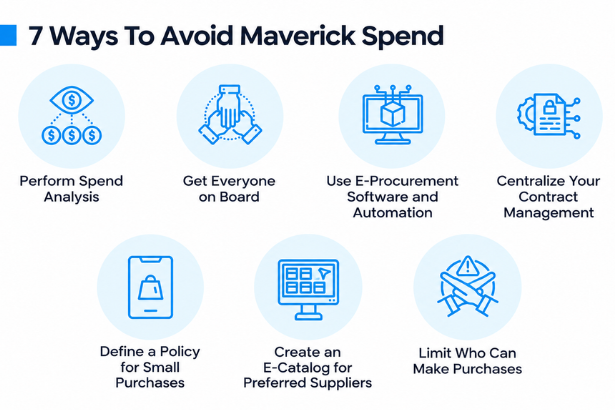
Practical Framework: How to Reduce Maverick Spending
Organizations can approach the problem through a structured improvement program rather than treating every unapproved purchase as an isolated incident.
Step 1: Establish a Reliable Baseline
Begin by examining historical purchasing activity.
Collect the available purchase order, invoice, purchasing-card, supplier, contract, catalog, and approval records. Where appropriate, include expense reimbursements and other purchasing channels that may not appear in the standard procurement system.
Define what counts as maverick spending before calculating the baseline.
For example, a transaction should not automatically be classified as noncompliant simply because a contract reference is missing. The purchase may have been an authorized exception or may not fall within the scope of an existing contract.
The analysis should distinguish validated off-contract purchases from legitimate exceptions and data-quality problems.
Step 2: Identify the Most Important Categories
Not every purchasing category needs the same controls.
Start with categories where unapproved purchases create meaningful financial, operational, or supplier risks.
In an industrial organization, these may include:
- Maintenance, repair, and operations supplies.
- Electrical and mechanical components.
- Facility maintenance materials.
- Industrial consumables.
- Safety-related equipment.
- Frequently purchased spare parts.
Prioritize based on spending patterns, transaction frequency, supplier fragmentation, urgency, and operational criticality.
The purpose is to identify where process improvements are likely to deliver the most value.
Step 3: Fix Catalog and Supplier Data
Standardize supplier names, part descriptions, category codes, and relevant product identifiers.
Remove confirmed duplicates and establish clear ownership for maintaining records.
For MRO items, consider capturing manufacturer part numbers, alternate identifiers, technical specifications, units of measure, and approved supplier options.
Catalog maintenance should be treated as an ongoing operational responsibility rather than a one-time cleanup exercise.
Step 4: Make Approved Purchasing Easier
Evaluate the process from the employee’s perspective.
Can a buyer find the correct item quickly? Are the preferred suppliers clearly displayed? Can employees understand the price and delivery options? Are approval requirements visible before a request is submitted?
Where appropriate, simplify repetitive steps and automate routine approvals within defined limits.
For urgent maintenance purchases, create an exception route that balances speed with visibility and accountability.
Step 5: Integrate Procurement With Existing Systems
Determine how the purchasing platform should exchange data with the ERP, inventory systems, supplier catalogs, and financial applications.
Document which system owns each critical record.
For example, the ERP may remain the authoritative source for financial transactions, while a specialized procurement interface provides a more accessible way for employees to search catalogs and initiate requests.
The integration should prevent duplicate data entry where possible and support reliable purchase, receipt, invoice, and reporting processes.
Step 6: Train Employees and Explain the Benefits
Employees are more likely to adopt a process when they understand why it exists and how it helps them.
Training should explain how to find products, select approved suppliers, request exceptions, and escalate urgent requirements.
Procurement teams should also collect feedback from the people using the system. Repeated complaints about unavailable parts, slow approvals, or confusing search results may reveal problems that cannot be solved through training alone.
Step 7: Monitor Results and Correct the Causes
After changes are introduced, track whether purchasing behavior improves.
Look beyond the headline percentage of off-contract spending. Review the categories, locations, suppliers, and workflows where the problem continues.
If the same exception occurs repeatedly, determine whether the cause is a supplier gap, inaccurate catalog, approval bottleneck, policy misunderstanding, or system limitation.
Continuous improvement is more sustainable than relying exclusively on periodic audits.
Measuring Success: Procurement KPIs That Matter
Procurement leaders need metrics that show whether controls are improving without damaging operational performance.
The following measures provide a useful starting point. Organizations should define each metric consistently and establish their own baselines and targets.
| KPI | What It Measures | Why It Matters |
|---|---|---|
| Validated maverick spend rate | Eligible purchasing value that falls outside approved policies or contracts | Shows the scale of off-contract purchasing |
| Contract compliance rate | Eligible spend made through applicable contracts | Indicates whether negotiated agreements are being used |
| Approved supplier utilization | Share of eligible purchases made through approved suppliers | Helps assess supplier consolidation and policy adoption |
| Requisition cycle time | Time between submitting a request and reaching the required approval or processing milestone | Reveals whether purchasing delays may encourage workarounds |
| Catalog search success | Share of product searches that result in a suitable, selectable item | Helps identify gaps in catalog quality and usability |
| Purchase order compliance | Share of applicable purchases processed with the required purchase order | Supports transaction control and financial visibility |
| Invoice exception rate | Share of invoices requiring manual investigation or correction | Reveals process and data problems |
| Supplier count by category | Number of suppliers used within a defined purchasing category | Helps identify fragmentation and consolidation opportunities |
| Emergency purchase rate | Frequency or value of purchases processed through the emergency route | Helps reveal recurring operational or sourcing gaps |
| MRO stockout rate | Frequency of inventory shortages for selected maintenance items | Helps determine whether purchasing changes are affecting operational readiness |
Important: A falling maverick spend rate is not sufficient on its own. If compliance improves but urgent parts take longer to arrive, the purchasing process may be creating operational problems.
A balanced scorecard should measure cost control, employee experience, inventory availability, supplier performance, and process speed together.
Broader Implications: What Better Procurement Means for the Supply Chain
Financial Visibility Improves Decision-Making
When purchasing activity is fragmented across suppliers, cards, invoices, and separate systems, procurement leaders may have an incomplete view of organizational spending.
Improving visibility can help teams identify duplicate suppliers, inconsistent prices, contract opportunities, and recurring exceptions.
It also supports better communication with finance, which needs reliable transaction records to reconcile spending and evaluate budget performance.
However, visibility alone does not produce savings. Organizations still need to validate opportunities, negotiate appropriate agreements, and ensure that the preferred purchasing route works in practice.
Supplier Consolidation Can Strengthen Purchasing Leverage
A large number of small supplier relationships can create administrative work and make it difficult to monitor performance consistently.
Where products and service requirements allow, consolidating purchasing through suitable suppliers may improve pricing consistency, reduce duplicated onboarding effort, and simplify invoice management.
Supplier consolidation should not be pursued blindly. A single-source strategy can create dependency, reduce flexibility, or increase risk if a supplier cannot deliver.
Procurement leaders should balance purchasing leverage with supplier resilience, technical requirements, geographic coverage, and continuity planning.
Inventory Visibility Can Reduce Unnecessary Purchases
A company may purchase a replacement component because the employee cannot see whether another facility already has the item in stock.
This problem is especially relevant in multi-site industrial operations, where inventory records may be managed differently across locations.
Connecting inventory information with procurement workflows can help buyers identify existing stock before placing another order.
The business case depends on data accuracy, stock location visibility, transfer costs, lead times, and the criticality of the item. A part that exists somewhere in the organization is not necessarily available when and where it is needed.
Technology Should Support People, Not Just Policies
Procurement technology is often evaluated through its financial controls, reporting functions, and integration capabilities.
Those features matter, but the employee experience is also a major factor in whether the system is adopted.
A process that is compliant but difficult to use may push employees toward workarounds. A well-designed process makes the right action easier while preserving the controls that protect the organization.
This is particularly important for industrial purchasing, where the person placing an order may be a technician or operations supervisor rather than a dedicated procurement professional.
For The Tech Marketer, a related follow-up article could explore how digital supply chain tools connect procurement, inventory visibility, and maintenance operations. Add an internal link once that article is published: Digital Supply Chains: How Procurement Technology Improves Operational Efficiency.
Related Technologies: ERP, eProcurement, and Spend Analytics
Different procurement technologies serve different roles. They should be evaluated as parts of an operating model rather than as interchangeable software categories.
Enterprise Resource Planning Systems
ERP systems connect broad business functions, often including finance, purchasing, inventory, and operational planning.
They can provide the central transaction records and governance framework used to manage procurement. Their effectiveness depends on configuration, data quality, process design, and how well employees can complete the tasks relevant to their roles.
An ERP should not automatically be considered inadequate simply because a company has maverick spending. The underlying issue may be policy design, training, supplier coverage, or data quality.
Electronic Procurement Platforms
Electronic procurement, or eProcurement, provides digital workflows for requesting, approving, ordering, and managing purchases.
Depending on the platform, capabilities may include searchable catalogs, guided buying, approval routing, supplier connections, and transaction reporting.
The Gartner glossary definition of e-procurement describes these applications as supporting indirect spending through self-service purchasing for employees who are not procurement specialists.
For industrial organizations, the key evaluation question is whether the platform can support real purchasing needs while fitting into the existing technology environment.
Spend Analytics
Spend analytics helps organizations examine purchasing data to understand supplier activity, category costs, contract utilization, and potential savings opportunities.
The quality of the results depends on accurate and sufficiently complete data.
Before investing in advanced analytics, organizations should establish consistent supplier records, category classifications, contract information, and definitions for the metrics they want to track.
Analytics can identify where to investigate. Procurement teams still need to validate the findings and act on them.
MRO and Inventory Management Systems
MRO management focuses on the parts, supplies, and services needed to keep facilities and equipment operating.
Inventory and maintenance systems may help organizations understand what is in stock, where items are located, when replenishment is required, and which components are critical to operations.
When these systems connect with procurement, employees may have better information before placing an order.
The right architecture depends on the organization’s operating model. A small facility may need a different setup from a manufacturer with dozens of plants and highly specialized maintenance requirements.
What Happens Next: A More Practical Approach to Procurement Control
Organizations seeking to reduce maverick spending should begin with a small number of clearly defined improvements rather than launching a technology project without a diagnosis.
First, measure the current problem. Build a baseline using purchasing, supplier, contract, and payment records. Establish a consistent definition of noncompliant spending.
Second, investigate why it occurs. Identify whether the main causes are slow approvals, catalog gaps, missing supplier coverage, poor data, unclear policies, or fragmented systems.
Third, prioritize high-impact categories. Focus on areas where spending leakage, supplier risk, or operational disruption justify attention.
Fourth, improve the purchasing experience. Fix search and catalog issues, simplify avoidable steps, and create clear exception routes for urgent requirements.
Fifth, evaluate technology against specific needs. Determine whether the existing ERP can be configured effectively or whether a specialized procurement platform would address a genuine capability gap.
Finally, measure both compliance and operational performance. Track off-contract spending alongside cycle time, inventory availability, invoice exceptions, supplier performance, and employee adoption.
This approach reduces the risk of treating software as a substitute for process improvement.
It also creates a clearer basis for deciding whether further investment is justified.
Conclusion: Make Compliant Purchasing the Easiest Route
Reducing maverick spending is not simply a matter of enforcing procurement rules more aggressively. It requires an understanding of why employees bypass approved processes and whether those processes are practical for the people using them.
ERP systems remain important for financial governance and enterprise-wide records. Specialized procurement platforms can provide a more accessible buying experience where the existing workflow does not meet operational needs. Clean data, suitable supplier coverage, and reliable integration are essential to making either approach work well.
For procurement and supply chain leaders, the strongest strategy combines clear policies with usable tools, accurate purchasing information, and measurable accountability.
The objective is not to prevent every exception at any cost. It is to make routine compliant purchasing straightforward, make legitimate exceptions visible, and give employees a reliable way to obtain what they need.
When procurement controls support operational reality, organizations are better positioned to protect negotiated value, improve spending visibility, and keep critical work moving.
FAQ: Reducing Maverick Spending
1. What does maverick spending mean in procurement?
Maverick spending refers to purchases made outside an organization’s approved procurement processes, supplier agreements, contracts, or purchasing policies. The purchase may be legitimate and necessary, but the transaction bypasses the intended controls.
2. How can companies reduce maverick spending?
Companies can reduce maverick spending by identifying the causes, improving catalog and supplier data, simplifying purchasing workflows, clarifying policies, establishing controlled emergency procedures, and monitoring transactions against approved contracts.
3. Can an ERP system prevent maverick spending?
An ERP can support purchasing approvals, supplier controls, financial records, and procurement reporting. Its effectiveness depends on configuration, data quality, and the usability of the purchasing process. Some organizations may benefit from adding specialized eProcurement capabilities that integrate with their existing ERP.
4. What is the difference between maverick spending and tail spending?
Maverick spending describes purchases made outside approved procurement processes. Tail spending describes the long tail of purchasing activity, often consisting of many smaller transactions spread across numerous suppliers. Tail spending can be fully compliant, while maverick spending can occur in both low-value and high-value purchases.
5. Why do employees bypass approved suppliers?
Common reasons include urgent requirements, slow approvals, missing catalog items, unclear supplier choices, poor product descriptions, and inadequate visibility into available inventory. Some cases may involve deliberate policy violations, but process friction is also an important cause to investigate.
6. What KPIs should procurement teams monitor?
Useful metrics include validated maverick spend rate, contract compliance, approved supplier utilization, requisition cycle time, catalog search success, invoice exception rate, emergency purchase frequency, and inventory stockouts.
These measures should be reviewed together so that stronger compliance does not come at the expense of operational readiness.
7. How does eProcurement software help control off-contract purchases?
Depending on its capabilities, eProcurement software can direct employees toward approved suppliers and catalogs, automate approval routing, capture transaction data, and provide visibility into purchasing behavior. It works best when integrated with existing enterprise systems and supported by reliable product and supplier data.
8. Should a company replace its ERP to reduce maverick spending?
Not necessarily. Organizations should first identify the limitations of the existing system and the reasons employees bypass it. If the ERP supports the required controls but lacks a convenient purchasing interface, a complementary procurement platform may be more appropriate than replacing the entire system.
Sources & References
1. SDI, Ron Fijalkowski. “General ERPs vs. Purpose-Built Procurement Platforms to Reduce Maverick Spending.” October 14, 2026.
The primary source for the article’s discussion of ERP limitations in MRO purchasing, purpose-built procurement tools, integration, and procurement data quality.
Read the original article.
2. Amazon Business. “Maverick Spend: How to Find and Control It.” September 2, 2026.
A practical guide to identifying off-contract purchases, consolidating spend data, validating exceptions, and addressing the underlying causes of noncompliant purchasing.
Read the guide.
3. Gartner. “E-Procurement.” IT Glossary.
A reference definition of electronic procurement and its role in enabling self-service purchasing for employees who are not procurement specialists.
Read the definition.
4. SDI. “Tackling Maverick Spend: How Procurement Leaders Can Regain Control.” July 9, 2024.
Additional industry context on procurement technology, supplier visibility, and reported challenges associated with maverick spending. Findings in this source should be attributed to the study and its respondents rather than generalized to every organization.