Introduction
Planet Labs is suddenly at the center of one of the more ambitious experiments in AI infrastructure: putting Google’s computing hardware in orbit. On October 1, Google’s prototype satellite for Project Suncatcher launched aboard SpaceX’s Transporter-18 rideshare mission. Google later confirmed contact with the spacecraft and said it was operating as expected. blog.google
The mission is not a commercial space data center. It is a hardware test designed to answer a much more basic question: can Google’s Tensor Processing Units, or TPUs, reliably operate in the harsh environment of space?
If the answer is yes, Google believes an entirely different approach to AI infrastructure could eventually become possible.
Background and Context
The rapid expansion of generative AI has created a less glamorous problem behind every chatbot and image generator: computing infrastructure needs enormous amounts of electricity.
Traditional data centers require land, grid connections, cooling systems and increasingly large supplies of power. Google says low-Earth-orbit satellites have access to near-constant sunlight and could potentially generate up to eight times more solar power than comparable systems on Earth. blog.google
That is the basic premise behind Project Suncatcher, Google’s long-term research effort to explore whether machine-learning infrastructure could eventually operate in space.
The idea was first announced in November 2025. Google described a future in which solar-powered satellites equipped with TPUs could be connected into large computing clusters. The company initially planned a learning mission with Planet involving prototype satellites. blog.google
Now that concept has moved from research papers into orbit.
Latest Update: Planet Labs Satellite Takes Google AI Hardware Into Orbit
The October 1 launch marked the first in-orbit test of Project Suncatcher.
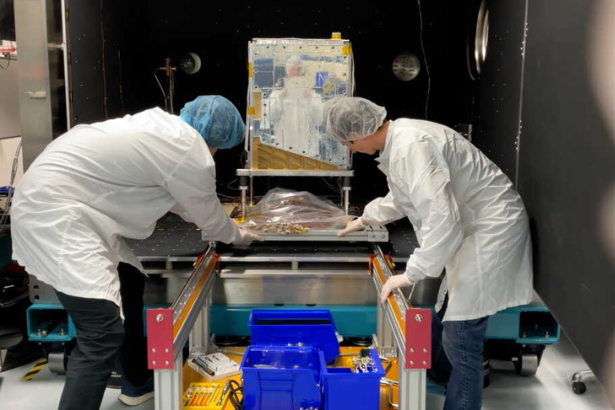
The prototype was built in partnership with Planet and carried Google’s AI computing hardware. It launched as part of SpaceX’s Transporter-18 rideshare mission from Vandenberg Space Force Base in California. The mission carried roughly 130 payloads into low-Earth orbit. blog.google
Google’s Travis Beals, senior director of Paradigms of Intelligence, said the team had confirmed contact with the satellite and that it was operating as expected. The immediate goal is to collect data about how the TPUs behave under actual space conditions. blog.google
That means exposing the hardware to conditions that are difficult to reproduce perfectly on Earth:
- Cosmic radiation
- Extreme thermal conditions
- Launch vibrations
- The vacuum of space
- The difficulty of moving heat away from electronic components
- Long-term reliability without conventional maintenance
The radiation question is particularly important. Google’s earlier research found that some TPU components showed resilience during radiation testing, but the company still needs real-world orbital data. Its research indicates that radiation-induced errors remain a consideration, particularly for more demanding workloads. Google Research
The prototype therefore represents less of a finished product and more of a flying laboratory.
Google’s Project Suncatcher prototype announcement
Expert Insights and Analysis
The most important part of Project Suncatcher may not be the satellite itself. It is the economic argument Google is testing behind it.
Google’s research suggests that launch costs could eventually become low enough to make large orbital computing systems economically interesting. Its modeling uses a target of roughly $200 per kilogram to low-Earth orbit as an important threshold. Google Services
That number is nowhere near today’s ordinary economics of launching large amounts of infrastructure.
Google’s analysis projects that launch prices could potentially fall below $200 per kilogram in the mid-2030s if the industry’s historical cost-learning trends continue. The company’s model estimates that achieving such economics would require a dramatic increase in cumulative launch activity. Google Research
This is where SpaceX becomes strategically important.
Reusable rockets have already pushed launch economics far below the historical norm. But a true orbital data center would require sending not just a few satellites into space, but potentially enormous quantities of computing hardware, solar equipment, communications systems and thermal infrastructure.
TechCrunch reported that Google’s own assumptions could require something on the order of 1,800 Starship launches over a decade to reach the required scale of launch activity. That is an enormous logistical challenge, especially since Starship has not yet demonstrated routine commercial payload operations at anything approaching that scale. TechCrunch
In other words, Planet Labs can help prove the satellite works, but the economics ultimately depend on the broader launch industry.
Why Planet Labs Matters
Planet’s role is significant because it puts an established satellite manufacturer between Google’s AI hardware ambitions and the realities of orbital engineering.
Google does not need to invent an entire satellite platform from scratch simply to determine whether its TPUs can operate in space. Partnering with Planet allows the experiment to focus on the computing problem while leveraging existing spacecraft expertise.
The arrangement also highlights how the emerging space-computing industry is becoming an intersection of several technology sectors:
AI companies provide processors and software.
Satellite companies provide spacecraft platforms and orbital operations.
Launch companies provide access to space.
Energy technology provides the solar infrastructure.
And optical communications could eventually connect individual satellites into a distributed computing system.
That architecture looks much more like a data center spread across orbit than a conventional satellite.
Broader Implications
The attraction of orbital computing is easy to understand.
A terrestrial AI data center has to negotiate with utilities, local governments and communities over electricity, land, water and construction. An orbital system could theoretically bypass many of those constraints.
Google’s own research argues that satellites in carefully selected orbits could receive substantially more sunlight than terrestrial solar installations. Multiple spacecraft could then communicate through high-speed optical links and operate as a distributed computing cluster. blog.google
But moving the problem into space does not make the engineering disappear.
Heat is a major issue. Space is cold, but vacuum does not allow conventional air cooling. Heat must instead be transported to radiators and emitted as infrared radiation.
Communications are another bottleneck. Moving large AI datasets between Earth and orbit can require substantial bandwidth. An orbital data center makes more sense for workloads that can be processed close to where the data originates, rather than constantly moving enormous datasets between Earth and space.
Then there is maintenance.
A terrestrial server can be replaced by an engineer carrying a replacement component. A failed satellite component is considerably harder to fix.
That means orbital infrastructure needs redundancy, highly reliable components and potentially robotic servicing.
For more on how AI infrastructure is reshaping the technology industry, see the AI and infrastructure coverage on The Tech Marketer.
Related History and Comparable Technologies
The concept of putting computers in space is not entirely new.
Satellites have processed data onboard for decades. Earth-observation spacecraft increasingly use onboard computing to analyze imagery before sending selected information back to Earth. The difference with Project Suncatcher is scale.
Instead of using a satellite primarily as a sensing platform, Google is exploring whether satellites themselves could become computing infrastructure.
Other companies are pursuing related ideas. Space-based data storage and computing startups have explored orbital servers, while companies working on space-based solar power are tackling another version of the same fundamental question: can the energy available beyond Earth justify the enormous cost of getting equipment there?
Google’s Project Suncatcher is distinctive because it connects that concept directly to the explosive demand for AI compute.
The experiment also resembles an earlier pattern in Google’s history. The company has repeatedly pursued infrastructure-heavy technologies before their commercial economics were obvious, from massive global data centers to specialized AI processors.
This time, the infrastructure may literally be above our heads.
What Happens Next
The next phase is less dramatic than the launch, but arguably more important.
Google needs to collect operational data from the prototype and determine whether its TPUs can perform reliably in orbit.
The company says the coming experiments will examine how the hardware handles the physical stresses, radiation and thermal extremes of space. blog.google
Future prototypes will also have to demonstrate that an orbital computing architecture can solve several problems simultaneously:
- Power: Generate enough electricity continuously for useful AI workloads.
- Cooling: Move heat from high-performance processors to spacecraft radiators.
- Radiation: Prevent space radiation from causing unacceptable computing errors.
- Networking: Connect satellites with sufficiently fast links.
- Reliability: Keep systems operating without routine human maintenance.
- Launch economics: Reduce the cost of putting enormous quantities of hardware into orbit.
- Manufacturing: Produce spacecraft cheaply enough to make large constellations practical.
Google’s own research suggests that the economic case becomes much more interesting if launch costs eventually approach $200 per kilogram. Google Services
That makes this a technology story with a very long timeline.
The October mission proves something can be launched.
The real question is whether it can eventually be scaled.
Conclusion
Planet Labs has helped turn Google’s space-based AI vision from a research concept into an orbital experiment.
Project Suncatcher’s first prototype is now in orbit, carrying Google TPUs and collecting the real-world data needed to determine whether advanced AI hardware can survive and compute reliably beyond Earth.
There is still a huge distance between one experimental satellite and a functioning orbital data center.
Launch costs need to fall. Thermal systems need to improve. Communications need to scale. Radiation needs to be managed. Satellites need to become dramatically more reliable and potentially serviceable.
But the significance of the October 1 mission is that Google is no longer asking whether the idea can exist only on paper.
It is testing the hardware in space.
And with Planet Labs providing the spacecraft platform and SpaceX providing the launch, the first pieces of Google’s orbital AI infrastructure experiment are already there.
FAQ
What is Planet Labs’ role in Google’s Project Suncatcher?
Planet Labs is partnering with Google on the spacecraft platform for Project Suncatcher, Google’s effort to investigate scalable machine-learning infrastructure in orbit. The first prototype satellite launched aboard SpaceX’s Transporter-18 mission. blog.google
What is Google Project Suncatcher?
Project Suncatcher is Google’s research initiative exploring whether solar-powered satellites equipped with Tensor Processing Units can eventually provide scalable AI computing infrastructure in space. blog.google
Did Google really put AI chips in space?
Yes. Google’s first Project Suncatcher prototype launched into low-Earth orbit on October 1, 2026, carrying Google’s Tensor Processing Units. Google subsequently confirmed contact with the satellite. blog.google
Why does Google want AI data centers in space?
The concept could provide access to abundant solar energy while avoiding some terrestrial constraints involving land, grid capacity and conventional data-center infrastructure. Google says satellites in low-Earth orbit can potentially access substantially more solar power than comparable installations on Earth. blog.google
Can space-based data centers replace data centers on Earth?
Not yet. Project Suncatcher remains an experimental research effort. Launch costs, thermal management, radiation, networking, maintenance and satellite manufacturing all remain major technical and economic challenges.
How much would it cost to launch a space data center?
The economics depend heavily on launch prices and the mass of the infrastructure. Google’s research identifies approximately $200 per kilogram to low-Earth orbit as a potentially important threshold for making large-scale orbital computing more competitive. Google Services
Sources & References
- Google: Our Project Suncatcher prototype satellite is in orbit
- CNBC: SpaceX launches Google AI chips into orbit in push toward space-based data centers
- Yahoo Finance: Google Takes Stunning First Step Toward Putting AI Data Centers in Space
- Google Research: Exploring a space-based, scalable AI infrastructure system design
- Google Research: Project Suncatcher research paper