Meta CEO defends Instagram against claims platform was deliberately designed to addict children and harm mental health in first-ever jury testimony
Introduction
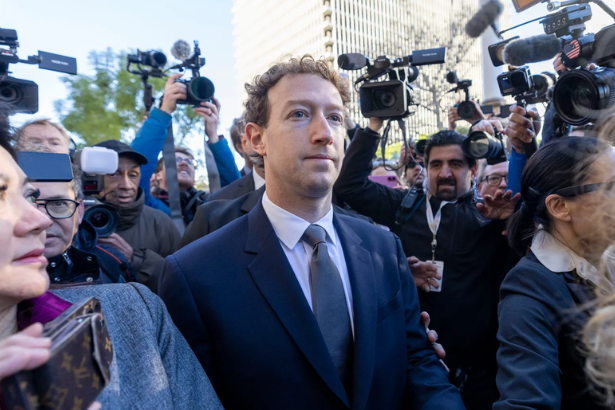
Mark Zuckerberg testimony drew national attention Wednesday as the Meta CEO took the witness stand in a Los Angeles Superior Court trial that could reshape how social media companies are held accountable for youth safety. This marks the first time Zuckerberg has testified about child safety before a jury, facing pointed questions about whether Instagram was deliberately designed to be addictive to children.
The landmark case centers on a 20-year-old California woman identified by the initials K.G.M., who claims her early use of Instagram — starting at age 9 — led to addiction, body dysmorphia, depression, and suicidal thoughts. Her lawsuit accuses Meta and YouTube of making deliberate design choices to hook children on their platforms for profit.
Zuckerberg testified for hours under cross-examination by plaintiff’s attorney Mark Lanier, who confronted him with internal emails, slide decks, and documents suggesting Meta targeted children as young as 11 and engineered features to maximize time spent on Instagram regardless of harm.
Background and Context
Mark Zuckerberg leads Meta, the parent company of Facebook and Instagram. The company has faced sustained scrutiny over youth safety for years, but this case represents a different kind of accountability: a jury trial with bereaved parents sitting in the courtroom audience, internal documents entered as evidence, and the possibility of a verdict that could influence thousands of similar lawsuits pending nationwide.
The case is one of three “bellwether trials” selected from more than 1,600 lawsuits filed by families and school districts alleging social media companies harmed children through addictive design. The outcome could set legal precedent and impact settlement negotiations in the broader litigation.
K.G.M.’s lawsuit claims she used YouTube starting at age 6, then Instagram at 9, and spent hours daily on the platforms — sometimes more than 16 hours in a single day — despite her mother’s attempts to curb usage. The suit alleges that features like beauty filters, infinite scroll, auto-play, visible like counts, and push notifications function like a “digital casino,” deliberately engineered to exploit children’s developing brains for engagement and profit.
Meta and YouTube argue that K.G.M.’s mental health struggles preceded her social media use and that she turned to the platforms as a coping mechanism for problems rooted in a turbulent home life. They contend the apps help kids combat loneliness, pursue creative expression, and access educational resources.
Zuckerberg previously testified before Congress in 2024 and apologized to families who lost children to tragedies they attributed to social media. But he stopped short of taking direct responsibility. This trial puts him in front of a jury with the power to deliver a verdict, not just ask questions.
Latest Update or News Breakdown
Mark Zuckerberg testified Wednesday, February 18, 2026, at the Los Angeles Superior Court. Here is what happened, based on verified reporting from CNBC, NPR, CNN, NBC News, PBS, The Hill, ABC News, AP, and Rolling Stone:
The Scene:
- First time testifying before a jury on youth safety issues
- K.G.M. attended and watched from the courtroom gallery for the first two hours
- Bereaved parents who lost children to tragedies they attribute to social media sat in limited public seats
- Judge Carolyn B. Kuhl threatened contempt of court for anyone using AI smart glasses (Meta’s Ray-Ban glasses) to record testimony
- Members of Zuckerberg’s security team were photographed wearing Meta Ray-Ban AI glasses outside the courthouse
Key Moments:
1. Time Spent Goals Lanier confronted Zuckerberg with internal documents showing Instagram had explicit goals to increase daily user engagement time to 40 minutes in 2023 and 46 minutes in 2026. Zuckerberg had previously told Congress that Instagram employees were not given goals to increase time spent.
Zuckerberg responded that the company previously had time-based goals but made a “conscious decision” to move away from them, focusing instead on “utility.” He said: “If something is valuable, people will use it more because it’s useful to them.”
Lanier presented a December 2015 email in which Zuckerberg wrote that he hoped to increase “time spent” by users by 12 percent over three years. Zuckerberg acknowledged the email but maintained the company’s approach had evolved.
2. Underage Users Lanier cited a 2018 internal Meta document estimating that 4 million users under 13 were on Instagram — representing approximately 30 percent of all kids aged 10 to 12 in the United States.
Instagram’s terms of service require users to be 13 or older. Zuckerberg said: “I don’t see why this is so complicated. It’s been our clear policy that people under 13 are not allowed on our services. We’re pretty consistent.” He acknowledged the company is “not perfect” at enforcement but said Meta takes “proactive steps” to identify and remove underage users.
Lanier asked if Zuckerberg expected a nine-year-old to read the “fine print” and comply.
3. Plastic Surgery Filters Lanier asked about cosmetic filters that allow users to alter features like noses and lips. Eighteen mental health experts had warned Meta that these filters could harm teenage girls. Zuckerberg testified the company temporarily banned all filters before restoring many of them, provided they did not explicitly promote plastic surgery.
When asked about the expert warnings, Zuckerberg said the experts had not presented “any data I found compelling.”
Pressed on an internal message where he expressed concern about being “paternalistic” in banning the filters, Zuckerberg said he didn’t want to be “overbearing” in dictating how people express themselves. “I genuinely want to err on the side of giving people the ability to express themselves,” he said.
4. The 35-Foot Instagram Collage At one point, Lanier had six lawyers unspool a 35-foot-wide collage of hundreds of selfies that K.G.M. posted to Instagram as a child. Lanier asked Zuckerberg to dwell on the posts and asked if her account had ever been investigated for excessive use by a child. Zuckerberg did not provide a direct answer. K.G.M. watched from the gallery.
5. Reaching Out to Tim Cook Zuckerberg testified he reached out to Apple CEO Tim Cook in February 2018 to discuss “the wellbeing of teens and kids.” Defense attorney Paul Schmidt used the email exchange to portray Zuckerberg as proactive about youth safety, even reaching out to a corporate rival.
6. Media Training Lanier pointed to internal documents about Zuckerberg’s media training and feedback on his public persona. One document instructed him to come off as “authentic, direct, human, insightful and real” and to not be “fake,” “corporate,” “cheesy,” or “try hard.”
Zuckerberg showed some humility when questioned about his performance in courtrooms and before Congress. At various points, he accused Lanier of “mischaracterizing” his remarks and taking documents “out of context.”
7. Scientific Evidence Zuckerberg said he still agrees with a statement he made in 2024 congressional testimony that “the existing body of scientific work” has not proven that social media causes mental health harms.
“We get feedback from a handful of different stakeholders, including people who study wellbeing,” Zuckerberg said. “I took into account all of that info and I think I navigated this in a reasonable way.”
8. Majority Ownership Zuckerberg discussed his majority ownership stake in Meta. He argued that the better Meta stock does, the more money gets invested into science and research, adding that he has pledged to give away 99 percent of his wealth. Lanier asked if Zuckerberg would also “pledge money for the victims of social media.” Zuckerberg replied: “I disagree with the characterization of your question.”
Outside the Courtroom: Julianna Arnold, whose daughter died from fentanyl she bought from someone on Instagram, said it was “surreal” to see Zuckerberg testify after years of calling on the company to make changes.
Josh Golin, executive director of Fairplay, said: “All Mark Zuckerberg accomplished with his testimony today was to prove yet again that he cannot be trusted, especially when it comes to kids’ safety.”
Expert Insights or Analysis
Zuckerberg’s Demeanor: Multiple reporters in the courtroom noted that Zuckerberg appeared visibly irritated at times, arching his eyebrows and shifting in his chair as Lanier pressed him on internal documents. NPR’s Bobby Allyn described him as “getting kind of testy,” frequently responding with “I think you’re mischaracterizing me” or “That’s not what I said at all.”
The Jury’s Role: Unlike congressional hearings where lawmakers ask questions but issue no binding rulings, this trial ends with a jury verdict. The jury will decide whether Instagram was a “substantial factor” in K.G.M.’s mental health struggles.
UCLA law professor Anna Pallen told CNN: “It’s going to turn on how these people testify in front of the jury, if the jury likes them, and what the documents show.”
The Broader Stakes: This is a bellwether trial. The outcome will influence how more than 1,600 similar lawsuits proceed. If the jury finds Meta liable, it could trigger a wave of settlements or encourage more families to take cases to trial. If Meta prevails, it strengthens the company’s legal position nationwide.
Matt Bergman, founding attorney of the Social Media Victims Law Center representing about 750 plaintiffs, said: “For the first time, a Meta CEO will have to sit before a jury, under oath, and explain why the company released a product its own safety teams warned were addictive and harmful to children.”
Suicide Rates: A recent Pew Research survey of American teens aged 13 to 17 found that 48 percent say social media sites have a mostly negative effect on people their age — up from 32 percent in 2022.
Suicide rates among young people aged 10 to 24 rose 62 percent between 2007 and 2021, according to the CDC. Before that, the rate remained stable from 2001 to 2007. Health experts, including former Surgeon General Vivek Murthy, say teens are especially susceptible to social pressures and peer opinions, making them particularly vulnerable to social media’s effects.
Broader Implications
For Tech Accountability: This trial represents a shift from regulatory hearings to legal liability. Congress can question. Juries can hold companies financially accountable.
For Platform Design: If Meta loses, other social media companies may preemptively adjust features like infinite scroll, auto-play, and push notifications to reduce legal exposure.
For Section 230: The case does not directly challenge Section 230, which shields platforms from liability for user-generated content. Instead, it focuses on product design — whether the platforms themselves are defective products that harm children.
For Parental Responsibility: Meta’s defense centers on the argument that K.G.M.’s problems preceded social media use and that her family dynamics, not Instagram, are the root cause. If the jury agrees, it could make future cases harder to win.
Related History or Comparable Moments
Previous Zuckerberg Testimony: Zuckerberg testified before Congress in 2024 and apologized to families who lost children to social media-related tragedies. He said: “I’m sorry for everything you have all been through.” But he stopped short of taking direct responsibility.
This is his first time testifying before a jury.
Instagram Chief Testimony: Adam Mosseri, head of Instagram, testified last week and said he does not believe people can be “clinically addicted” to social media platforms.
Other Defendants: TikTok and Snap settled with K.G.M. before trial. YouTube is also a defendant. YouTube CEO Neal Mohan was scheduled to testify this week but was removed from the witness list.
New Mexico Trial: Meta is simultaneously facing a separate trial in New Mexico that began last week.
What Happens Next
K.G.M. is expected to testify later in the trial, delivering what lawyers anticipate will be the most emotional testimony. She will describe her experiences using Instagram starting at age 9 and the mental health struggles she attributes to the platform.
The trial will continue with additional witnesses and closing arguments. The jury will then deliberate and deliver a verdict that could:
- Award damages to K.G.M. if they find Meta liable
- Set legal precedent for the 1,600+ pending cases
- Influence settlement negotiations nationwide
If Meta loses, expect appeals and potentially years of additional litigation. If Meta wins, it strengthens the company’s defense against similar claims.
Legislative Implications: Regardless of the verdict, the testimony and internal documents revealed during the trial are likely to fuel renewed calls for federal legislation regulating social media’s effects on children.
Conclusion
Mark Zuckerberg testimony in a Los Angeles courtroom Wednesday marked a pivotal moment in the fight over youth safety on social media. For the first time, the Meta CEO faced a jury with the power to hold his company financially accountable for design choices that plaintiffs claim deliberately addicted children and harmed their mental health.
The testimony was contentious. Zuckerberg defended Meta’s policies, argued that Instagram’s features are not designed to be addictive, and maintained that the scientific evidence does not prove social media causes harm. Plaintiff’s attorney Mark Lanier confronted him with internal documents showing engagement goals, underage user estimates, and warnings from mental health experts that were dismissed.
The jury will decide. And whatever they decide will ripple through more than 1,600 pending lawsuits, shape how social media companies design their platforms, and potentially redefine corporate accountability in the digital age.
FAQ
Q1: Why did Mark Zuckerberg testify in court? Mark Zuckerberg testified in a landmark Los Angeles civil trial over whether Instagram was deliberately designed to be addictive to children. This is the first time he has testified about child safety before a jury.
Q2: What is the lawsuit about? A 20-year-old California woman identified as K.G.M. claims her early use of Instagram — starting at age 9 — led to addiction, body dysmorphia, depression, and suicidal thoughts. Her lawsuit alleges Meta and YouTube designed their platforms with addictive features to maximize engagement and profit.
Q3: Is Congress investigating Meta? This is not a congressional hearing. It is a civil trial with a jury that will deliver a verdict. Zuckerberg previously testified before Congress in 2024, but this trial carries the possibility of financial liability, not just oversight.
Q4: What is the main controversy? Whether Instagram’s features — like beauty filters, infinite scroll, and push notifications — were deliberately engineered to addict children and whether Meta knew these features were harmful but prioritized engagement and profit over safety.
Q5: Will this lead to new regulations? Possibly. The trial is civil, not regulatory, but the testimony and documents revealed could fuel legislative efforts to regulate social media’s impact on children.
Sources and References
CNBC: Zuckerberg testimony – Meta CEO said he reached out to Apple’s Tim Cook
NPR: Zuckerberg grilled about Meta’s strategy to target ‘teens’ and ‘tweens’
CNN: Meta’s Zuckerberg testifies about social media’s effects on children in landmark trial