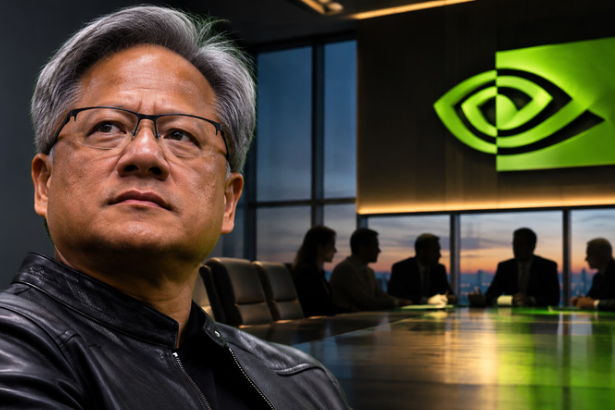
The Jensen Huang Nvidia controversy has become a major technology and financial news story in November 2026, bringing renewed attention to the leadership of one of the world’s most influential semiconductor companies.
A November 11 report by The New York Times alleged that Nvidia CEO Jensen Huang had an extramarital relationship with Kimberly Powell, the company’s vice president of healthcare. The report cited five people who had worked at Nvidia.
The development followed an earlier controversy involving Huang and reports about a possible foreign intelligence operation targeting him.
On November 8, Huang publicly acknowledged being unfaithful to his wife in a message to Nvidia employees. He also confirmed that he would cooperate with an independent investigation initiated by Nvidia’s board.
The latest allegations have introduced another dimension to the situation.
Investors are now considering questions about executive conduct, corporate governance, leadership continuity and the potential consequences for Nvidia’s market valuation.
The issue is particularly important because Nvidia sits at the center of the global artificial intelligence infrastructure market.
Its GPUs power data centers, AI model development and advanced computing systems used by some of the world’s largest technology companies.
Any uncertainty surrounding the company’s leadership could therefore attract attention well beyond its own shareholders.
Background and Context: Why Jensen Huang Is Facing Scrutiny
NVIDIA CEO Jensen Huang Delivers Keynote At Developers Conference
Jensen Huang co-founded NVIDIA in 1993 and has served as its chief executive since the company’s founding.
Under his leadership, Nvidia transformed from a graphics processing company into a central supplier of AI computing infrastructure.
Its GPUs are used in:
- AI model training and inference.
- Hyperscale data centers.
- Cloud computing infrastructure.
- Autonomous vehicles and robotics.
- Scientific research and accelerated computing.
- Enterprise AI applications.
This position has made Huang one of the most influential executives in the technology industry.
It also means that developments involving his leadership can have implications for investors, employees, customers and the broader semiconductor market.
How the controversy developed
The events unfolded over several days in November 2026.
| Date | Development |
|---|---|
| November 8 | Huang acknowledged being unfaithful to his wife in a message to employees. |
| November 8 | Nvidia’s board announced an independent investigation following reports that Huang had been targeted by a foreign intelligence effort. |
| November 10 | Independent directors appointed former acting US Attorney Joon H. Kim and law firm Wachtell, Lipton, Rosen & Katz to oversee the investigation. |
| November 11 | The New York Times published a report alleging a separate relationship involving Kimberly Powell. |
| November 11 | Reuters reported that Nvidia’s board was preparing to consider Huang’s future as CEO, citing a Wall Street Journal report. |
| November 12 | The controversy continued attracting attention from investors and financial media. |
Sources: Nvidia Newsroom and Reuters. NVIDIA Newsroom+3
Latest Update: What the Kimberly Powell Report Says
Nvidia and Wall Street Target $500bn for AI Infrastructure | Parrhesia News
The latest development came from a November 11 report by The New York Times titled Jensen Huang’s Nvidia Relationship Report.
The publication reported that Huang had an alleged relationship with Kimberly Powell, identified as Nvidia’s vice president of healthcare.
The report cited five people who had worked at Nvidia.
According to the reporting, some former colleagues described interactions between the two executives at a hotel during Nvidia’s GTC conference in San Jose in March.
The allegations have raised questions about Nvidia’s workplace policies and executive oversight.
However, several distinctions are important:
- The relationship described in the New York Times report is an allegation based on sources cited by the publication.
- Huang’s November 8 admission of infidelity did not publicly identify Kimberly Powell.
- Nvidia did not confirm the specific allegation in the material available for this article.
- Powell’s position or response to the allegation should not be inferred from the reporting.
Reuters also reported that the New York Times had not received an immediate response from Nvidia or Powell regarding the allegations. AOL+1
Why the report matters to Nvidia
The issue goes beyond the private lives of company executives.
Huang is Nvidia’s founder, chief executive and a central figure in the company’s strategic direction.
The company’s board has responsibilities involving executive oversight, workplace policies and shareholder interests.
If allegations involve a senior executive and a subordinate, questions may arise concerning:
- Potential conflicts of interest.
- Workplace reporting structures.
- Compliance with company policies.
- Independent board oversight.
- Executive accountability.
These are corporate governance questions, not conclusions about the truth of the specific allegations.
Nvidia Board Investigation: What Has the Company Officially Confirmed?
NVIDIA (NVDA) announces AI partnership with Corning (GLW) | Shacknews
Nvidia’s official response is particularly important because it establishes what the company has actually confirmed.
On November 8, the Nvidia board released a statement announcing an independent investigation following reports that Huang had been the target of a foreign intelligence effort.
The board said a committee of independent directors would oversee the investigation with assistance from outside independent counsel.
It also stated that it had no reason to believe national security or Nvidia secrets had been compromised, while emphasizing that the inquiry would examine available information.
Read the official Nvidia board statement. NVIDIA Newsroom
Independent directors appoint outside legal counsel
On November 10, Nvidia issued another statement.
The independent members of the board announced that they had retained Joon H. Kim, a former acting US Attorney for the Southern District of New York, and the law firm Wachtell, Lipton, Rosen & Katz.
The appointment was intended to support a thorough and independent investigation.
This is significant because it places the review under the supervision of independent directors and outside legal counsel.
The appointment does not establish that any particular allegation has been substantiated. NVIDIA Newsroom+1
Jensen Huang’s message to Nvidia employees
Nvidia Computex 2024 keynote liveblog: Nvidia’s data center presentation as it happened | TechRadar
On November 8, Huang sent a message to employees acknowledging that he had been unfaithful to his wife.
In the message, he accepted responsibility for the personal consequences of his actions and apologized to his family and Nvidia colleagues.
He also said he remained committed to leading Nvidia and would cooperate with the board’s independent investigation.
The statement is important because it represents Huang’s own public acknowledgment of infidelity.
However, it should not be treated as confirmation of every separate allegation subsequently reported in the media.
The full message is available through Nvidia’s official newsroom. NVIDIA Newsroom
Nvidia CEO Leadership Crisis: Is Jensen Huang at Risk of Losing His Position?
The possibility of leadership changes has become another major part of the story.
On November 11, Reuters reported that Nvidia’s board was preparing to meet to consider Huang’s future, citing reporting by The Wall Street Journal.
The report followed the latest allegations and the company’s ongoing independent investigation.
CNN also reported that Nvidia’s board was meeting to discuss Huang’s future, citing two sources familiar with the matter.
These reports indicate that the situation has moved beyond reputational questions and into the company’s leadership structure.
However, a reported board discussion is not the same as a formal decision to remove a CEO.
As of November 12, the official Nvidia statements cited here establish the investigation and appointment of outside counsel, but do not announce Huang’s removal. Reuters+2
Why leadership uncertainty matters
Nvidia is not an ordinary technology company.
Huang has been closely associated with its product strategy, AI infrastructure vision and relationships with major customers.
A change in leadership could create questions about:
- Long-term AI chip strategy.
- Data center product development.
- Relationships with major cloud providers.
- Strategic partnerships.
- Executive succession.
- Investor confidence.
The board’s handling of the situation could therefore become an important factor in how markets assess Nvidia’s governance.
Nvidia Stock Reaction: Why Investors Are Watching the Controversy
Nvidia stock plunges nearly 2% today: here’s why NVDA is trading in red – Invezz
The controversy has introduced another source of uncertainty for Nvidia shareholders.
On November 11, Nvidia shares fell approximately 8.6% in after-hours trading as reports about Huang’s leadership intensified.
Reuters reported that the developments could erase hundreds of billions of dollars in market value, highlighting how sensitive investor sentiment has become to the company’s leadership situation. News Channel 3-12+1
Why Nvidia stock could be affected
There are four major investment considerations.
1. CEO succession uncertainty
Huang has led Nvidia since its founding in 1993.
Investors may be concerned about how a potential leadership transition could affect strategic decisions, product launches and relationships with major customers.
2. Corporate governance concerns
The board investigation could bring additional attention to Nvidia’s executive oversight, workplace policies and internal controls.
Investors will want to understand whether the company has appropriate procedures for managing executive conduct and potential conflicts of interest.
3. Market confidence
Nvidia’s valuation reflects expectations about its continued leadership in AI computing.
Leadership uncertainty can influence how investors assess future earnings, even when the underlying demand for AI chips remains strong.
4. Institutional investor exposure
Nvidia is a major component of many diversified investment portfolios and market indices.
This means changes in its share price can affect mutual funds, exchange-traded funds and retirement portfolios that hold the stock.
However, the impact on individual retirement accounts depends on their holdings, portfolio allocations and investment strategies.
Could the controversy affect Nvidia’s AI business?
The central question is whether the leadership developments remain a governance issue or begin affecting business operations.
Nvidia’s competitive position is supported by several established businesses and technologies:
- GPU computing.
- CUDA software and developer tools.
- AI data center infrastructure.
- Networking technologies.
- Enterprise AI systems.
- Strategic relationships with cloud providers.
These operations do not automatically change because of a controversy involving the CEO.
However, prolonged uncertainty could affect investor confidence, executive decision-making and strategic planning.
For now, the distinction between reputational risk and operational disruption is important.
CNN Analysis: How the Nvidia Scandal Could Affect Retirement Funds
Фондовая биржа на Уолл-Стрит закрыла июньскую сессию резким падением | Новини.live
A November 12 CNN report also examined how the Nvidia controversy could affect retirement funds.
The discussion is important because Nvidia is widely held through institutional investment products.
Many people who own index funds or diversified retirement portfolios may have indirect exposure to Nvidia without purchasing individual NVDA shares.
This creates several possible channels of market impact:
| Investment channel | Potential impact |
|---|---|
| S&P 500 index funds | Nvidia share-price movements can affect index performance |
| Technology ETFs | Funds with large Nvidia allocations may experience increased volatility |
| Mutual funds | Portfolio values may change depending on Nvidia exposure |
| Retirement accounts | Indirect exposure through underlying investment funds |
| Individual shareholders | Direct exposure to NVDA price movements |
The important point is that a fall in Nvidia’s share price does not mean every retirement account experiences the same decline.
Portfolio diversification, fund composition and allocation percentages all matter.
Read the CNN report: Nvidia Scandal and Its Potential Impact on Retirement Funds.
Expert Analysis: What This Means for Nvidia’s Corporate Governance
The latest developments highlight a broader issue facing founder-led technology companies.
When a founder remains CEO for decades, the company can become closely associated with that individual’s leadership, reputation and decision-making.
This creates strategic advantages, but it also makes governance and succession planning especially important.
1. Founder-led companies face concentrated leadership risk
Huang’s role at Nvidia extends beyond ordinary executive management.
He has been closely associated with the company’s transformation into a central supplier of AI infrastructure.
Investors therefore need to understand how Nvidia’s leadership responsibilities are distributed across its executive team.
The investigation also raises questions about the independence of internal reporting and oversight processes.
2. Independent investigations matter
The appointment of outside counsel indicates that Nvidia’s independent directors are taking formal steps to examine the situation.
Independent investigations can help establish facts, assess relevant company policies and provide the board with information needed for its responsibilities.
The credibility of the process will depend on its independence, scope and eventual findings.
3. Succession planning is becoming an investor consideration
Nvidia has built a strong executive team across engineering, finance, operations and sales.
Nevertheless, the sudden possibility of a CEO transition would raise questions about leadership continuity.
Investors may pay greater attention to the responsibilities of senior executives, including:
- Colette Kress, chief financial officer.
- Other senior engineering and business leaders.
- The board’s independent directors.
- Executive succession procedures.
These are potential areas of investor scrutiny, not announcements that any individual has been selected as Huang’s successor.
4. Nvidia’s AI demand story remains a separate consideration
The AI infrastructure market continues to be a major driver of Nvidia’s business.
Demand for GPUs, networking and accelerated computing is supported by investments from hyperscalers, cloud providers and enterprises.
The controversy does not independently establish that customer demand has weakened.
Investors should therefore assess operational performance and governance developments separately rather than assuming that one automatically determines the other.
Related History: Why Executive Governance Matters in the Technology Industry
Leadership controversies are not unique to Nvidia.
Large technology companies have previously experienced periods when executive decisions, workplace policies and board oversight became major investor concerns.
These situations demonstrate that a company’s market value depends on more than its products and financial performance.
Corporate governance also matters.
For technology businesses, several governance principles are particularly important:
- Independent board oversight.
- Clear executive accountability.
- Transparent internal reporting procedures.
- Effective succession planning.
- Appropriate conflict-of-interest policies.
- Consistent communication with shareholders.
Nvidia’s current situation puts these issues into focus because of its enormous influence on the global AI industry.
The company’s next steps will be watched by shareholders, employees, technology partners and institutional investors.
What Happens Next? Five Important Developments to Watch
US Stocks Slump Anew After Nvidia Results Fail to Quiet AI Angst – Bloomberg
The next several days and weeks could provide greater clarity about Nvidia’s leadership and the investigation.
Here are five developments investors should monitor.
1. Board investigation: Whether independent directors provide further information about the investigation and its scope.
2. CEO leadership decision: Whether Nvidia formally confirms Huang’s continued leadership or announces a change.
3. Executive succession: Whether the board discusses an interim or permanent successor.
4. Stock market response: Whether NVDA shares stabilize or continue experiencing volatility as investors assess new information.
5. Quarterly earnings: Nvidia has scheduled its fiscal third-quarter 2027 earnings conference call for November 17, 2026. Investors will be watching the company’s financial performance and management commentary alongside the governance developments. NVIDIA Newsroom
The earnings announcement could provide an important opportunity to evaluate whether the controversy is affecting Nvidia’s operational performance or customer outlook.
Conclusion: Nvidia Faces a Corporate Governance Test at a Critical Moment for AI
The Jensen Huang Nvidia controversy has introduced an unexpected challenge for a company that has become central to the global artificial intelligence industry.
The New York Times report involving Kimberly Powell has added to scrutiny surrounding Huang, while Nvidia’s independent board investigation has created additional questions about executive oversight and leadership continuity.
For investors, the immediate concern is uncertainty.
Nvidia’s AI computing business remains a separate part of the investment story, but its leadership and corporate governance are now receiving greater attention.
The board’s investigation, its communication with shareholders and any decision concerning Huang’s position could influence market sentiment.
The coming earnings announcement will also be important because investors need to understand whether the developments have affected business operations.
Ultimately, Nvidia’s long-term position will depend on its technology, customer relationships, financial performance and ability to maintain confidence in its leadership.
The biggest question is no longer just how fast Nvidia can grow in the AI market. It is how effectively the company can manage a leadership and governance crisis while maintaining its position at the center of the AI industry.
Frequently Asked Questions
1. Why is Jensen Huang trending in November 2026?
Jensen Huang is trending following reports about his personal conduct, an independent Nvidia board investigation and questions surrounding his continued leadership of the company.
2. Who is Kimberly Powell at Nvidia?
Kimberly Powell is identified in the New York Times report as Nvidia’s vice president of healthcare. The November 11 article reported allegations of a relationship with Jensen Huang, citing five people who had worked at the company.
3. Did Jensen Huang confirm the Kimberly Powell allegations?
Huang publicly acknowledged being unfaithful to his wife in a November 8 message to Nvidia employees. That statement did not identify Kimberly Powell or confirm the specific allegations reported by the New York Times.
4. Is Nvidia investigating Jensen Huang?
Yes. Nvidia’s board announced an independent investigation on November 8 following reports that Huang had been targeted by a foreign intelligence effort. Independent directors subsequently appointed outside legal counsel to conduct the investigation.
5. Will Jensen Huang be removed as Nvidia CEO?
Reuters reported on November 11 that Nvidia’s board was preparing to consider Huang’s future. However, the official company statements cited here do not announce his removal.
6. Why did Nvidia stock fall?
Nvidia shares fell approximately 8.6% in after-hours trading on November 11 amid reports about Huang’s leadership and the company’s ongoing controversy.
7. Could the Nvidia controversy affect retirement funds?
Yes, indirectly. Retirement portfolios holding Nvidia through index funds, ETFs or mutual funds may be affected by movements in NVDA shares. The actual impact depends on each portfolio’s exposure.
8. Who could replace Jensen Huang?
No successor has been officially announced in the company statements covered here. Nvidia’s executive leadership and succession planning may receive greater investor attention.
9. Will Nvidia’s AI business be affected?
The controversy does not establish that Nvidia’s AI chip demand or customer relationships have weakened. However, prolonged leadership uncertainty could create governance and operational concerns.
10. When is Nvidia’s next earnings announcement?
Nvidia scheduled its fiscal third-quarter 2027 earnings conference call for November 17, 2026.
Sources & References
Use these links in the published article:
1. The New York Times: Jensen Huang and the Reported Relationship With Nvidia Executive Kimberly Powell
2. CNN: How the Nvidia Scandal Could Impact Retirement Funds
3. NVIDIA Newsroom: Statement From NVIDIA Board of Directors
4. NVIDIA Newsroom: A Message to Our Company: Jensen Huang’s Statement to Employees
5. NVIDIA Newsroom: Statement From the Independent Members of the NVIDIA Board
6. Reuters: Nvidia Board Meets to Decide CEO Huang’s Future as Leadership Crisis Deepens
7. Le Monde: Nvidia CEO Faces Allegations of Second Affair With Employee