


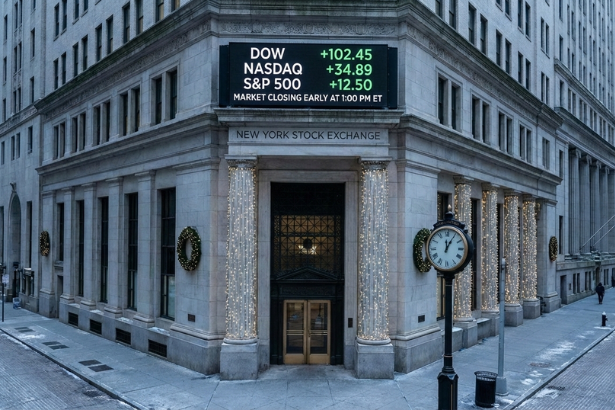
Is the stock market open on Christmas Eve 2025? That question surged across U.S. search engines this week as investors scrambled to figure out whether they could squeeze in last-minute trades before the holiday weekend. The short answer is yes, but only for half a day. The NYSE and Nasdaq both close at 1:00 PM Eastern Time on Wednesday, December 24, 2025, then stay shut completely on Christmas Day itself before reopening Friday, December 26 for normal hours.
The confusion this year stems partly from a presidential order closing federal government offices on both December 24 and 26, which initially made some investors wonder if Wall Street would follow suit. It won’t. Major exchanges including NYSE, Nasdaq, Cboe Global Markets, and Investors’ Exchange all confirmed they’re sticking to their published holiday schedule regardless of what federal buildings do. That means your bank branch might be closed when the stock market is open, creating the kind of logistical headaches that define year-end trading.
Stock Market Christmas Eve 2025 Hours Are Shorter Than You Think
The stock market opens at its normal 9:30 AM Eastern Time on Christmas Eve, but closes at 1:00 PM instead of the usual 4:00 PM. That gives you exactly 3.5 hours to execute any trades you’ve been delaying, rebalance portfolios, harvest tax losses, or panic about positions you should have closed earlier.
Options traders get a 15-minute grace period. Eligible options markets close at 1:15 PM Eastern on Christmas Eve, giving those dealing with contracts a tiny bit more time to manage expiring positions or roll strategies forward. That extra quarter hour matters more than it sounds when you’re racing to close complex option spreads before the holiday shutdown.
Bond markets follow a slightly different schedule. SIFMA (the Securities Industry and Financial Markets Association) recommends that fixed-income markets close at 2:00 PM Eastern on Christmas Eve, a full hour later than equities. That creates a weird window where stocks have stopped trading but bonds continue, requiring traders who work across both markets to juggle different closing times.
After-hours trading sessions on Christmas Eve are limited or completely unavailable depending on your broker. Most platforms either shut down after-hours entirely or restrict what you can trade. Don’t count on being able to execute trades once the 1:00 PM bell rings. You’re done for the day whether you like it or not.
The Tech Marketet has covered extensively how shortened trading sessions create liquidity traps that amplify volatility when fewer market participants show up and normal price discovery mechanisms break down.
Christmas Day Shuts Everything Down Completely
Thursday, December 25, 2025, is a full market holiday. NYSE is closed. Nasdaq is closed. Bond markets are closed. Options markets are closed. Everything financial shuts down for Christmas Day in observance of the federal holiday.
That complete closure matters for settlement timing. Any trades you execute on Christmas Eve won’t settle until December 26 at the earliest, assuming standard T+1 (trade date plus one business day) settlement rules. If you need funds available immediately after Christmas, you needed to complete those transactions well before Christmas Eve’s early close.
Prediction markets like Kalshi and Polymarket remain open throughout the holiday for anyone desperate to scratch their trading itch. But those platforms trade political outcomes, sports events, and entertainment predictions rather than traditional stocks and bonds. If you absolutely must trade something on Christmas Day, your options are betting markets or heading to your local sportsbook for the three NFL games Netflix is streaming.
Speaking of which, the Washington Commanders play the Dallas Cowboys at 1:00 PM Eastern, and the Minnesota Vikings face the Detroit Lions at 4:30 PM Eastern on Christmas Day. Both games happen while the stock market remains dark. Netflix grabbed exclusive rights to Christmas Day NFL games, so you’ll need a subscription to watch rather than traditional broadcast television.
Markets Reopen December 26 Despite Federal Office Closures
Here’s where 2025 gets confusing. The stock market is open for normal hours (9:30 AM to 4:00 PM Eastern) on Friday, December 26, 2025. But federal government offices remain closed that day under a separate presidential order.
Major exchanges announced on December 18, 2025, that they would disregard the federal closure and stick to their published trading calendar. That means the NYSE, Nasdaq, and other exchanges operate normally on December 26 even though your local post office, Social Security office, and federal courthouses are shut.
The disconnect between government closures and market operations creates practical problems. Many banks follow federal holiday schedules, meaning your bank might be closed December 26 even though the stock market is trading. Wire transfers, check deposits, and other banking operations that normally support trading activity might be unavailable or delayed.
International markets add another layer of complexity. Many global exchanges have their own Christmas and Boxing Day schedules that don’t align with U.S. markets. European exchanges might be closed December 26 for Boxing Day even though U.S. markets are open. Asian markets follow entirely different calendars. Currency trading and cross-border transactions get messy when major markets operate on conflicting schedules.
Why Christmas Eve Trading Feels Different From Normal Days
Christmas Eve trading volumes are notoriously thin. Institutional traders take the day off. Hedge funds run skeleton crews. Retail investors focus on holiday preparations instead of market moves. The result is a market that’s technically open but operating with far fewer participants than a typical Wednesday.
Lower liquidity creates wider bid-ask spreads. The difference between what buyers are willing to pay and what sellers are asking grows when fewer traders are active. That means you pay more to enter positions and receive less to exit them. The market effectively charges a premium for the inconvenience of trading on Christmas Eve.
Price movements become more volatile during thin sessions. A single large order that would barely move markets on a normal day can cause outsized swings when volume is light. News events that would generate measured reactions during full liquidity can trigger exaggerated moves when most traders have already logged off for the holiday.
Market depth deteriorates throughout the shortened session. The early hours from 9:30 AM to 11:00 AM typically see the most activity as traders who absolutely need to execute get their orders in. By noon, volumes drop off considerably. The final hour before the 1:00 PM close often resembles weekend futures trading more than typical weekday equity markets.
Stop-loss clusters get hit more easily during thin trading. Automated orders sitting at specific price levels trigger more readily when there isn’t enough depth to absorb selling pressure. That can create cascading effects where one stop-loss triggers another, causing temporary price dislocations that reverse once normal trading resumes.
ETF rebalancing flows become more visible during low-volume sessions. The mechanical buying and selling that happens continuously in normal markets stands out more when fewer traders are active. You might see seemingly random price movements in specific stocks or sectors that reflect ETF creation and redemption activity rather than fundamental news.
S&P 500 index levels can appear deceptively calm while individual stocks fluctuate wildly. The headline number might not move much, but underlying components could be experiencing unusual volatility due to thin liquidity and concentrated trading interest. Relying on index movements alone during Christmas Eve misses the chaos happening at the individual security level.
New Year’s Eve and New Year’s Day Follow Different Rules
Just when you think you’ve figured out the holiday schedule, New Year’s throws a curveball. New Year’s Eve (Wednesday, December 31, 2025) is a regular full trading day for stocks. The NYSE and Nasdaq operate normal 9:30 AM to 4:00 PM hours.
But bond markets close early at 2:00 PM Eastern on New Year’s Eve. So once again, you have a situation where equities trade for two more hours after fixed-income markets shut down. Traders working across asset classes deal with staggered closures that complicate portfolio management.
New Year’s Day (Thursday, January 1, 2026) is a full market holiday. Everything closes for the federal New Year’s Day observance. Markets reopen Friday, January 2, 2026, for normal hours assuming no other complications arise.
The combination of Christmas Eve early close, Christmas Day closure, regular hours December 26, regular hours December 31, and New Year’s Day closure creates a choppy week where normal trading rhythms don’t exist. Institutional strategies get disrupted. Retail investors struggle to maintain discipline. Everyone’s just trying to get through year-end without making costly mistakes.
What Smart Investors Do on Christmas Eve
Professional traders treat Christmas Eve as a liquidity event, not just a calendar event. They adjust strategies specifically for the unusual conditions rather than trading like it’s a normal Wednesday.
Use limit orders instead of market orders. Market orders guarantee execution but not price. During thin sessions, that price might be much worse than you expected. Limit orders specify the maximum you’ll pay or minimum you’ll accept, protecting against unfavorable fills caused by temporary liquidity gaps.
Reduce position sizes below normal levels. If you typically trade 100-share lots, consider 25 or 50 shares on Christmas Eve. Smaller orders fill more easily in thin markets and limit your exposure if prices move against you unexpectedly.
Avoid building new exposure late in the session. Opening positions after noon on Christmas Eve means you’re effectively holding over a long weekend with minimal ability to adjust if news breaks. Most traders close or reduce positions rather than expanding them as the early close approaches.
Confirm your broker’s specific deadlines. Some platforms impose cutoffs earlier than the exchange’s official 1:00 PM close. Your broker might require orders submitted by 12:30 PM or 12:45 PM to guarantee execution before the holiday shutdown. Check platform-specific rules rather than assuming you have until 1:00 PM.
Remember that settlement timing extends over the holiday. Trades executed Christmas Eve settle December 26 under normal T+1 rules. But if your broker is closed December 26 following the federal holiday schedule, settlement complications can arise. Verify your broker’s operational status for the entire week to avoid surprises.
Be mindful of options expiration mechanics during holiday weeks. If you hold options expiring between Christmas and New Year’s, make sure you understand exercise procedures and timing given the modified market schedules. Automatic exercise at expiration might happen on different days than you expect.
The Historical Pattern Christmas Eve Trading Follows
Christmas Eve trading behavior shows consistent patterns across years. Volume typically runs 30 to 50 percent below normal Wednesday averages. The S&P 500 shows slightly positive average returns on Christmas Eve, though the statistics aren’t reliable given thin liquidity and small sample sizes.
The Santa Claus Rally, a phenomenon where stocks supposedly rise during the final week of December and first two trading days of January, gets disrupted by Christmas falling midweek in 2025. The traditional rally window spans December 24 through January 2, but this year’s schedule fragments that period with holiday closures and shortened sessions that make pattern analysis nearly meaningless.
Volatility as measured by the VIX typically stays subdued Christmas Eve unless major news breaks. Most years see quiet, range-bound trading where prices drift slightly rather than making directional moves. But outlier years do happen, usually when unexpected geopolitical or economic news emerges during the holiday period.
International market movements during U.S. holidays sometimes predict how U.S. stocks will trade once they reopen. If European or Asian markets move significantly December 24 or 25, those moves often influence U.S. opening prices December 26. Watching overnight futures and international markets provides clues about what to expect when U.S. exchanges resume.
The period between Christmas and New Year’s historically shows reduced volume and directionless trading as institutional money stays on the sidelines. January effect buying doesn’t typically start until after New Year’s Day when funds begin implementing new calendar year strategies. The dead zone between holidays often sees stocks drift without strong conviction moves in either direction.
The Shift Toward Year-Round Trading That Never Quite Happens
Stock market holidays represent one of the last areas where finance still stops completely. Futures markets trade almost continuously through holidays. Currency markets operate 24/7 except weekends. Cryptocurrency exchanges never close at all. Yet equity markets maintain traditional holiday schedules that shut down trading entirely for Christmas Day, New Year’s Day, and eight other federal holidays annually.
Proposals for extended trading hours and reduced holiday closures surface periodically but face resistance from market participants, regulators, and exchanges themselves. The argument for 24/7 equity markets focuses on matching global investment flows and providing constant liquidity. The argument against emphasizes that mandatory breaks prevent burnout, allow system maintenance, and provide coordination points when all participants are offline simultaneously.
The Texas Stock Exchange, a proposed competitor to NYSE and Nasdaq, hasn’t announced whether it will follow traditional holiday schedules or attempt to differentiate itself through extended hours. If a major exchange eventually operates through holidays, it could force incumbent exchanges to reconsider their schedules to remain competitive. But for 2025, business as usual prevails.
Understanding why Christmas Eve matters for investors requires recognizing that markets aren’t just abstract numbers on screens. They’re human systems that reflect the reality that even traders and algorithms need breaks. The shortened session and complete Christmas Day closure acknowledge that trying to maintain full operations during major holidays creates more problems than it solves, even as technology makes continuous trading increasingly feasible.
Organizations watching market structure evolution will analyze whether holiday closures represent outdated traditions that could be eliminated or essential pressure valves that prevent the 24/7 trading cycles from grinding participants into exhaustion.
Quick Answers to What Everyone’s Asking
Is the stock market open on Christmas Eve every year?
Not necessarily. It depends on what day of the week Christmas falls. When Christmas Eve lands on a weekday, markets typically open with an early close at 1:00 PM Eastern. When Christmas Eve falls on a Saturday or Sunday, markets aren’t affected. The NYSE publishes holiday schedules years in advance showing exactly when early closes will occur.
What time does the stock market close on Christmas Eve 2025?
Major U.S. stock exchanges (NYSE and Nasdaq) close at 1:00 PM Eastern Time on Wednesday, December 24, 2025. Options markets close at 1:15 PM Eastern, giving options traders 15 extra minutes. Bond markets close at 2:00 PM Eastern per SIFMA recommendations, an hour later than equities.
Is the bond market open on Christmas Eve?
Yes, but with an early close at 2:00 PM Eastern Time on December 24, 2025. That creates a one-hour window where bond markets are still trading after stock markets have already closed. This timing difference matters for traders managing both equity and fixed-income positions.
Is after-hours trading available on Christmas Eve?
After-hours sessions are typically limited or unavailable on Christmas Eve depending on your specific broker. Most platforms either shut down after-hours completely or severely restrict what can be traded. Don’t count on executing trades after the 1:00 PM close. If you need to trade, do it during regular hours.
Are international markets open on Christmas Eve?
It varies by country and exchange. Many European markets also close early or completely on December 24. Asian markets follow their own holiday calendars that don’t necessarily align with U.S. Christmas schedules. If you trade international securities, check specific exchange calendars rather than assuming they match U.S. hours.
Why does the stock market close early on Christmas Eve?
Early closures on days before major holidays have been standard practice for decades. They allow market participants to travel, prepare for holidays, and spend time with families while minimizing the operational burden of maintaining full trading operations when participation would be extremely low anyway. It’s tradition as much as practical necessity.
Will the stock market be open December 26, 2025?
Yes. The NYSE and Nasdaq will operate normal hours (9:30 AM to 4:00 PM Eastern) on Friday, December 26, 2025, even though federal government offices are closed that day. Major exchanges confirmed they’re sticking to their published schedules regardless of the federal office closures.
What about New Year’s Eve trading hours?
New Year’s Eve (December 31, 2025) is a regular full trading day for stocks. The NYSE and Nasdaq operate normal hours (9:30 AM to 4:00 PM Eastern). However, bond markets close early at 2:00 PM Eastern on New Year’s Eve. New Year’s Day (January 1, 2026) is a complete market holiday with all exchanges closed.
Sources :
- USA Today: Stock market open closed Christmas Day 2025
- Akron Beacon Journal: Christmas holiday changes to Wall Street trading
- Detroit Free Press: Dow Jones Nasdaq NYSE stocks closed Christmas New Years


