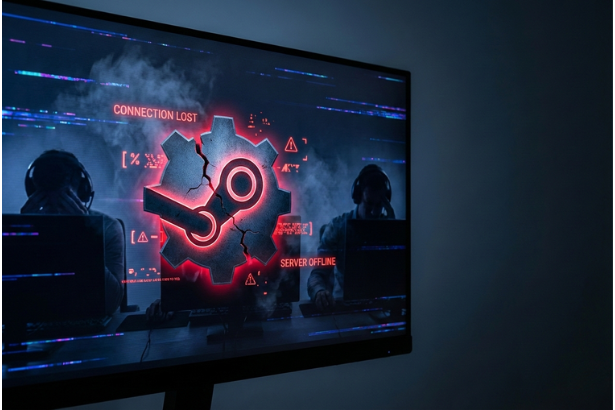
Is Steam down just crashed Google Trends Tuesday afternoon after more than 41,000 users reported widespread connection failures on Valve’s gaming platform, marking the second major outage in under 24 hours. Downdetector logged a massive spike in reports around 3:30 PM Pacific Time, with 81 percent of complaints centering on server connection issues that prevented gamers from logging in, accessing their libraries, or playing online multiplayer titles.
The timing couldn’t be worse. Steam hosts over 24 million concurrent players at peak times, making it the world’s largest PC gaming distribution platform. When Steam goes down, millions of gamers worldwide lose access simultaneously to purchased games, cloud saves, Workshop content, community features, and the Steam Store itself. This latest disruption came less than 24 hours after Monday evening’s widespread failure at 7:59 PM EST that left players unable to access accounts for hours.
Steam Suffered Two Major Outages Within 24 Hours
The first outage hit Monday, December 15 at approximately 7:59 PM EST. Users across North America and Europe reported sudden disconnections, inability to log in, and E502 “Bad Gateway” errors indicating Valve’s servers weren’t responding properly. That incident lasted several hours before services gradually restored throughout the evening.
Then Tuesday, December 16 brought an encore performance. By mid-afternoon Pacific Time, Downdetector showed reports surging from baseline levels to over 41,000 complaints within minutes. The pattern suggested a platform-wide infrastructure failure rather than isolated regional problems or scheduled maintenance.
GV Wire confirmed that most users experiencing problems cited server connection difficulties specifically, not client-side crashes or local network issues. That distinction matters because it meant troubleshooting steps like restarting routers, clearing caches, or reinstalling Steam wouldn’t help. The problem existed entirely on Valve’s end.
The outage lasted approximately 50 to 53 minutes at its most intense phase, according to monitoring sites tracking report volumes. Services began returning gradually late Tuesday afternoon, with some users regaining access while others remained locked out. By Tuesday evening Pacific Time, most reports indicated Steam had stabilized, though intermittent connection issues persisted for some players.
Valve followed its standard playbook: complete silence. The company issued no public statement explaining what caused either outage, what recovery steps they took, or whether users should expect additional disruptions. That communication vacuum forced gamers to rely on third-party monitoring services and community forums for information about service status.
What E502 Errors Mean When Steam Goes Down
The E502 error code that plagued Tuesday’s outage tells a specific technical story. HTTP 502 “Bad Gateway” errors occur when a server acting as a gateway or proxy receives an invalid response from an upstream server. In Steam’s architecture, that typically means the authentication servers, content delivery systems, or backend databases failed to respond correctly to user requests.
Think of it this way: when you try logging into Steam, your client contacts Valve’s front-end servers, which then query backend systems to verify your credentials, retrieve your library, and load your profile. If those backend systems timeout, crash, or get overwhelmed by traffic, the front-end servers return E502 errors because they can’t complete your request.
E502 errors differ from E500 “Internal Server Errors” that indicate something broke on Valve’s end without external causes. The “Bad Gateway” designation specifically points to communication failures between different parts of Steam’s infrastructure. That suggests cascading problems where one system’s failure creates ripple effects throughout the platform.
Users reported the E502 L3 variant specifically during this outage. The “L3” designation likely refers to a specific layer or server cluster within Valve’s architecture, though the company has never publicly documented their error code taxonomy. Whatever L3 represents, its failure Tuesday afternoon brought down functionality for tens of thousands of users simultaneously.
The Tech Marketet has covered extensively how centralized gaming platforms create single points of failure where infrastructure problems cascade across millions of users despite redundancy systems.
Why Steam Outages Hit Harder Than Other Platform Failures
Steam’s unique position in PC gaming creates disproportionate impact when services fail. Unlike console gaming where players can still access single-player content during network outages, Steam’s DRM integration means many games won’t launch at all without authenticating through Valve’s servers.
Even games that support “offline mode” require Steam to be running, and enabling offline mode in advance. Users who weren’t already signed in when Tuesday’s outage struck couldn’t authenticate to enter offline mode, leaving them completely locked out of their entire game libraries despite having purchased hundreds or thousands of dollars in content.
Cloud saves compound the problem. Steam automatically syncs saved game progress to Valve’s servers, meaning players who haven’t manually backed up local saves can’t access their game progress during extended outages. Competitive multiplayer titles, live-service games, and always-online content become completely unplayable regardless of whether servers supporting those specific games remain operational.
The Workshop system creates additional dependencies. Mods, user-generated content, and community features all rely on Steam’s infrastructure. When that fails, modders can’t update content, players can’t download new mods, and community discussions freeze. Developers using Workshop integration for technical support or beta testing lose those channels entirely.
The Steam Store outages affect both consumers and developers. Gamers can’t purchase or download new titles. Developers and publishers lose sales during downtime, particularly painful during high-traffic periods like seasonal sales, major game launches, or competitive esports events. Indie developers relying on launch day momentum suffer disproportionately when outages coincide with their release windows.
How Tuesday’s Pattern Matched Historical Steam Failures
Steam outages aren’t unprecedented. The platform experiences brief disruptions several times per year, often during Tuesday maintenance windows when Valve pushes updates to backend systems. Major sales events like Steam Summer Sale or Winter Sale typically trigger traffic spikes that overwhelm capacity despite Valve’s preparation.
What made this week unusual: back-to-back failures within 24 hours suggest systemic problems rather than routine maintenance gone wrong or predictable traffic surges. Either Valve’s infrastructure sustained damage requiring multiple repair attempts, or Monday’s fix created secondary problems that manifested Tuesday.
Historical comparison offers context. October 2025 saw a Steam outage lasting approximately one hour. September 2025 experienced a weeklong period of elevated user reports suggesting degraded service rather than total failure. The pattern shows Steam typically recovers from outages quickly, but doesn’t always fix underlying causes that resurface days or weeks later.
PlayStation Network and Xbox Live have faced similar challenges with centralized authentication creating platform-wide vulnerabilities. Sony’s 2011 PSN outage lasted 23 days after hackers compromised the network. Microsoft’s Xbox Live experienced Christmas Day outages in 2014 and 2021 that prevented players from accessing new consoles received as gifts. Steam’s outages pale in comparison to those disasters, but the underlying architectural weakness remains identical: centralization creates systemic risk.
The timing raised speculation about intentional attacks. DDoS attacks targeting gaming platforms spike during school holidays when attackers have more free time and victim inconvenience reaches maximum levels. However, neither outage matched typical DDoS patterns showing gradual degradation as attackers ramp up traffic. The sudden, complete failures suggested infrastructure problems rather than external attacks.
What Users Can’t Do While Steam Is Down
The outage’s impact extended beyond just “can’t play games.” The interruption affected multiple interconnected systems that gamers rely on daily.
Game launches failed completely for DRM-protected titles requiring online authentication. Even single-player games with zero online components wouldn’t start if Steam couldn’t verify ownership. That meant gamers with hours of free time Tuesday afternoon couldn’t access content they’d legally purchased and downloaded.
Friends lists and chat disappeared. Steam’s social features integrate into many games, allowing players to coordinate multiplayer sessions, share screenshots, and voice chat through the platform. The outage severed those connections mid-conversation, disrupting gaming communities organized through Steam rather than Discord or other third-party services.
Workshop content became inaccessible. Games like Cities: Skylines, Skyrim, and Garry’s Mod rely heavily on mod ecosystems hosted through Steam Workshop. Players couldn’t browse new mods, download updates, or enable previously subscribed content during the outage. That essentially broke modded games requiring workshop integration.
Cloud saves couldn’t sync. Players finishing game sessions during the outage risked losing progress if their local saves didn’t upload before Steam crashed. Switching between multiple PCs, a common pattern for gamers using both desktop and laptop systems, became impossible without current cloud saves.
Store purchases and downloads halted. The Steam Store remained inaccessible, preventing both browsing and transactions. Users who’d planned to purchase games during Tuesday afternoon found themselves unable to complete transactions. Developers counting on launch-day sales momentum watched potential revenue evaporate during the outage window.
Why Valve Stays Silent During Steam Outages
Valve’s communication strategy during outages follows a consistent pattern: say nothing publicly. No Twitter updates. No status page announcements. No estimated restoration times. That approach frustrates users desperate for information about when services will return.
The strategy has logic behind it. Premature communication commits Valve to timelines they might not meet. If they announce “services will restore in two hours” and it takes three, that creates additional backlash. Staying silent until services actually return avoids setting expectations they can’t guarantee.
It also limits legal exposure. Public acknowledgments of outages create documentation that could support damage claims from developers who lost sales, competitive players who missed tournaments, or enterprises using Steam for legitimate business purposes. Silence makes those claims harder to substantiate.
The approach assumes users will figure things out through third-party sources. Sites like Downdetector, IsDown, SteamStat.us, and Outage.Report aggregate user reports and provide real-time status tracking without Valve needing to maintain official communications. Community forums, Reddit, and social media fill the information vacuum organically.
But silence has costs too. Users spend time troubleshooting local systems unnecessarily when clear communication would indicate the problem exists on Valve’s end. Support tickets flood in from confused users seeking answers, creating workload for customer service teams. Trust erodes when a platform provider seems indifferent to major service disruptions affecting millions.
What Users Should Do When Steam Goes Down
The outage revealed how unprepared many Steam users are for service disruptions. Simple preparation steps would mitigate much of the frustration when inevitable outages occur.
Enable offline mode before you need it. Steam requires online authentication to enter offline mode, meaning you can’t enable it during an outage. Enabling offline mode while services work allows playing single-player games during future disruptions. Settings > Account > Beta participation > Steam Beta Update > Enable offline mode.
Back up local saves manually. Don’t rely solely on Steam Cloud for important game progress. Navigate to Steam’s userdata folder and copy save files to external storage or cloud backup services independent of Steam. That protects against both outages and cloud save corruption.
Monitor third-party status sites. Bookmark Downdetector’s Steam page, IsDown’s Steam tracker, or SteamStat.us for real-time outage information. These aggregate user reports faster than Valve provides official updates, helping you distinguish between local problems and platform-wide failures.
Restart Steam client and router as first troubleshooting step. While Tuesday’s outage existed entirely on Valve’s servers, many Steam issues do stem from local network configuration or client cache corruption. Restarting clears temporary glitches without requiring deep technical knowledge.
Clear Steam download cache if problems persist. Steam > Settings > Downloads > Clear Download Cache removes corrupted temporary files that sometimes prevent proper authentication. This doesn’t help during server-side outages but resolves many client-side issues.
Verify game files for title-specific problems. Right-click game in library > Properties > Installed Files > Verify integrity of game files. This checks for corrupted or missing files that might prevent launching even when Steam works correctly.
Change DNS settings to Google’s public DNS (8.8.8.8) or Cloudflare’s (1.1.1.1). Occasionally ISP DNS servers fail to resolve Steam’s domain names correctly. Alternative DNS providers often work when default settings don’t.
None of these steps helped during Tuesday’s outage because the problem existed entirely on Valve’s servers. But they help diagnose whether you’re experiencing platform-wide issues or isolated local problems requiring different solutions.
The Shift Steam Users Are Demanding
Steam suffered two major outages in 24 hours, affecting tens of thousands of users each time. Valve said nothing publicly about causes, fixes, or prevention measures for future disruptions. That pattern has become so routine that gamers don’t even expect communication anymore.
The broader gaming industry is watching whether Valve’s centralized monopoly remains sustainable as player expectations for reliability increase. Cloud gaming services like GeForce NOW and Xbox Cloud Gaming offer alternatives that distribute infrastructure risk differently. Epic Games Store, GOG, and other competitors position themselves as more reliable options.
Understanding why these outages matter requires recognizing that Steam isn’t just a store—it’s the infrastructure layer for most PC gaming. When Steam fails, millions of gamers lose access to content they legally purchased. That dependency creates responsibility Valve doesn’t always acknowledge through transparent communication and robust redundancy.
Organizations building digital distribution platforms will study whether Steam’s silent crisis management approach remains viable as user tolerance for disruption decreases and competitors offer more reliable alternatives with better communication during problems.
Quick Answers to What Everyone’s Asking
Is Steam down right now?
As of Tuesday evening Pacific Time, December 16, Steam services have largely restored after a major outage affecting 41,000+ users. However, monitoring sites show intermittent connection issues persisting for some players. Check Downdetector or SteamStat.us for real-time status before troubleshooting local systems. If reports show under 100 complaints, the problem likely exists on your end rather than Valve’s servers.
What caused the Steam outage?
Valve has not publicly explained what caused either Monday evening’s or Tuesday afternoon’s outages. The E502 “Bad Gateway” errors suggest communication failures between Steam’s front-end servers and backend authentication/database systems. The back-to-back timing indicates either incomplete fixes from Monday’s incident or cascading problems where one system’s failure created ripple effects across the platform.
How long did the Steam outage last?
Tuesday’s outage lasted approximately 50 to 53 minutes at peak intensity from roughly 3:30 PM PT until services began gradually restoring late afternoon. However, some users experienced extended connection problems beyond the main outage window. Monday’s outage lasted several hours from 7:59 PM EST before stabilizing. Total recovery times vary by region and individual network configurations.
What is the E502 L3 error on Steam?
E502 is an HTTP “Bad Gateway” error indicating Valve’s front-end servers received invalid responses from backend systems. The “L3” designation likely refers to a specific server layer or cluster in Steam’s architecture, though Valve doesn’t publicly document error code meanings. This error appears during infrastructure failures affecting authentication, cloud saves, Workshop, or store services.
Can I play games offline during Steam outages?
Only if you enabled offline mode before the outage occurred. Steam requires online authentication to enter offline mode, creating a catch-22 during unexpected downtime. Games with DRM integration won’t launch without Steam authentication. To prepare for future outages, enable offline mode while services work: Settings > Account > Beta participation > Enable offline mode.
How can I check if Steam is down or if it’s my connection?
Visit Downdetector.com/status/steam, IsDown.app/status/steam, or SteamStat.us for real-time outage tracking. If thousands of users report problems simultaneously, it’s a platform-wide outage. If reports show normal baseline levels (under 100), troubleshoot your local network. Try accessing Steam through your web browser at store.steampowered.com—if that loads but the client doesn’t, restart your router and Steam client.
Did Steam outages affect all games or just online titles?
The outages affected all Steam games requiring authentication, including single-player titles with DRM. Even offline games won’t launch if Steam can’t verify ownership when the client starts. Only games previously launched with offline mode enabled remained playable. Cloud saves couldn’t sync, Workshop content became inaccessible, and multiplayer features failed completely regardless of individual game server status.
Will Steam compensate users for downtime?
No. Steam’s Subscriber Agreement explicitly states Valve isn’t liable for service interruptions. The company doesn’t compensate for outages, refund pro-rated subscription costs (Steam doesn’t have subscriptions), or extend sale deadlines affected by downtime. Users lose access to purchased content temporarily but have no recourse for time-based losses like missed multiplayer events or limited-time sales.
Sources:
- GV Wire: Steam down for thousands Tuesday, Downdetector reports
- Hindustan Times: Steam Workshop community outage coverage
- LiveMint: Steam server faces second outage in 24 hours