Introduction
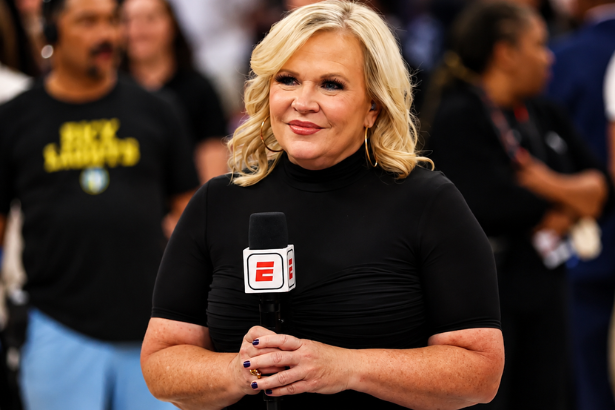
The Holly Rowe Caitlin Clark story has become the latest example of how quickly a WNBA moment can move from the arena to social media and then into the news cycle. Rowe became visibly emotional before the Indiana Fever’s August 18 game against the Toronto Tempo, filming herself as she took in a sold-out Scotiabank Arena filled with roughly 19,300 fans.
Rowe’s message was about the growth of women’s basketball. But online reaction quickly shifted toward a different question: why did she celebrate the massive crowd without mentioning Caitlin Clark, the Indiana Fever star whose presence has become a major driver of WNBA attention?
That disagreement explains the sharp Google Trends spike shown in the supplied screenshot. Searches for “holly rowe” surged, with the trend breakdown specifically connecting the search to Caitlin Clark. News results then focused on Rowe’s emotional reaction, the size of the Toronto crowd and accusations that Clark had been left out of the story.
The reality is more nuanced than the viral headlines suggest.
Background and Context
Holly Rowe has spent decades covering women’s basketball.
She joined ESPN full time in 1998 and has worked across college sports, the WNBA and other major sporting events. The Sun described her as one of ESPN’s longest-serving reporters, while noting her extensive work across college basketball, college football and professional sports.
That history matters because Rowe was not reacting to an ordinary regular-season crowd.
Toronto’s WNBA expansion represents a significant moment for women’s basketball in Canada. The Toronto Tempo entered the league in 2026 alongside the Portland Fire, following the Golden State Valkyries’ arrival the previous season. More expansion teams are expected in the coming years.
For Rowe, the sight of approximately 19,300 people gathering to watch women’s basketball was clearly emotional.
In her Instagram video before the game, she struggled to speak without crying and pointed the camera toward the packed arena. She said she was proud of what had been built and emphasized the significance of seeing that many people attend a women’s basketball game in Canada.
That was the original story.
The Caitlin Clark angle came afterward.
Latest Update or News Breakdown
Holly Rowe’s emotional reaction
Rowe’s video was filmed before the Fever and Tempo tipped off.
She described herself as trying to work the game but becoming overwhelmed by the atmosphere. She highlighted the approximately 19,300 fans expected inside Scotiabank Arena and described herself as proud of the growth of women’s basketball.
The emotional response was quickly embraced by many fans.
Some praised Rowe for her years of involvement with women’s sports and argued that she had earned the right to appreciate a moment that represented the growth of the league she has covered for so long. The Sun reported several supportive reactions from fans who viewed Rowe’s emotion as genuine and understandable.
The story then took another turn.
Why Caitlin Clark entered the conversation
The Indiana Fever were in Toronto, and Caitlin Clark was playing her first WNBA game in Canada.
That detail became central to the criticism.
The Spun reported that some fans believed Rowe had “snubbed” Clark because her emotional video celebrated the crowd without mentioning the Fever star. Critics argued that Clark’s popularity was an important reason the game drew such a large audience.
The criticism was not universal.
The Spun itself offered a more measured assessment, noting that many fans may indeed have attended specifically to see Clark while also arguing that Toronto’s accomplishment in building interest around women’s basketball deserved recognition.
That distinction is important.
There is a difference between saying “Caitlin Clark was an important reason people attended” and saying “Caitlin Clark was the only reason people attended.”
The available reporting supports the first statement far more comfortably than the second.
The Caitlin Clark effect
The OutKick report took a stronger position, arguing that Clark’s presence deserved more context in Rowe’s celebration.
It noted that the Fever’s arrival in Toronto prompted the game to be moved to the larger Scotiabank Arena to accommodate demand. The report characterized this as part of what it calls the “Caitlin Clark effect,” pointing to similar attendance boosts around the league.
That argument has a straightforward basis.
Clark is one of the WNBA’s most recognizable players, and her games routinely attract unusual levels of attention. The Fever themselves have become one of the league’s most watched teams.
But the Toronto crowd was also evidence of something broader.
The WNBA had successfully created an expansion franchise in a major Canadian market, and thousands of fans showed up for a professional women’s basketball game.
Both things can be true at the same time.
The game itself
Once the game began, Indiana took care of business.
The Fever defeated Toronto 101-95, extending their winning streak to five games. Kelsey Mitchell scored 29 points, while Clark added 24.
The result gave Indiana a 24-12 record at the time, according to The Spun. Toronto, meanwhile, fell to 10-25 and lost again the following night against Washington.
So the night ultimately contained three separate stories:
- Toronto hosted an enormous crowd for women’s basketball.
- Holly Rowe became emotional while witnessing it.
- Caitlin Clark and the Fever won another game while online debate erupted around Rowe’s comments.
That combination was almost guaranteed to generate a social-media afterlife.
Expert Insights or Analysis
The most important part of the Holly Rowe Caitlin Clark discussion is separating what happened from what people inferred.
What happened is clear.
Rowe filmed an emotional reaction to a packed Toronto arena. She celebrated the growth of women’s basketball and specifically pointed to the size of the crowd.
What happened next is interpretation.
Some fans interpreted the absence of Clark’s name as intentional. The Spun documented several social-media posts making exactly that accusation.
But the available reporting does not establish that Rowe deliberately tried to diminish Clark.
In fact, the reporting provides evidence pointing in the opposite direction. The Spun notes that Rowe has been a supporter of Clark and women’s basketball generally.
That makes the “snub” framing difficult to treat as an established fact.
A more defensible interpretation is that Rowe was celebrating the league itself.
The packed arena represented a larger structural change. Toronto now has a professional women’s basketball franchise. Thousands of Canadians were watching in person. The WNBA is expanding into new markets. And the league is attracting attention well beyond its traditional American footprint.
Clark’s influence can be part of that story without becoming the entire story.
Why the debate became so intense
The answer lies in how closely Caitlin Clark is associated with the WNBA’s current growth narrative.
For many fans, Clark is the most visible symbol of the league’s recent surge in attention. Her arrival has coincided with increased media interest, major television audiences, sold-out games and a much larger online conversation around women’s basketball.
That means any discussion of a major WNBA attendance event can quickly become a debate about Clark.
The Toronto game demonstrates the upside and downside of that dynamic.
Clark can bring new eyes to the league, but her enormous profile can also overshadow the accomplishments of expansion teams, veteran players and the broader ecosystem that makes the league work.
The best analysis does not require choosing one side.
Broader Implications
The WNBA’s growth is becoming impossible to ignore
The Toronto crowd was significant regardless of which players drove individual ticket purchases.
A crowd of roughly 19,300 for a WNBA game in a newly established Canadian market represents meaningful demand. Rowe’s emotional reaction was rooted in that bigger development.
Toronto’s expansion is also part of a wider growth strategy.
The league now has the Golden State Valkyries, Toronto Tempo and Portland Fire as recent expansion franchises, with additional markets planned. The Sun reported that Cleveland, Detroit and Philadelphia are among the cities expected to receive teams in the coming seasons.
That changes the economics of the league.
More teams mean more markets, more arenas, more local media opportunities and more chances for players to develop regional fan bases.
But star power still matters
Expansion alone does not explain every major crowd.
The Indiana Fever were in Toronto. Caitlin Clark was playing. Sophie Cunningham was also making her first appearance in the city, according to the OutKick report.
The matchup therefore had an established fan draw.
This is one of the WNBA’s most interesting business questions: can the league use superstar attention to build lasting local interest?
Toronto provides an intriguing test.
Clark may help fill the building the first time. The long-term goal is for Toronto fans to return because they have become Tempo fans.
That is how a visiting-star phenomenon turns into a sustainable sports market.
Social media is changing sports journalism
The Holly Rowe Caitlin Clark controversy also demonstrates how sports journalism is increasingly shaped by social media interpretation.
Rowe’s original video was relatively straightforward. It showed a reporter becoming emotional about a large crowd.
The controversy emerged when fans began examining what she did not say.
That is a very different form of media criticism.
The question is no longer simply “What did the reporter say?”
It becomes “Who did the reporter mention?” “Who did she leave out?” “What did she imply?” and “What does that omission mean?”
A short video can therefore generate an entirely separate news cycle based on interpretation.
For readers interested in the intersection of media, technology and digital culture, The Tech Marketer can provide a useful internal destination for related coverage.
Google Trends shows the attention spike
The supplied Google Trends screenshot offers a useful visual representation of this process.
Search interest for “holly rowe” rises sharply around the news cycle, peaks and then falls before beginning to recover.
The trend breakdown shown in the screenshot connects the search directly to “holly rowe caitlin clark.”
That does not prove what people believed.
Google Trends cannot distinguish supporters from critics. Someone searching Holly Rowe could be looking for the original video, defending her, criticizing her or simply trying to understand why she is trending.
What it does show is that the conversation became large enough to generate significant search interest.
That is valuable information in itself.
Related History or Comparable Technologies
The current debate fits into a longer history of women’s basketball moving from niche sports coverage toward mainstream sports culture.
For decades, the WNBA struggled with the familiar challenges facing women’s professional sports: limited media exposure, smaller venues, fewer broadcast windows and lower commercial visibility.
The expansion era is different.
The league is increasingly being discussed through the same digital mechanisms that drive attention in men’s sports.
Players become viral subjects.
Clips circulate independently of games.
Fans build online communities around individual stars.
Arena capacity becomes a news story.
And a reporter’s 60-second emotional video can become a headline.
Caitlin Clark sits at the center of that transformation, but she is not operating alone.
Players such as Paige Bueckers, Angel Reese, A’ja Wilson and others contribute to a broader ecosystem of star power.
Toronto’s expansion is another piece.
The goal is not simply to produce more games. It is to create more local basketball cultures.
That is the real significance behind Rowe’s emotion.
What Happens Next
The immediate controversy surrounding Rowe will probably fade faster than the underlying WNBA growth story.
The more important question is whether Toronto can maintain the momentum generated by its first season.
The Tempo’s 101-95 loss to Indiana was followed by another defeat, a 93-82 loss to the Washington Mystics, according to The Sun. Toronto was listed at 10-25 after the Fever game.
The team’s competitive performance will matter.
But so will the audience.
Can the Tempo consistently draw strong crowds when Clark, the Fever or another major star is not in town?
Can the franchise turn casual fans into season-ticket holders?
Can local players become household names?
Those are the questions that will ultimately determine whether the Toronto experiment becomes a long-term success.
For Caitlin Clark, the next stage will be equally interesting.
Every time she visits a new market, her presence provides a test of the so-called Clark effect.
If arenas continue filling when she arrives, the evidence for her enormous commercial impact becomes stronger.
If teams like Toronto eventually sell out regardless of the opponent, that could be even more important.
It would mean the league has moved from relying on individual stars to building durable franchises.
Conclusion
The Holly Rowe Caitlin Clark story started with tears, not controversy.
Before the Fever faced the Toronto Tempo, Rowe looked around Scotiabank Arena and became emotional at the sight of roughly 19,300 people gathering for women’s basketball. She described herself as proud of what the WNBA had built in Canada.
Then the internet did what it increasingly does.
Fans noticed that Caitlin Clark was not mentioned.
Critics accused Rowe of overlooking the player they believe was central to the crowd’s size. Supporters argued that Rowe was celebrating the broader growth of women’s basketball, not denying Clark’s influence. The Spun ultimately described the reality as somewhere in the middle.
That is probably the fairest conclusion.
Clark’s influence matters.
So does Toronto’s achievement.
The 101-95 Fever victory gave fans another memorable game, but the bigger story was the environment around it. A new WNBA franchise had filled a major Canadian arena, and an experienced basketball journalist was emotional because of what that represented.
The debate over whether Holly Rowe should have mentioned Caitlin Clark will continue to circulate for a while.
The more significant development is happening underneath it.
Women’s basketball is growing, new markets are joining the league and star players are turning individual games into major cultural events.
The Toronto crowd suggests that the WNBA’s next chapter may be about something bigger than any one player.
FAQ
What happened with Holly Rowe and Caitlin Clark?
Holly Rowe became emotional before the Indiana Fever played the Toronto Tempo, celebrating a crowd of approximately 19,300 fans. Some fans later criticized Rowe for not mentioning Caitlin Clark, who was playing her first WNBA game in Canada.
Why is Holly Rowe trending?
Holly Rowe is trending because a video of her crying over the large Toronto crowd went viral. The conversation expanded after some fans accused her of failing to acknowledge Caitlin Clark’s role in drawing attention to the game.
Did Holly Rowe intentionally snub Caitlin Clark?
The supplied reporting does not establish that Rowe intentionally snubbed Clark. The Spun noted that Rowe has been a supporter of Clark and women’s basketball, while also acknowledging that Clark was likely an important attraction for many fans at the game.
How many people attended the Toronto Tempo vs Indiana Fever game?
The reports cited a crowd of approximately 19,300 people at Scotiabank Arena. Rowe specifically highlighted the attendance in her emotional pregame video.
Did Caitlin Clark play against the Toronto Tempo?
Yes. Clark played for Indiana and scored 24 points as the Fever defeated Toronto 101-95. Kelsey Mitchell led Indiana with 29 points.
Why is Caitlin Clark important to the WNBA’s growth?
Clark has become one of the league’s most prominent stars and a major driver of attention around Fever games. The OutKick report argued that her presence helped create demand strong enough for the Toronto game to be moved to the larger Scotiabank Arena.
Is Toronto’s WNBA team new?
Yes. The Toronto Tempo debuted in the WNBA in 2026 alongside the Portland Fire. The expansion followed the Golden State Valkyries’ arrival the previous season.
What does the Toronto crowd mean for the WNBA?
The crowd suggests there is substantial interest in women’s professional basketball in Canada. The long-term test will be whether Toronto can maintain strong attendance beyond games featuring major visiting stars such as Caitlin Clark.
Sources & References
- OutKick: “Longtime ESPN reporter Holly Rowe openly weeps before WNBA game and Caitlin Clark is to blame.” Published August 20, 2026. Read the OutKick report
- The Sun: “Holly Rowe ‘can’t stop crying’ in emotional WNBA moment as ESPN star sits on sidelines at Fever-Tempo.” Published August 20, 2026. Read The Sun report
- The Spun: “Holly Rowe Faces Backlash For Apparent ‘Snubbing’ of Caitlin Clark.” Published August 19, 2026. Read The Spun report