Alphabet’s robotics software moonshot joins Google as distinct entity, gains direct access to Gemini AI models and DeepMind collaboration — CEO Wendy Tan White: “Unlock the promise of physical AI”
Introduction
Google Intrinsic AI robotics strategy is entering a new phase as Google formally integrates Intrinsic, its robotics software venture, into Google as a distinct entity announced Wednesday, February 25, 2026. The move signals a strategic consolidation of one of Alphabet’s most ambitious moonshot projects and positions Google to compete more aggressively in the emerging “physical AI” market against rivals like Amazon’s warehouse automation and Tesla’s Optimus humanoid platform.
Intrinsic will remain a separate unit within Google but will work closely with Google DeepMind and tap into Google’s Gemini AI models, Cloud infrastructure, and global scale. Financial terms were not disclosed. The decision reflects how artificial intelligence is rapidly reshaping robotics development from research experiment to deployable enterprise infrastructure — what industry leaders are calling the next major wave of AI monetization.
“Joining Google allows us to amplify our collective work across frontier AI spanning R&D through to deployment and daily operations enabling industrial use cases in manufacturing and logistics,” Intrinsic said in its announcement. CEO Wendy Tan White added: “Combined with Google’s incredible AI and infrastructure, we’re going to unlock the promise of physical AI for a much broader set of manufacturing businesses and developers.”
Background and Context
Google operates under parent company Alphabet Inc., which houses various experimental divisions inside its innovation lab, X (formerly Google X). One of those projects, Intrinsic, was launched within X in 2016 and spent five years in development before “graduating” into an independent Alphabet-owned company in 2021 — following a path similar to other X graduates including robotaxi company Waymo and drone delivery company Wing.
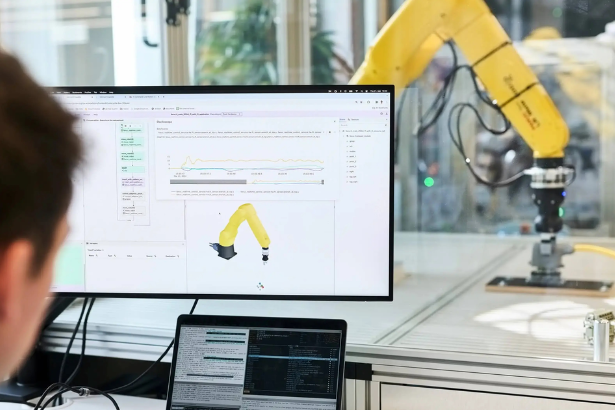
Intrinsic’s goal has been clear from the start: simplify robotic automation so manufacturers and logistics operators can adopt intelligent robotics without deep programming expertise. The company’s flagship product, Flowstate, is a web-based platform that allows users to build robotic applications using modular “skills” without writing thousands of lines of code. Flowstate helps teams design, simulate, and deploy robotic workflows without hand-coding every motion primitive.
Under the leadership of CEO Wendy Tan White (who has led the company since the 2021 spinout), Intrinsic aggressively expanded through acquisitions and product development:
- April 2022: Acquired Vicarious, a robotics software firm that had raised approximately $250 million from venture capitalists including Jeff Bezos. Purchase price was not disclosed.
- Late 2022: Acquired several for-profit divisions of Open Robotics, a nonprofit that builds hardware and software platforms for the robotics industry.
- January 2023: Laid off 20% of its workforce as part of a restructuring to refocus on product execution.
- Mid-2023: Launched Flowstate as its first major commercial product aimed at developers without deep robotics experience.
- Late 2025: Released Intrinsic Vision AI model to simplify perception-heavy tasks and improve robotic perception. The model topped seven of eleven BOP benchmarks at ICCV 2025 and offers sub-millimeter accuracy with standard RGB cameras — eliminating the need for costly depth sensors.
- October 2025: Announced a joint venture with Foxconn (major electronics manufacturer and Nvidia supplier) to develop general-purpose intelligent robots for electronics manufacturing, with the goal of full factory automation. The partnership targets AI servers, GPUs, and data center hardware production — high-growth segments still relying on manual processes despite surging demand.
Now, Google is tightening its involvement by formally bringing Intrinsic into Google’s organizational structure.
Latest Update: What the Integration Means
Here’s what the move entails, based on verified reporting from TechCrunch, CNBC, Yahoo Finance, Dataconomy, The Verge, and other outlets:
1. Intrinsic Joins Google as Distinct Entity
While Intrinsic was initially structured as a semi-independent Alphabet company (an “Other Bet” in Alphabet’s corporate taxonomy), the new shift places robotics more squarely within Google’s expanding artificial intelligence framework. Intrinsic will remain a distinct entity within Google but will operate under Google’s organizational umbrella rather than as a standalone Alphabet subsidiary.
Key structural changes:
- Direct access to Gemini AI models for robotics applications
- Integration with Google Cloud infrastructure for scalability
- Close collaboration with Google DeepMind on frontier robotics research
- Shared AI infrastructure and resources across Google’s ecosystem
Financial terms were not disclosed. Alphabet declined to share information regarding funding or purchase price.
2. “Physical AI” as Strategic Priority
Google is framing the integration as part of its commitment to “physical AI” — the application of AI models to real-world robotic systems. This represents a shift from software-only AI (chatbots, search, image generation) to AI that interacts with the physical world through robotics.
Industry leaders have been explicit that physical AI is the next commercialization wave for foundation models:
- Nvidia’s Jensen Huang has showcased model-driven autonomy across logistics and assembly
- Qualcomm’s Cristiano Amon has emphasized on-device intelligence for robots and edge systems
Google’s step with Intrinsic signals it intends to compete not just in the data center, but on factory floors alongside ABB, Fanuc, Yaskawa, Universal Robots, and integrators who turn software into throughput.
3. Accelerating Robotics Software Development
Robotics software development is now increasingly tied to Google’s AI models. The integration allows:
- Faster development cycles: Access to Google’s vast computational resources and AI research teams
- Real-time learning and adaptation: Advanced robotics software that can learn and adapt in real time
- Reduced operational barriers: Merging removes the operational barriers that often slow down innovation in independent subsidiaries
- Global scale: Google’s global presence and brand recognition provide Intrinsic with a larger platform to deploy robotics software across industries worldwide
4. From Moonshot to Enterprise Priority
This is not a shutdown. It is a strategic realignment. The move shifts Intrinsic from experimental moonshot to core enterprise priority, allowing Google to better compete with rivals like Amazon (warehouse automation) and Tesla (Optimus humanoid platform).
Google’s prior consumer-leaning robotics efforts, including elements of the Everyday Robots project (which was shut down in 2023), underscored how hard it is to take lab demos to robust, real-world systems. Folding Intrinsic into Google, alongside DeepMind’s maturing robotics research, suggests a more production-first strategy: start where ROI is measurable — industrial tasks with clear KPIs — and scale outward as models and tooling harden.
Expert Insights or Analysis
1. AI Is Now the Core Layer of Robotics
Robotics historically depended heavily on rule-based programming and physical engineering breakthroughs. Today, machine learning and generative AI models dramatically reduce programming complexity. Google’s integration suggests that robotics is no longer treated as a separate hardware moonshot. Instead, it is viewed as an AI application layer — software that sits on top of existing hardware platforms.
As one industry observer put it: “Intrinsic’s stack fits neatly into Google’s ambitions to make AI useful beyond screens.”
2. Alphabet’s Cost Discipline and Commercial Viability Strategy
Alphabet has increasingly consolidated moonshot initiatives into commercially viable frameworks. Projects that cannot scale independently often migrate closer to core business operations. Folding Intrinsic more tightly into Google allows:
- Shared AI infrastructure: Avoid duplicating AI research and compute resources
- Reduced overhead: Eliminate standalone corporate functions (finance, HR, legal)
- Faster commercialization pathways: Direct sales through Google Cloud and DeepMind partnerships
This shift reinforces a broader trend: experimental projects must increasingly justify commercial viability. Moonshots are evolving into integrated business units.
3. Market Timing: Industrial Robot Demand is Surging
The timing reflects where the robotics market is headed. The International Federation of Robotics reported:
- 553,000 industrial robot installations in 2022 (record high)
- Operational stock approaching 3.9 million units worldwide
- Electronics and automotive sectors fueling demand
As factories confront labor shortages, quality variability, and shorter product cycles, the appetite for adaptable, AI-driven automation is rising.
4. Competition Is Intensifying
AI-powered robotics is heating up globally. Major technology companies and startups alike are racing to deploy intelligent automation:
- Amazon: Proteus autonomous mobile robots, Sparrow robotic arms, Sequoia warehouse system
- Tesla: Optimus humanoid robot targeting factory automation and eventually consumer markets
- Nvidia: Isaac Sim platform and Isaac robotics AI models
- Boston Dynamics (Hyundai-owned): Spot and Atlas robots with AI-enhanced mobility
- Universal Robots, ABB, Fanuc, Yaskawa: Traditional industrial robot manufacturers integrating AI software layers
By aligning Intrinsic with its main AI efforts, Google strengthens its competitive position. The company can now offer end-to-end solutions: AI models (Gemini), cloud infrastructure (Google Cloud), robotics software (Intrinsic Flowstate), and research expertise (Google DeepMind).
5. Foxconn Partnership as Proving Ground
The October 2025 joint venture with Foxconn is particularly strategic. Foxconn manufactures electronics for Apple, Google, Amazon, and Nvidia — making it an ideal proving ground to validate speed, yield, and cost improvements at industrial scale.
If Intrinsic can demonstrate measurable ROI in Foxconn’s U.S. factories (assembly of AI servers, GPUs, data center hardware), it provides a blueprint for expansion into aerospace, healthcare, automotive, and other manufacturing verticals.
Broader Implications
For Industrial Automation:
If AI-first robotics platforms mature, factories may deploy adaptable robots capable of learning new tasks without traditional reprogramming cycles. This lowers barriers to automation adoption, particularly for small and medium manufacturers that cannot afford dedicated robotics engineering teams.
Intrinsic’s Flowstate platform targets exactly this market: developers who don’t have deep robotics expertise but need to automate complex tasks.
For AI Infrastructure:
Google’s cloud AI stack, including large language models (Gemini) and multimodal systems, could power future robotic training environments. Robotics may become another endpoint device for AI models, similar to smartphones or autonomous vehicles.
The integration positions Google Cloud as a one-stop shop for AI robotics: develop in simulation (Isaac Sim via Nvidia partnership), train with Gemini models, deploy with Flowstate, and scale on Google Cloud infrastructure.
For Alphabet’s Moonshot Model:
This shift reinforces a broader trend: experimental projects must increasingly justify commercial viability. Moonshots are evolving into integrated business units. The “Other Bets” category in Alphabet’s financials — which historically included money-losing projects like Waymo, Wing, and Verily — is being transformed into commercially viable divisions.
Intrinsic’s integration follows similar moves:
- Waymo (autonomous vehicles) partnering with Uber, Hyundai, and automotive OEMs
- Wing (drone delivery) operating commercial services in Australia and limited U.S. markets
- Verily (life sciences) focusing on profitable healthcare partnerships
For Manufacturing and Logistics:
Factories and production lines could benefit from more intelligent, adaptable robots that reduce downtime and improve efficiency. Intrinsic’s software can help automate complex tasks that previously required human intervention, including:
- Electronics assembly: Cable insertion, component placement, quality inspection
- Automotive manufacturing: Welding, painting, final assembly
- Warehouse logistics: Pick-and-place, sorting, inventory management
- Healthcare: Laboratory automation, surgical assistance, patient care
Warehouses and distribution centers may see increased automation with robots that can navigate dynamic environments and handle a variety of tasks without reprogramming.
Related History or Comparable Technologies
Alphabet previously pursued ambitious robotics initiatives with mixed results:
Boston Dynamics (2013-2017): Google acquired Boston Dynamics in 2013 for its advanced humanoid and quadruped robots. However, the company struggled to commercialize the technology and was sold to SoftBank in 2017 (later acquired by Hyundai in 2021). The robots were technologically impressive but lacked clear business models.
Everyday Robots (2019-2023): Google’s Everyday Robots project aimed to create general-purpose robots for office tasks (sorting trash, cleaning tables, opening doors). The project was shut down in 2023 as part of broader cost-cutting measures, with the team absorbed into DeepMind.
The Difference Now: AI Maturity
The difference now is AI maturity. Large-scale neural networks provide robotics with adaptable decision-making frameworks that were unavailable a decade ago. Instead of hand-coding every task, modern robots can learn from demonstrations, generalize across situations, and improve through experience.
The evolution mirrors transitions in autonomous driving, where AI-first systems replaced rule-heavy frameworks. Tesla’s Full Self-Driving and Waymo’s autonomous taxis rely heavily on neural networks trained on massive datasets — a technical approach that was impossible in 2010 but is standard practice today.
Intrinsic benefits from this AI maturity: Gemini models, DeepMind research, and Google Cloud infrastructure provide capabilities that didn’t exist when Google first experimented with robotics.
What Happens Next
Several developments are worth watching:
1. Developer Challenge and Ecosystem Growth
Intrinsic launched the AI for Industry developer challenge focused on electronics assembly tasks like cable insertion. Registration opened February 11, 2026, and closes April 17, 2026. Top participants gain access to Flowstate and Intrinsic Vision Model (IVM). The challenge uses simulation tools like Nvidia Isaac Sim to bridge research and deployment.
This could generate case studies for robotics adoption and draw developers to Intrinsic’s ecosystem, building momentum for broader commercial rollout.
2. Nvidia Partnership Expansion
Intrinsic has partnered with Nvidia on agentic and physical AI, including optimizations for Flowstate with Nvidia Isaac models and Omniverse integration. Closer ties with Google DeepMind and Nvidia suggest forthcoming enhancements to Flowstate, including:
- Better grasping via foundation models
- Omniverse streaming for visualization
- Real-time simulation and testing
3. Foxconn Joint Venture Deployment
The Foxconn joint venture targets U.S. factories with initial deployment expected in 2026. Success here would validate the business model and could lead to expansion across Foxconn’s global manufacturing footprint and other electronics manufacturers.
4. Google Cloud Integration
Whether Intrinsic products become more tightly integrated into Google Cloud offerings (similar to how Google Workspace integrates AI features). Potential packaging:
- Robotics-as-a-Service (RaaS) subscriptions via Google Cloud
- Flowstate on Google Cloud Marketplace
- Turnkey robotics solutions combining Intrinsic software + hardware partners
5. Competitive Response
How will Amazon, Tesla, Nvidia, and traditional industrial robot manufacturers respond? Amazon may accelerate its own robotics software development. Tesla could open-source parts of Optimus software to build ecosystem. Nvidia may deepen partnerships with Intrinsic competitors.
If Google successfully merges scalable AI with practical robotics software, it could unlock a new growth vector within industrial automation — potentially a multi-billion dollar market opportunity over the next decade.
Conclusion
Google Intrinsic AI robotics integration represents strategic consolidation, not retreat. As AI becomes the central operating system for emerging technologies, robotics is shifting from experimental moonshot to applied infrastructure. The move underscores a larger reality: the next phase of AI competition extends beyond chatbots and search into physical automation.
Intrinsic CEO Wendy Tan White captured the opportunity: “Combined with Google’s incredible AI and infrastructure, we’re going to unlock the promise of physical AI for a much broader set of manufacturing businesses and developers.”
For Google, the rationale is straightforward: accelerate the translation of frontier AI into real-world robotics systems, from simulation to the factory floor. For Alphabet, the integration demonstrates evolving discipline around moonshot investments — prioritizing projects that can achieve commercial scale within existing infrastructure.
Robotics may soon become one of the most important real-world deployment arenas for advanced artificial intelligence. And Google, through Intrinsic, is positioning itself to compete directly with Amazon, Tesla, and traditional industrial automation giants.
The question now is execution: Can Flowstate deliver measurable ROI in Foxconn factories? Can Intrinsic Vision achieve sub-millimeter accuracy at production scale? Can Google’s Gemini models generalize across diverse robotic tasks?
The answers will determine whether “physical AI” becomes Google’s next major business — or another abandoned moonshot.
FAQ
Q1: What is Intrinsic? Intrinsic is Alphabet’s robotics software company focused on simplifying industrial automation using AI. Founded within Alphabet’s X moonshot lab in 2016, it graduated as an independent Alphabet company in 2021 and is now joining Google as a distinct entity. Its flagship product, Flowstate, is a web-based platform that allows users to build robotic applications without writing thousands of lines of code.
Q2: Is Google shutting down Intrinsic? No. The move reflects deeper integration into Google’s AI strategy rather than closure. Intrinsic will remain a distinct entity within Google but will work closely with Google DeepMind and tap into Google’s Gemini AI models and Cloud infrastructure. Financial terms were not disclosed.
Q3: Why is AI important for robotics? AI reduces programming complexity and allows robots to adapt to new tasks more efficiently. Traditional robotics required hand-coding every motion and decision. Modern AI-powered robotics uses neural networks that can learn from demonstrations, generalize across situations, and improve through experience — dramatically reducing deployment time and cost.
Q4: What does this mean for Alphabet’s moonshots? It signals a shift toward commercially viable integration of experimental technologies. Alphabet is consolidating moonshot initiatives that cannot scale independently into core business operations. Intrinsic joins a pattern that includes Waymo partnering with automotive OEMs and Wing focusing on profitable delivery markets.
Q5: Will this impact Google Cloud? Potentially. Robotics AI platforms could integrate with Google’s cloud AI infrastructure, offering Robotics-as-a-Service (RaaS) subscriptions, Flowstate on Google Cloud Marketplace, and turnkey robotics solutions combining Intrinsic software with hardware partners like Foxconn, ABB, Fanuc, and Universal Robots.
Sources and References
TechCrunch: Alphabet-owned robotics software company Intrinsic joins Google https://techcrunch.com/2026/02/25/alphabet-owned-robotics-software-company-intrinsic-joins-google/
CNBC: Former Alphabet ‘moonshot’ robotics company Intrinsic is folding into Google https://www.cnbc.com/2026/02/25/alphabet-robotics-software-intrinsic-google-ai.html
The Verge: Google Swallows AI Robotics Moonshot Intrinsic https://www.theverge.com/tech/885113/google-swallows-ai-robotics-moonshot-intrinsic