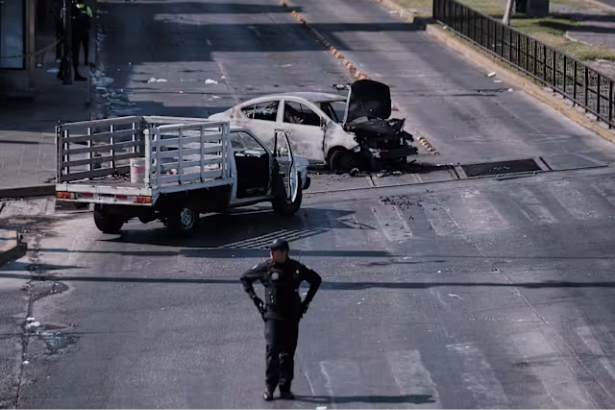
Security crackdown intensifies as Liga MX postpones matches, airlines cancel flights, and cartel retaliation spreads across 11 Mexican states
Introduction
El Mencho is dead. Nemesio Rubén Oseguera Cervantes, the leader of Mexico’s most powerful drug cartel, was killed Sunday in a military operation in Tapalpa, Jalisco, marking a seismic moment in Mexico’s long-running war against organized crime. The 59-year-old former police officer who rose to lead the Jalisco New Generation Cartel (CJNG) died while being airlifted to Mexico City after being wounded in a shootout with Mexican forces.
The operation — conducted with U.S. intelligence support — triggered immediate and violent retaliation across nearly a dozen Mexican states. Cartel members burned buses, blocked highways with vehicles, and clashed with authorities from Jalisco to Michoacán to Guanajuato. Liga MX postponed four professional soccer matches. Major airlines including Delta, American, Alaska, and Air Canada canceled flights to Puerto Vallarta and Guadalajara. The U.S. State Department urged American nationals in affected areas to “seek shelter and remain in residences or hotels” until further notice.
Mexico’s Defense Ministry said six other cartel members were killed and two were arrested during the operation. Three Mexican soldiers were wounded. Authorities seized armored vehicles, rocket launchers capable of shooting down aircraft, and other weapons.
Background and Context
Nemesio Oseguera Cervantes, widely known as El Mencho, led the Jalisco New Generation Cartel, often abbreviated as CJNG. Over the past 15 years, CJNG evolved into one of the most powerful and violent criminal organizations in the Western Hemisphere, with an estimated 19,000 members operating across 21 of Mexico’s 32 states.
CJNG controls trafficking routes for fentanyl, methamphetamine, and cocaine into the United States. The cartel is linked to suppliers of chemical precursors in China and controls several seaports for importing chemicals, according to the U.S. Drug Enforcement Administration. The DEA described CJNG as “a key supplier of illicit fentanyl” to the United States, reaping “billions of dollars in profit.”
Born July 17, 1966, in Michoacán, Oseguera dropped out of school after sixth grade to pick avocados. In the 1990s, he moved to the United States and was convicted in California for conspiracy to distribute heroin. He served more than four years in federal prison and was deported in 1994 after selling heroin to undercover officers at the Imperial Bar in San Francisco.
After returning to Mexico, Oseguera worked as a police officer in Jalisco before resuming criminal activities. He rose through the ranks of the Milenio Cartel and later became chief of security for the Sinaloa Cartel. When the Milenio Cartel splintered in 2009 after its leader Óscar Nava Valencia was captured, Oseguera formed CJNG with Abigael González Valencia, leader of Los Cuinis — a family-based cartel that handled CJNG’s money laundering operations.
Oseguera built the group into a brutally violent operation responsible for assassination attempts on Mexican government officials and homicides against rival trafficking groups and law enforcement officers. In May 2015, CJNG demonstrated its firepower by responding to a security operation with simultaneous roadblocks across several municipalities and shooting down a military helicopter, killing three soldiers.
The U.S. government had previously offered a $15 million reward for information leading to Oseguera’s capture — the highest reward offered for any drug trafficker. In February 2025, the Trump administration designated CJNG as a foreign terrorist organization.
Latest Update or News Breakdown
The operation unfolded Sunday, February 22, 2026, in Tapalpa, Jalisco, approximately two hours southwest of Guadalajara. Here is what happened, based on verified reporting from CNN, ESPN, NBC News, CBS News, Fox News, Al Jazeera, The Associated Press, and Mexican government statements:
The Operation: Mexican Army forces, supported by the National Guard, Mexican Air Force, and intelligence personnel from the Attorney General’s Office, conducted the operation after intelligence reports indicated Oseguera was present in the area. Tapalpa had long been regarded as a CJNG stronghold.
The Mexican Defense Department confirmed the operation was conducted “as part of bilateral coordination and cooperation with the U.S.,” and that U.S. authorities provided “complementary intelligence that contributed to El Mencho’s killing.” A U.S. defense official confirmed that the Joint Interagency Task Force-Counter Cartel “played a role” in the operation.
During the raid, troops came under fire. The Defense Ministry said six cartel members were killed at the scene, including four during the initial firefight. Three more people, including Oseguera, were wounded. Oseguera died while being airlifted to Mexico City. Two cartel members were arrested.
Three Mexican soldiers were wounded and received medical treatment.
The Retaliation: Immediately following the operation, CJNG members unleashed a wave of violence across western Mexico. Suspected cartel members:
- Set buses, trucks, and vehicles on fire
- Blocked highways with burning vehicles in nearly a dozen states
- Clashed with security forces
- Attacked businesses
Jalisco Governor Pablo Lemus Navarro activated “Code Red” — a protocol for a state of emergency or security crisis. He urged residents to remain in their homes and suspended public transportation across Jalisco “until the situation is under control.”
The violence spread to at least 11 Mexican states, including Jalisco, Michoacán, Guanajuato, Colima, Nayarit, Querétaro, and others. Mexico’s security agency reported 252 roadblocks throughout the country by Sunday evening. By 8 p.m., 23 still hadn’t been cleared.
Video obtained by CNN showed multiple fires burning and plumes of smoke rising across Puerto Vallarta, a resort town popular with U.S. tourists on Mexico’s west coast.
Liga MX Postponements: Four professional soccer matches were postponed:
- Men’s Liga MX: Querétaro vs. Juárez FC
- Women’s Liga MX: Chivas vs. América
- Two second-division matches
An international friendly match between Mexico and Iceland, scheduled for Wednesday at the Corregidora Stadium in Querétaro, was also canceled by the Mexican Football Federation.
Guadalajara’s Akron Stadium is scheduled to host four 2026 FIFA World Cup matches in June, including two involving South Korea. Co-hosts Mexico, Spain, Uruguay, and Colombia are also scheduled to play there.
Airline Disruptions: Major airlines canceled flights to and from Puerto Vallarta and Guadalajara:
- Delta Air Lines: Canceled flights and issued travel waivers
- American Airlines: Canceled flights
- Alaska Airlines: Canceled flights
- Air Canada: Canceled flights
- Southwest Airlines: Canceled flights
Delta said in a statement: “The safety of our customers and crew always comes first and we are closely monitoring the situation in the region. We have taken steps to adjust our operation accordingly and are working to communicate with our impacted customers.”
U.S. State Department Alert: The U.S. State Department urged American nationals in parts of Mexico to “seek shelter and remain in residences or hotels” until further notice. The Embassy issued a security alert warning about ongoing military activity and advising travelers to avoid affected areas.
Official Reactions: U.S. Deputy Secretary of State Christopher Landau posted on X: “I’ve just been informed that Mexican security forces have killed ‘El Mencho,’ one of the bloodiest and most ruthless drug kingpins. This is a great development for Mexico, the US, Latin America, and the world. The good guys are stronger than the bad guys.”
Mexican President Claudia Sheinbaum Pardo acknowledged the roadblocks on social media but stressed: “In the vast majority of the national territory, activities are proceeding with complete normality.” She applauded Mexican security forces and called for calm.
Families Speak: Terry Puerta, who gives presentations at the FBI Academy about the impact of fentanyl deaths after losing his son, told NBC News: “As a father who lost his one and only son, regardless of whichever political party one may subscribe to, this is definitely something that was needed a long time ago and very much applauded by many in my community.”
Cindy Demaio, whose daughter Rachel died from fentanyl poisoning in 2016, called the eruption of violence “very concerning.”
Expert Insights or Analysis
Does This End CJNG? Security analysts note that eliminating a cartel leader does not automatically dismantle the organization. In many cases, leadership decapitation creates fragmentation, splinter groups, or violent succession battles.
Vanda Felbab-Brown, an expert on international organized crime at the Brookings Institution, told Reuters: “Apart from the heads of the Sinaloa Cartel, ‘El Mencho’ has been the biggest prize for many, many years. I expect a tremendous amount of violence is going to happen.”
The DEA says CJNG is structured like a franchise business, composed of around 90 organizations. Eduardo Guerrero, director of Mexican consulting group Lantia Intelligence, told CNN earlier this year: “This fragmentation has meant that you’ll need a more complex, more sophisticated strategy to weaken and dismember them.”
CJNG’s Operational Model: CJNG combined aggressive territorial expansion with paramilitary-style tactics, including drone attacks and armored convoys. That adaptability makes post-leadership instability particularly unpredictable.
Historical Precedent: Mexico has previously targeted high-profile cartel leaders, including Joaquín “El Chapo” Guzmán of the Sinaloa Cartel. Those operations often resulted in short-term violence spikes. Historically, cartel fragmentation sometimes leads to smaller but more volatile criminal groups.
Analysts point to lessons from Colombia’s dismantling of the Medellín and Cali cartels, where decentralized violence persisted even after leadership removal.
Political Context: Mexican President Claudia Sheinbaum, like her predecessor, has criticized the “kingpin” strategy of previous administrations that took out cartel leaders only to trigger explosions of violence as cartels fractured. While she has remained popular in Mexico, security is a persistent concern. Since Donald Trump returned to office a year ago, she has been under tremendous pressure to show results against drug trafficking.
Broader Implications
For Mexico’s Security Strategy: Mexico’s federal government has alternated between militarized crackdowns and more restrained security approaches. The killing of El Mencho could be seen as validation of direct military engagement strategies, particularly under pressure from the Trump administration.
However, long-term stabilization depends on institutional reform, anti-corruption efforts, and economic alternatives for vulnerable regions.
For U.S.–Mexico Relations: The U.S. has long pressured Mexico to intensify anti-cartel operations, particularly against fentanyl trafficking networks. CJNG has been linked to synthetic opioid supply chains impacting American communities. The U.S. intelligence support for this operation highlights cross-border coordination and the interconnected nature of security policy.
For Civil Society and Commerce: The postponement of Liga MX matches illustrates how cartel violence disrupts mainstream institutions. Soccer in Mexico is not merely entertainment but a national cultural pillar and economic engine. Temporary suspensions reflect risk management decisions when public gatherings could become targets or flashpoints.
The airline cancellations and tourism warnings underscore the economic impact of cartel retaliation. Puerto Vallarta and Guadalajara are major tourist destinations, and disruptions to air travel cost businesses millions in lost revenue.
For the 2026 World Cup: Guadalajara is scheduled to host four World Cup matches in June 2026. FIFA and Mexican authorities will now face increased scrutiny over security preparations. The ability to guarantee safety for international teams, fans, and media will be critical.
Related History or Comparable Events
Previous Kingpin Captures:
- Joaquín “El Chapo” Guzmán — captured multiple times, finally extradited to the U.S. in 2017, now serving life sentence
- Ismael “El Mayo” Zambada — co-founder of Sinaloa Cartel, recently arrested
- Arturo Beltrán Leyva — killed by Mexican Marines in 2009, triggering cartel fragmentation
- Héctor Beltrán Leyva — arrested 2014, Beltrán Leyva Organization splintered into smaller factions
Each operation resulted in short-term violence spikes. The pattern underscores how real-time cartel retaliation and succession battles amplify instability.
Colombian Precedent: The dismantling of Colombia’s Medellín and Cali cartels in the 1990s showed that removing leadership does not eliminate trafficking networks. Smaller, more decentralized groups emerged, prolonging violence for years.
What Happens Next
Several scenarios are now plausible:
1. Swift Internal Succession: A new CJNG leader consolidates power quickly, stabilizing operations and reducing violence. Candidates likely include Oseguera’s son, Rubén Oseguera González (known as “El Menchito”), who was extradited to the U.S. in 2020, or other high-ranking lieutenants.
2. Violent Infighting: Internal power struggles fracture CJNG into competing factions, escalating violence as groups fight for control of territory and trafficking routes.
3. Rival Cartel Expansion: The Sinaloa Cartel and other groups attempt territorial expansion into CJNG strongholds, triggering turf wars.
4. Sustained Military Pressure: Federal forces maintain elevated security posture in Jalisco and neighboring states to prevent regrouping.
Authorities are expected to maintain heightened security for the coming weeks. International monitoring agencies and financial crime investigators will likely track asset movements and cartel-linked businesses.
The next few weeks will determine whether Mexico can capitalize on this moment to weaken CJNG or whether the cartel’s franchise structure allows it to adapt and survive.
Conclusion
The reported killing of El Mencho marks one of the most consequential moments in Mexico’s anti-cartel campaign in years. The symbolic impact is immense — the most wanted drug lord in Mexico, a $15 million bounty on his head, eliminated in a joint U.S.-Mexico operation.
But the structural realities of organized crime networks suggest the situation remains fluid. CJNG’s franchise model, estimated 19,000 members, and operations across 21 states mean the organization is unlikely to collapse overnight. History shows that cartel fragmentation often leads to increased violence, not decreased violence.
Whether this moment becomes a turning point or a precursor to renewed instability depends on what follows in the weeks ahead. For now, Mexico is on high alert, tourists are sheltering in place, soccer matches are postponed, and the world is watching to see if the death of El Mencho marks the beginning of the end for CJNG — or simply the next chapter in Mexico’s ongoing drug war.
FAQ
Q1: Who was El Mencho? El Mencho was the alias of Nemesio Rubén Oseguera Cervantes, the 59-year-old leader of the Jalisco New Generation Cartel (CJNG). Born July 17, 1966, in Michoacán, he was a former police officer who became one of the world’s most wanted fugitives. The U.S. offered a $15 million reward for his capture.
Q2: Why were Liga MX matches postponed? Four professional soccer matches were suspended due to security concerns linked to violent cartel retaliation following the military operation. CJNG members burned vehicles, blocked highways, and clashed with authorities across 11 Mexican states, making public gatherings unsafe.
Q3: Did the U.S. Embassy issue a warning? Yes. The U.S. State Department issued a security alert urging American nationals in affected areas of Mexico to “seek shelter and remain in residences or hotels” until further notice. The Embassy advised travelers to avoid areas with ongoing military activity and cartel violence.
Q4: Does this end the Jalisco cartel? Unlikely. Cartels often continue operating after leadership losses, sometimes becoming more fragmented and violent. CJNG is structured like a franchise business with around 90 organizations and an estimated 19,000 members. Experts expect succession battles and potential turf wars with rival cartels.
Q5: Is travel to Mexico affected? Yes. Major airlines including Delta, American, Alaska, Air Canada, and Southwest canceled flights to and from Puerto Vallarta and Guadalajara on Sunday. The U.S. State Department advised travelers to monitor official embassy guidance. Travel advisories may vary by region, but violence spread across at least 11 Mexican states following the operation.
Sources and References
ESPN: Mexican league matches postponed after cartel leader killed
CNN: Who was El Mencho, the feared cartel leader killed in a military operation?
U.S. Embassy in Mexico: Security Alert – Ongoing Security Operations