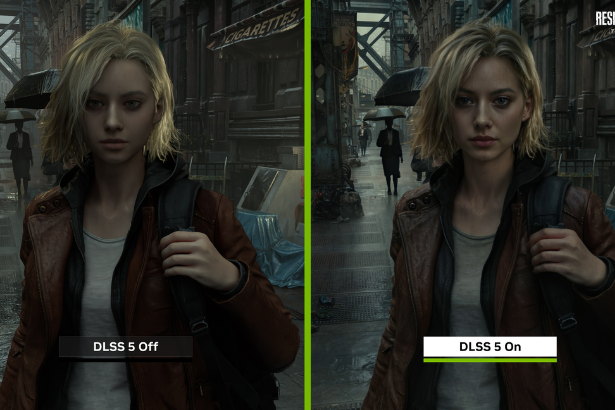
From neural rendering to real-time path tracing, DLSS 5 signals a major leap in how games are generated, not just rendered
Introduction
DLSS 5 represents Nvidia’s most ambitious leap yet in AI-driven graphics, promising photorealistic lighting and massive performance gains for next-generation gaming hardware.
Background and Context
Nvidia first introduced Deep Learning Super Sampling (DLSS) as a way to upscale lower-resolution frames using AI.
DLSS 1 offered basic AI upscaling with mixed results. DLSS 2 brought temporal reconstruction that became the industry standard. DLSS 3 added frame generation using AI interpolation. DLSS 4 refined latency and quality.
DLSS 5 shifts the paradigm entirely.
Instead of just enhancing frames, it generates lighting and scene realism itself using neural rendering techniques.
Latest Update or News Breakdown
According to Nvidia and independent analysis from Digital Foundry, DLSS 5 introduces several major upgrades.
Neural Rendering Pipeline
DLSS 5 moves beyond upscaling into AI-assisted rendering, where parts of the scene are generated by neural networks rather than traditional GPU pipelines.
Real-Time Path Tracing Acceleration
With next-gen RTX 50-series GPUs, DLSS 5 dramatically improves path tracing performance. Nvidia claims orders-of-magnitude improvements. Lighting becomes physically accurate in real time. Scenes approach cinematic realism.
AI Lighting Reconstruction
Instead of calculating every light ray, AI models predict lighting behavior, reducing computational cost while maintaining fidelity.
Massive Performance Gains
Reports suggest performance leaps that could redefine expectations for AAA gaming, especially in ray-traced environments.
Expert Insights or Analysis
Technical analysts see DLSS 5 as a turning point.
From Rasterization to AI Rendering
Traditional rendering relies on brute-force computation. DLSS 5 introduces inference-based rendering, where AI predicts outcomes instead of calculating every pixel.
Hardware-Software Co-Design
The system is deeply tied to Nvidia’s upcoming RTX 50-series architecture, signaling tighter integration between silicon and AI models.
Developer Impact
Game developers may need to rethink pipelines. Instead of optimizing geometry and shaders alone, they will increasingly train and integrate AI models.
Broader Implications
For Gaming
Photorealistic environments become standard. Lower-end hardware may achieve higher fidelity through AI. Game development timelines could shrink with AI-assisted rendering.
For AI and Computing
DLSS 5 reflects a broader shift in artificial intelligence applications: AI replacing deterministic computation, GPUs evolving into hybrid AI accelerators, and real-time applications benefiting from neural inference.
For Competition
Rivals like AMD and Intel are now under pressure to match Nvidia’s AI-first graphics approach.
Related History or Comparable Technologies
DLSS 5 builds on earlier innovations like real-time ray tracing (RTX 20-series), AI frame generation (DLSS 3), and neural rendering research from academic labs.
It also parallels trends in AI-generated video, neural radiance fields (NeRFs), and real-time simulation using machine learning. These developments represent part of a larger wave of technology innovation reshaping how computing handles visual information.
What Happens Next
DLSS 5 is expected to debut alongside RTX 50-series GPUs. Game studios will begin integrating neural rendering workflows. Benchmarks will determine real-world performance gains.
The biggest unknown remains adoption. If widely supported, DLSS 5 could redefine graphics standards for the next decade.
Conclusion
DLSS 5 is not just an upgrade. It is a redefinition of how graphics are produced.
By blending AI with rendering, Nvidia is moving gaming closer to a future where scenes are generated, not just computed. The implications extend beyond gaming into film, simulation, and virtual worlds.
FAQ
What is DLSS 5?
DLSS 5 is Nvidia’s next-generation AI rendering technology that enhances graphics quality and performance using neural networks.
Does DLSS 5 require new hardware?
Yes, it is designed primarily for RTX 50-series GPUs.
What makes DLSS 5 different from DLSS 3?
DLSS 5 introduces neural rendering and AI-generated lighting, not just frame generation.
Will DLSS 5 improve performance?
Yes, it aims to significantly boost performance, especially in path-traced games.
When will DLSS 5 be available?
It is expected to launch alongside Nvidia’s next-generation GPUs.