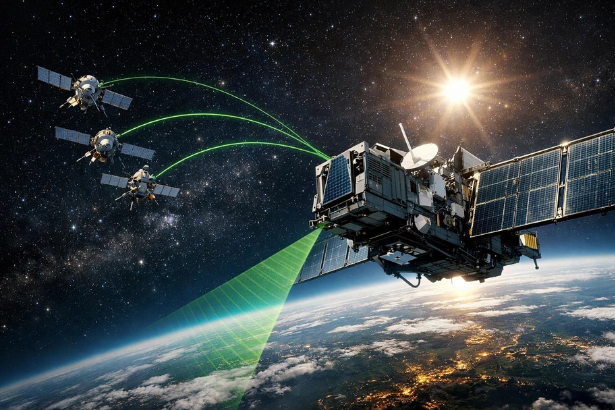
The encounter between Cosmos 2612 and ICEYE X36 is raising new questions about the security of commercial satellites and the growing military importance of Earth’s orbit. In October 2026, a Russian military satellite maneuvered into unusually close proximity to ICEYE-X36, a commercial synthetic aperture radar (SAR) satellite operated by Finnish-founded ICEYE through its U.S. entity.
The approach attracted attention because ICEYE’s radar-imaging technology can collect useful imagery at night and through cloud cover, capabilities that have made commercial satellite data valuable to military users, including Ukraine. Analysts are concerned that the Russian spacecraft’s movements could be intended to observe, intimidate or potentially interfere with the commercial satellite.
The Center for Strategic and International Studies (CSIS) warned on October 15 that Cosmos 2612’s maneuvers warranted close attention because of Russia’s history of testing counterspace capabilities. Subsequent reporting by The New York Times and CNN brought the encounter to a wider audience.
The important distinction is that an unusually close orbital approach is not, by itself, proof of an attack. Public orbital data and expert analysis can help establish where spacecraft have traveled, but they cannot independently establish the intentions of the satellite’s operator.
The episode nevertheless highlights a growing security challenge: commercial satellites have become strategically important infrastructure, and the same orbital environment that enables global communications, navigation and Earth observation can also become a place for military competition.
Background and Context: What Are Cosmos 2612 and ICEYE X36?
Cosmos 2612: A Russian Military Satellite
Cosmos 2612 belongs to a group of Russian satellites launched in April 2026. According to CSIS, Russia launched six spacecraft designated Cosmos 2609 through Cosmos 2614 during that month.
Several of those satellites subsequently performed orbital maneuvers that brought them into alignment with the orbital plane of ICEYE-X36. Such movements attracted attention because changing an orbital plane can require substantial fuel, particularly for satellites operating in low Earth orbit.
CSIS reported that Cosmos 2609 approached ICEYE-X36 in May 2026, coming within approximately 2.5 kilometers on May 26. After a period in which the orbital planes diverged, Cosmos 2612 began another sequence of maneuvers in late September.
The later movements brought Cosmos 2612 back toward ICEYE-X36’s orbital path, culminating in the close approach reported in October.
These maneuvers are observable evidence of unusual satellite activity. They do not, on their own, establish whether the Russian spacecraft was conducting surveillance, testing a counterspace capability or pursuing another objective.
ICEYE X36: A Commercial Radar Satellite With Military Relevance
ICEYE is a Finnish-founded space technology company specializing in synthetic aperture radar imaging. Unlike conventional optical satellites, SAR spacecraft transmit radar signals and process the returned echoes to produce images of Earth’s surface.
This gives radar imaging several practical advantages. It can operate at night, and it can often collect useful observations through clouds that would obstruct ordinary optical cameras.
Those capabilities make SAR imagery valuable for monitoring flooding, tracking environmental changes, observing infrastructure and assessing activity in areas of military interest.
ICEYE has provided satellite-imaging capabilities to Ukraine. However, the public reporting does not establish that ICEYE-X36 itself was actively supporting a specific Ukrainian military operation at the time of the encounter.
That distinction matters. The satellite’s commercial and strategic relevance helps explain the concern, but its exact operational role should not be assumed without confirmation.
Latest Update: What Happened Between Cosmos 2612 and ICEYE X36?
September 30: A New Sequence of Orbital Maneuvers Begins
CSIS reported that Cosmos 2612 began a new series of maneuvers on September 30, 2026. The changes helped bring the Russian spacecraft back into an orbital plane aligned with ICEYE-X36.
Matching an orbital plane can make it easier for one satellite to approach another. Once spacecraft occupy similar orbital paths, comparatively small additional maneuvers can change their relative positions.
That is why analysts paid attention to the sequence rather than treating the eventual close pass as an isolated coincidence.
October 12: The Russian Satellite Moves Closer to the Same Orbital Path
According to the CSIS analysis, a further maneuver on October 12 returned Cosmos 2612 to an altitude of roughly 555 kilometers and aligned its orbital plane with ICEYE-X36.
The Russian spacecraft was then reported to be hundreds of kilometers behind the commercial satellite, setting up the subsequent approach.
The significance lies in the broader pattern: the satellite’s orbit changed in ways that brought it closer to the same orbital track as a spacecraft of strategic interest.
October 15-17: The Gap Narrows
CSIS published its assessment on October 15, warning that Cosmos 2612 was positioned for a potentially close encounter with ICEYE-X36.
By October 17, independent satellite tracking reports described Cosmos 2612 as station-keeping within approximately five kilometers or less of ICEYE-X36.
The close spacing raised concerns because satellites generally operate according to mission-specific orbital plans. Deliberately matching another spacecraft’s orbital plane and remaining nearby is different from a routine pass between two satellites traveling on unrelated trajectories.
Still, proximity is not proof of hostile intent. Close-proximity operations can have benign purposes, including inspection, servicing and debris-removal work, although the circumstances of this particular encounter have prompted security concerns.
October 18-19: Reports of an Exceptionally Close Approach
Subsequent orbital tracking analyses indicated that the spacecraft may have approached much more closely than the initial five-kilometer estimate suggested.
A report published by AeroTime on October 19 cited independent orbital analysis indicating that the satellites may have passed within a few hundred meters, or potentially closer, on October 18. The report also noted that uncertainty in publicly available orbital data prevented a reliable determination of their minimum separation.
These estimates should not be treated as a confirmed collision distance. Orbital calculations depend on the accuracy and timing of tracking data, and estimates can change as new observations become available.
The key finding is that the encounter was unusually close and attracted attention from space-security analysts. The public evidence cited in these reports does not establish that ICEYE-X36 was struck, damaged or disabled.
Key Facts at a Glance
| Detail | What is currently reported |
|---|---|
| Russian spacecraft | Cosmos 2612 |
| Commercial spacecraft | ICEYE-X36 |
| Russian spacecraft type | Military satellite |
| Commercial spacecraft type | Synthetic aperture radar imaging satellite |
| Orbit | Low Earth orbit |
| Renewed maneuvering | Began around September 30, 2026, according to CSIS |
| Reported close approach | October 18, 2026, with reports published October 19 |
| Initial reported separation | Approximately five kilometers or less by October 17 |
| Minimum separation | Uncertain; some independent tracking estimates suggested hundreds of meters or less |
| Confirmed collision or damage | Not established by the cited public reporting |
| Principal concern | Potential surveillance, interference or counterspace activity |
Expert Analysis: Why the Cosmos 2612 Encounter Matters
1. Orbital Maneuvering Can Be a Strategic Capability
Satellites do not simply follow fixed paths forever. Operators can change their orbits by firing thrusters, adjusting altitude or making other maneuvers.
However, some changes are expensive in fuel. A satellite that deliberately changes its orbital plane to align with another spacecraft is demonstrating a capability that could support several types of close-proximity operation.
CSIS researchers Clayton Swope and Chantal Li emphasized that these maneuvers are unusual for many conventional low Earth orbit missions. They also warned that an aligned orbit could allow a spacecraft to move closer to another satellite with relatively little additional fuel.
That capability is not inherently a weapon. The concern comes from how it could be used and the strategic context surrounding the operation.
2. The Risk Extends Beyond Physical Collision
When people hear about satellites approaching one another, they may immediately imagine a collision. That is one possible hazard, but it is not the only concern.
Close-proximity operations could potentially support inspection, intelligence gathering, interference or the deployment of a counterspace capability. A spacecraft could also attempt to intimidate another operator by demonstrating that it can approach a strategically important satellite.
The public evidence does not establish that Cosmos 2612 performed any of those hostile actions. They are possible scenarios that help explain why the maneuver has attracted attention.
The distinction is essential: analysts can identify capabilities and risks without claiming that a particular hostile act has already occurred.
3. Commercial Spacecraft Are Now Part of the Security Equation
Commercial satellites increasingly provide services that governments and armed forces depend on, from communications and navigation to radar imagery and weather monitoring.
This creates a complicated security environment. A spacecraft may be privately operated, commercially registered and used for civilian purposes while also providing information that supports military operations.
ICEYE’s radar-imaging technology illustrates this overlap. Its products have civilian applications, but radar imagery can also help military users monitor activity and assess changing conditions on the ground.
If commercial spacecraft become targets of interference or coercion, the consequences could extend beyond a single company to the customers and institutions that rely on its data.
Broader Implications: The Future of Satellite Security
Commercial Satellites Are Strategic Infrastructure
The Cosmos 2612 and ICEYE-X36 encounter demonstrates why commercial space infrastructure has become a national-security concern.
Governments no longer rely exclusively on military-owned satellites for every space-based service. Commercial operators can provide capabilities that are useful in emergencies, intelligence analysis, disaster response and military planning.
That creates an incentive for governments to protect the availability of commercial space services. It also creates new questions about how a state should respond if a satellite supporting its interests is threatened.
CSIS argues that the United States and its European partners should consider how they would respond to hostile actions against commercial or allied satellites.
Those are policy recommendations from the think tank, not evidence that an attack has occurred.
Space Is Becoming a More Contested Operational Environment
Low Earth orbit is home to Earth-observation spacecraft, communications satellites, scientific missions and other systems. As more satellites are launched, monitoring their positions and coordinating safe operations become increasingly important.
The ability to maneuver near another spacecraft introduces additional complexity. Operators need accurate tracking data, clear procedures for assessing conjunctions and effective ways to communicate concerns when another satellite behaves unexpectedly.
The challenge is especially significant when spacecraft are operated by states with competing strategic interests.
Why International Rules and Communication Matter
The international legal framework for outer space includes the Outer Space Treaty, which establishes principles governing state activities in space and responsibility for national space activities.
However, not every potentially threatening maneuver is straightforward to classify under international law. Close proximity alone does not automatically establish that a satellite operation is illegal or constitutes an attack.
Clearer communication, transparency around orbital activities and effective crisis-management channels could reduce the risk that an ambiguous encounter escalates into a wider confrontation.
For additional coverage of emerging technology and geopolitical developments, readers can explore The Tech Marketer.
Related History: Russia’s Earlier On-Orbit Experiments
The Cosmos 2612 episode is not the first time Russian satellite activity has raised concerns about counterspace capabilities.
CSIS describes earlier Russian tests involving satellites that released objects in orbit. One example occurred in July 2020, when Cosmos 2543 released an object that traveled at high relative velocity. The United States and United Kingdom subsequently criticized the test, citing concerns about its possible counterspace implications.
Russia has also maneuvered satellites into orbital configurations that allowed them to approach or observe other spacecraft.
These historical examples help explain why analysts are paying attention to Cosmos 2612. They provide context for evaluating Russia’s demonstrated capabilities, but they do not prove that the current encounter was intended to culminate in an attack.
Each event must be assessed on its own evidence.
What Happens Next?
Several developments will determine how the Cosmos 2612 encounter is understood.
First, satellite operators and tracking organizations may publish additional orbital data that helps clarify the spacecraft’s minimum separation and subsequent movements.
Second, officials may provide information about whether ICEYE-X36 experienced any operational interference. Public orbital tracking alone cannot establish every aspect of a satellite’s health or performance.
Third, governments and space-security researchers will continue examining what the maneuvering indicates about Russia’s orbital capabilities and the risks faced by commercial spacecraft.
Finally, the incident could add momentum to discussions about satellite protection, information sharing and responses to potentially hostile actions in orbit.
For now, the evidence supports a cautious conclusion. Cosmos 2612 performed maneuvers that brought it unusually close to ICEYE-X36, prompting concern among analysts. The public evidence reviewed here does not establish that the commercial satellite was attacked or damaged, nor does it conclusively reveal Russia’s intentions.
Conclusion
The close approach between Cosmos 2612 and ICEYE-X36 is a significant development in the debate over satellite security.
Russia’s spacecraft maneuvered toward a commercial radar-imaging satellite with strategic relevance, creating an encounter that analysts consider unusual and potentially concerning. The episode highlights the growing overlap between commercial space technology and military operations.
But the distinction between a concerning capability and a confirmed hostile act matters. The available public evidence does not establish a collision, damage or a completed attack.
The larger lesson is that space security increasingly depends on more than preventing accidental collisions. It also requires reliable tracking, careful interpretation of orbital behavior, clear communication between operators and credible ways to respond when one spacecraft approaches another in potentially threatening circumstances.
FAQ: Cosmos 2612 and ICEYE X36
1. What is Cosmos 2612?
Cosmos 2612 is a Russian military satellite launched in April 2026 as part of a group of spacecraft designated Cosmos 2609 through Cosmos 2614. Its orbital maneuvers brought it into unusually close proximity to ICEYE-X36 in October 2026.
2. What is ICEYE-X36?
ICEYE-X36 is a commercial synthetic aperture radar imaging satellite operated by ICEYE through its U.S. entity. SAR technology can produce useful imagery at night and through cloud cover, making it valuable for civilian monitoring and certain military applications.
3. How close did Cosmos 2612 get to ICEYE-X36?
Tracking reports initially described the satellites as being within approximately five kilometers or less by October 17. Later estimates suggested they may have passed within hundreds of meters or less, but uncertainty in publicly available orbital data prevents a definitive minimum-distance figure.
4. Did the Russian satellite attack ICEYE-X36?
The cited public reporting does not establish that an attack occurred. The close approach raised concerns about potential surveillance, interference or counterspace activity, but those possibilities should not be presented as confirmed events.
5. Why is ICEYE-X36 strategically important?
ICEYE operates radar-imaging satellites that can collect observations at night and through clouds. Commercial radar imagery can support disaster response and environmental monitoring, as well as military analysis. ICEYE has supported Ukraine, although the specific operational role of ICEYE-X36 has not been established in the reporting reviewed.
6. What is an on-orbit weapon?
An on-orbit weapon is a system designed to damage, disable or otherwise interfere with a spacecraft from space. Depending on the design, a counterspace capability could use physical impact, released objects or non-kinetic methods. The available evidence does not establish that Cosmos 2612 deployed a weapon during this encounter.
7. Why are satellite operators concerned about close-proximity maneuvers?
An approaching spacecraft may be capable of inspecting, monitoring or interfering with another satellite. Even when no collision occurs, unexplained maneuvers can create uncertainty about the intentions of the operator and the safety of the spacecraft being approached.
8. Could this incident affect the wider space industry?
It could intensify discussions about satellite tracking, commercial spacecraft protection, transparency and international responses to threatening maneuvers. The longer-term impact will depend on further evidence, official responses and whether similar encounters occur.
Sources & References
- The New York Times: Russian Satellite Makes a Menacing Approach to Another Craft in Orbit
- CNN: Russian Satellite Makes Possibly Unprecedented Approach of Another Satellite
- Center for Strategic and International Studies (CSIS): Could Russia Be Poised to Use an On-Orbit Weapon Against a Commercial Satellite?
- AeroTime: Russian Satellite Makes Close Approach to ICEYE-X36