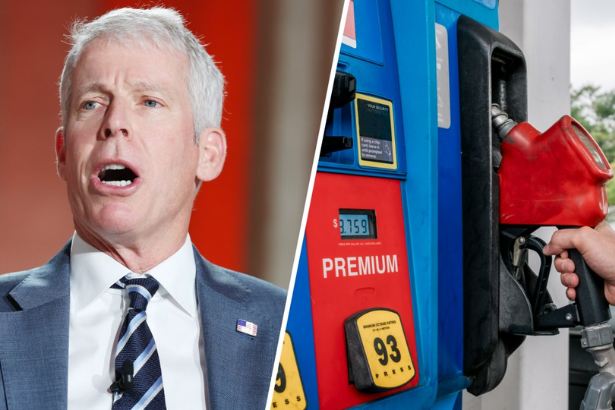
The energy secretary went on two Sunday shows promising relief at the pump within weeks. Earlier in the week, a single erroneous post on X sent oil prices crashing 17% — and then partly back up — before being deleted. Both episodes reveal the same thing: the market is more powerful than the message.
Chris Wright gas prices commentary dominated Sunday’s political media cycle after the energy secretary made the rounds on NBC’s Meet the Press and ABC’s This Week, pledging that Americans stand a “very good chance” of seeing gasoline drop below $3 per gallon by summer and that the conflict with Iran will “certainly” end within the next few weeks. The reassurances landed during one of the most volatile stretches for global oil markets in years — and against a backdrop that included a separate, more embarrassing episode involving Wright just days earlier.
What Wright Said — and Where He Said It
On ABC’s This Week, host Martha Raddatz put the question directly. Wright’s answer was unambiguous: “I think that this conflict will certainly come to an end in the next few weeks. Could be sooner than that, but the conflict will come to an end in the next few weeks.”
He then addressed the consumer concern head-on. “There’s no guarantees in wars at all,” he said. “This is short-term pain to get through to a much better place.”
On NBC’s Meet the Press, host Kristen Welker confronted him with numbers. Since the war began, the national average price for gasoline has risen 24% and diesel prices have jumped 32%. GasBuddy data put the pump price increase at 76 cents per gallon on average. Wright said there is a “very good chance” gas prices drop below $3 a gallon by summer — the most specific public forecast the administration has attached to the situation.
He also pointed out that gas prices remain below their peak under the Biden administration. “We had $5 gasoline in the middle of the Biden administration,” he said. “We hope we don’t get there this time, but at least this increase in gasoline prices is for something that’s going to change the geopolitical situation in the world forever.”
On the post-war scenario, Wright was expansive: “We’ll go to a world more abundant in energy, more affordable in energy, and less risky for American soldiers and commerce in the Middle East.”
The Strait of Hormuz: Closed, Not Just Threatened
The reason Wright’s comments matter so much is the Strait of Hormuz. The 21-mile-wide passage connecting the Persian Gulf and the Gulf of Oman is the single most important chokepoint in the global energy system — roughly 20% of the world’s oil supply previously flowed through it before the war. Iranian leaders have vowed to keep it closed, and tanker traffic through the strait has been at a near standstill since the U.S.-Israeli conflict began. The closure represents the largest oil supply disruption in history, according to analysis from consulting firms Rapidan Energy and Wood Mackenzie.
Brent crude touched $100 per barrel earlier in the week, while Iran publicly threatened to push prices to $200 per barrel. Welker asked Wright point-blank whether the strait is currently safe for ships. “No, no it is not,” he said. He added that making it safe for reopening is “one of the objectives at the end of this conflict.”
There was a narrow piece of positive news: Wright said that five tanker ships carrying crude oil and LNG passed through the waterway the previous night without incident. The passage is constrained, not entirely sealed — but the difference matters mostly to traders pricing risk rather than drivers pricing fuel.
On the Navy escort question, Wright told CNBC on March 12 that the U.S. is “not ready” to begin escorting tankers — all military assets are currently focused on destroying Iran’s offensive capabilities. He said the Navy might be in position to start escorts by the end of the month. “You will see the straits open again in the not too distant future,” he told ABC on Sunday.
The Deleted Tweet That Crashed Oil by 17%
Before Sunday’s measured television appearances, Wright had a rougher week on the same topic. On the previous Tuesday, he posted on X that “the U.S. Navy successfully escorted an oil tanker through the Strait of Hormuz to ensure oil remains flowing to global markets.” The post was wrong. Oil prices immediately fell more than 17% on the news — a staggering single-day move for a major commodity.
The White House moved quickly to correct it. Press Secretary Karoline Leavitt told reporters: “The U.S. Navy has not escorted a tanker or vessel at this time.” The Department of Energy attributed the error to staff having “incorrectly captioned” a video of Wright. The post was deleted. Oil prices recovered, but the episode left a visible mark on the administration’s energy credibility.
The sequence illustrated something JPMorgan Chase commodities analysts put plainly in a note that week: “Policy measures may have limited impact on oil prices unless safe passage through the Strait of Hormuz is assured.” Words, even from a cabinet secretary, move markets. But they also give them back.
Bob McNally, president of Rapidan Energy Group, captured the current dynamic accurately: “Traders assumed for decades that no country would be allowed to shut the Strait. The fact that it has happened at all is ‘completely calamitous and unexpected.'”
The Coalition Question — and China
A consistent thread in Wright’s Sunday appearances was the push for international cooperation on reopening the strait. President Trump posted on Truth Social Saturday calling on China, France, Japan, South Korea, and the UK to send ships to the area. Trump told NBC that some countries have “not only committed, but they think it’s a great idea” — then declined to name any of them.
Wright, when pressed Sunday on which countries have committed, gave a similarly hedged answer: “I have been in dialogue with some of those nations, so I know that to be true.” He listed Japan, Korea, China, Thailand, and India as the countries most dependent on Hormuz energy flows.
The China element is the most complicated. Beijing is Iran’s most significant strategic partner and has not publicly committed to helping the United States reopen the strait. Wright told Meet the Press that “opening the Strait of Hormuz is even more important for China than it is for the United States” and that he expects China “will be a constructive partner in reopening” the passageway. That expectation has not yet been confirmed by Chinese officials.
Meanwhile, more than 30 nations agreed this week to inject 400 million barrels from their emergency stockpiles into the global market — the largest release of emergency reserves in history. The United States will release 172 million barrels from the Strategic Petroleum Reserve as part of that effort. Oil markets were not calmed.
The Political Fight at Home
Democrats moved quickly to place the fuel price spike in Trump’s lap. Senate Minority Leader Chuck Schumer asked on the Senate floor: “How did Donald Trump not see this coming?” Wright rebuffed that framing directly on Sunday, calling Schumer “disingenuous” and saying the administration was “very aware, very aware that we would have short-term disruption” and had prepared “meticulous” plans for the Strait.
Trump himself weighed in by phone with NBC on Saturday: “I think they’ll go lower than they were before, and I had them at record lows.” He acknowledged the current situation but framed it as temporary: “There’s so much oil, gas — there’s so much out there, but you know, it’s being clogged up a little bit.”
For energy market analysis, semiconductor supply chains, and the intersection of geopolitical risk and technology investment, The Tech Marketer provides ongoing context worth bookmarking.
FAQ
Q1: What did Chris Wright say about gas prices on Sunday, March 15? Energy Secretary Chris Wright said there is a “very good chance” gas prices could drop below $3 per gallon by summer. Appearing on NBC’s Meet the Press and ABC’s This Week, he said the war with Iran will “certainly” end within the next few weeks and that Americans should expect relief at the pump, though he repeatedly added “there are no guarantees in wars.” He cited the administration’s military focus on destroying Iran’s offensive capabilities as the precondition for reopening the Strait of Hormuz and bringing prices down.
Q2: How much have gas prices risen since the Iran war began? Since the start of the U.S.-Israeli conflict with Iran, the national average price of gasoline has risen approximately 24%, with diesel prices up 32%. GasBuddy data as of Sunday March 15 showed an average increase of 76 cents per gallon at the pump. Brent crude touched $100 per barrel earlier in the week, and Iran has threatened to push prices as high as $200 per barrel.
Q3: What happened with Chris Wright’s deleted tweet about the Strait of Hormuz? On Tuesday March 10, Wright posted on X claiming the U.S. Navy had successfully escorted an oil tanker through the Strait of Hormuz. The post was incorrect. Oil prices fell more than 17% immediately on the news. White House press secretary Karoline Leavitt told reporters “the U.S. Navy has not escorted a tanker or vessel at this time,” and the Department of Energy attributed the error to staff having “incorrectly captioned” a video. The post was deleted, and prices partially recovered.
Q4: Is the Strait of Hormuz currently open to oil tankers? Not fully. Iranian leaders have vowed to keep the strait closed, and tanker traffic has been severely disrupted since the war began — representing the largest oil supply disruption in history according to Rapidan Energy and Wood Mackenzie. Wright confirmed on Sunday that the strait is “not currently safe” for ships. He noted that five tankers carrying crude oil and LNG passed through without incident the previous night, suggesting constrained but not entirely halted flow. Wright previously told CNBC that the U.S. Navy is not yet ready to escort tankers.
Q5: What is being done internationally to address the Strait of Hormuz oil disruption? President Trump called on China, France, Japan, South Korea, and the UK to send ships to help reopen the strait. More than 30 nations have agreed to release a combined 400 million barrels from emergency stockpiles — the largest such release in history — with the United States contributing 172 million barrels from the Strategic Petroleum Reserve. China, Iran’s key strategic partner, has not publicly committed to the U.S. effort. Wright said he expects China “will be a constructive partner,” but that expectation has not been confirmed by Beijing.
Sources & References
- ABC News — Energy Secretary Wright Says War With Iran ‘Will Certainly’ End in Next Few Weeks
- NBC News — Energy Secretary: Americans Could Feel Relief on Gas Prices ‘in a Few More Weeks’
- CNBC — Energy Secretary Wright Says U.S. ‘Not Ready’ to Escort Tankers Through Strait of Hormuz Yet
- CNBC — White House: Navy Didn’t Escort Oil Tanker in Strait of Hormuz
- New York Times — Energy Secretary and Iran Oil Prices