Voice-enabled chatbot embedded in employee headsets monitors worker politeness, scores “friendliness,” and assists with meal prep — rolling out to all U.S. locations by end of 2026
Introduction
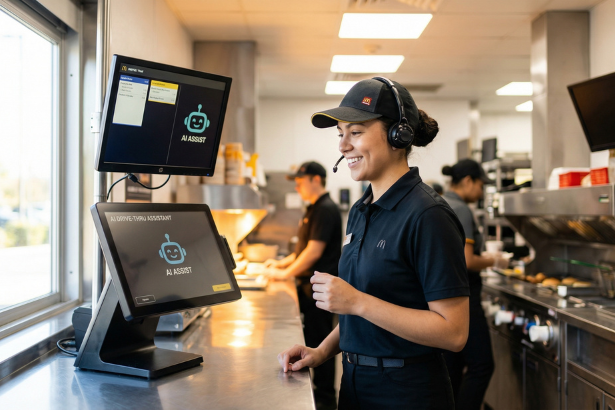
Burger King AI assistant Patty is rolling out as part of the company’s broader push into artificial intelligence-powered restaurant operations — but not in the way most headlines suggest. Announced February 26, 2026 (with reporting from The Verge the same day), Patty is a voice-enabled chatbot that lives inside employee headsets, designed to serve dual purposes: assist workers with meal preparation AND monitor how polite they sound to customers by tracking specific phrases like “welcome to Burger King,” “please,” and “thank you.”
The system is part of Burger King’s new BK Assistant platform, which integrates with the chain’s cloud-based point-of-sale system to provide real-time intelligence to restaurant teams. While Burger King frames Patty as a helpful productivity tool, the monitoring component has sparked immediate controversy about workplace surveillance, emotional labor evaluation, and the ethics of AI-powered management.
The announcement reflects a growing trend across the restaurant industry where AI is being deployed to increase efficiency, reduce labor strain, improve order accuracy — and now, evaluate worker behavior in real time.
Background and Context
Burger King is one of the largest quick service restaurant brands in the world, operating thousands of locations globally under Restaurant Brands International (which also owns Tim Hortons, Popeyes, and Firehouse Subs). In recent years, major chains have experimented with AI-driven ordering systems to streamline operations and reduce friction during peak hours.
Voice AI in restaurants is not entirely new. McDonald’s famously piloted AI drive-thru ordering technology in partnership with IBM in 2021-2024, but pulled the plug in 2024 after widely publicized failures including orders for 260 McNuggets and bacon added to ice cream. Taco Bell, Wendy’s, and Carl’s Jr. have all tested AI ordering systems with mixed results.
What makes Patty different is its focus: rather than replacing workers at the drive-thru speaker (though Burger King is testing that separately in fewer than 100 locations), Patty is embedded directly into the communication device employees already use — their headsets — making it a tool for both assistance and surveillance.
Thibault Roux, Burger King’s chief digital officer, told The Verge that the company worked with franchisees and customers to define what “friendliness” actually means in measurable terms. The result? An AI system trained to recognize specific words and phrases that trigger positive scores for managers to review.
Latest Update: What Patty Actually Does
Here’s what Patty does, based on verified reporting from The Verge, Kotaku, TechBuzz, PRNewswire (NYSE), Retail Watchers, and other outlets:
1. Dual-Purpose Design: Assistance + Surveillance
Patty operates as a voice-enabled chatbot integrated into employee headsets, performing two simultaneous functions:
Assistance with meal preparation:
- Guides employees through order fulfillment steps
- Alerts managers if a machine is down for maintenance
- Notifies teams when items are out of stock
- Updates inventory across all ordering channels (kiosks, drive-thru, mobile app) within 15 minutes
Monitoring worker politeness:
- Listens to every drive-thru and counter interaction
- Tracks whether employees say specific phrases: “welcome to Burger King,” “please,” “thank you”
- Generates “friendliness scores” for managers to review
- Evaluates tone and content of customer interactions
As The Verge put it: “Burger King just turned every drive-thru headset into a listening device.”
2. How It Works Technically
Patty operates through the BK Assistant platform, which integrates with Burger King’s new cloud-based point-of-sale system. Core technical components likely include:
- Speech recognition models to transcribe employee-customer conversations
- Natural language understanding systems to identify target phrases and assess tone
- Real-time menu database integration for inventory management
- Manager dashboard displaying friendliness scores and performance metrics
The system is always on during shifts, continuously evaluating employee interactions and providing meal prep assistance simultaneously.
3. Rollout Timeline and Scale
- Currently piloted in approximately 500 Burger King locations in the U.S.
- Full U.S. rollout planned by end of 2026
- BK Assistant web and app platform launching to all U.S. restaurants by end of 2026
- Separate AI drive-thru pilot (where AI takes customer orders directly) running in fewer than 100 locations
Roux emphasized that the customer-facing AI drive-thru is “still a risky bet” and “not every guest is ready for this,” suggesting Burger King is proceeding cautiously on that front while aggressively scaling the employee-facing Patty system.
4. What Roux Says About “Friendliness” Measurement
Thibault Roux told The Verge: “We worked with franchisees and customers to define what ‘friendliness’ actually means in measurable terms.”
The resulting AI system focuses on specific verbal markers:
- “Welcome to Burger King” — opening greeting
- “Please” — polite requests
- “Thank you” — gratitude expressions
These phrases are weighted in the friendliness scoring algorithm, which managers can review to assess employee performance.
5. Inventory Management Integration
Because Patty integrates with the cloud POS system, it can alert teams to operational issues in real time:
“Within 15 minutes, the entire ecosystem will remove it from stock — whether you’re walking into a restaurant to order from the kiosk, whether you’re going to the drive-thru, the digital menu board will be updated,” Roux said.
This functionality addresses a longstanding pain point in fast food: customers ordering items that are unavailable, only to be told at the window. Patty’s real-time inventory sync prevents that friction.
Expert Insights or Analysis
1. This Is About Monitoring Emotional Labor
The most significant aspect of Patty is not the meal prep assistance — it’s the surveillance of emotional labor. Service workers are expected to perform friendliness dozens or hundreds of times per shift, and Patty quantifies that performance into measurable metrics.
As TechBuzz noted: “This isn’t just about automation anymore — it’s about AI evaluating the emotional labor that service workers perform. The technology represents a significant shift in how AI gets deployed in retail and quick-service environments. Where previous generations of restaurant tech focused on order accuracy or kitchen efficiency, Patty is explicitly designed to monitor the tone and content of human interactions.”
2. The “Helpful Tool” Framing Obscures Surveillance
By combining meal preparation assistance with conversation monitoring, Burger King is essentially making the surveillance layer feel like a helpful tool rather than pure oversight. Employees get AI support with their tasks, but that support comes with a listening ear that’s always on and always evaluating.
This dual-purpose design is a deliberate strategy to increase acceptance. Workers may appreciate help with meal prep, but the trade-off is continuous monitoring of their interpersonal communication — something that would likely face resistance if presented purely as surveillance.
3. Workplace AI Monitoring Is Expanding
Burger King isn’t alone in exploring AI-powered employee monitoring:
- Retailers are using AI-powered cameras that track worker movements
- Call centers employ sentiment analysis tools to evaluate customer service interactions
- Amazon warehouses use productivity tracking systems that measure worker output per hour
But putting the technology directly into the communication device that workers rely on to do their jobs feels like a particularly intimate form of surveillance. The headset becomes both a tool and a monitor.
4. Labor Market Context
The timing is significant. As labor markets remain tight and minimum wage debates continue, fast food chains are increasingly turning to technology not just to replace workers but to extract more measurable value from the workers they keep.
Patty represents the next evolution of that strategy — not replacing the human entirely, but augmenting them with AI that ensures they perform their emotional labor according to corporate specifications.
5. Privacy and Consent Questions
Unlike optional productivity tools, Patty is mandatory for headset-wearing employees. Workers cannot opt out of the monitoring if they want to use the communication system required for their jobs. This raises questions:
- Are employees informed about what data is collected?
- How long is conversation data retained?
- Can employees review their friendliness scores?
- What consequences exist for low scores?
Burger King has not publicly addressed these questions in detail.
6. LLM Accuracy Concerns
Kotaku raised concerns about the reliability of large language model (LLM)-based systems like Patty:
“Given it’ll be an LLM, it’ll confidently make up anything it doesn’t have data for. This will all likely lead to wildly inaccurate stock information, misinformation being given to customers, and nonsense instructions being fed to staff, and it’s presumably those minimum wage employees who will bear the burden of this all.”
LLMs are known to “hallucinate” — generate plausible-sounding but incorrect information. If Patty provides incorrect meal prep instructions or inventory data, front-line workers (often minimum wage) will face customer complaints and operational chaos, not the AI system or corporate management.
Broader Implications
For the Restaurant Industry:
AI-powered monitoring may reduce dependency on manual oversight, but it also introduces new forms of worker stress. Employees may feel pressured to perform emotional labor in ways that satisfy algorithmic scoring rather than genuine customer connection.
If successful, other fast food chains and retailers will likely adopt similar systems, normalizing AI surveillance across the service industry.
For Consumers:
Customers may experience:
- More consistent greetings (employees incentivized to say scripted phrases)
- Accurate inventory information (real-time syncing prevents ordering unavailable items)
- Potentially less authentic interactions (employees performing for the algorithm rather than connecting naturally)
However, some consumers may prefer human interaction without the artificial consistency that algorithmic enforcement produces.
For Workers:
The most direct impact falls on front-line employees:
- Constant monitoring creates stress and reduces autonomy
- Emotional labor quantification turns interpersonal skills into measurable metrics
- Privacy erosion as every interaction is recorded and analyzed
- Potential consequences for low friendliness scores (disciplinary action, reduced hours, termination)
Labor advocates have raised concerns that these systems disproportionately impact low-wage workers who lack bargaining power to resist workplace surveillance.
For AI Commercialization:
Patty represents the expansion of AI beyond digital platforms into physical retail infrastructure and human behavior monitoring. AI is increasingly embedded in everyday workplace experiences, often without meaningful worker consent or input.
This deployment signals where voice AI is headed in enterprise settings: not just automating tasks, but evaluating human performance in real time and shaping worker behavior through algorithmic incentives.
Related History or Comparable Deployments
McDonald’s AI Drive-Thru Failure (2021-2024): McDonald’s partnered with IBM to test AI drive-thru ordering but abandoned the technology in 2024 after viral videos showed the system ordering 260 McNuggets, adding bacon to ice cream, and misunderstanding customer requests. The failures demonstrated that customer-facing AI ordering is still unreliable despite technological advances.
Taco Bell, Wendy’s, Carl’s Jr. Pilots: Multiple chains have tested AI drive-thru systems with mixed results. Some locations in California have implemented AI ordering, but adoption remains limited due to accuracy concerns and customer resistance.
Amazon Warehouse Monitoring: Amazon uses AI-powered productivity tracking systems that measure worker output, break times, and movement efficiency. The systems have been criticized for creating high-pressure environments and contributing to workplace injuries.
Call Center Sentiment Analysis: Many customer service call centers use AI to analyze agent tone, word choice, and customer satisfaction in real time. These systems generate performance scores that influence bonuses, promotions, and job security.
Patty combines elements of all these precedents: productivity assistance (Amazon), communication monitoring (call centers), and food service automation (McDonald’s, Taco Bell).
What Happens Next
Key factors to monitor:
1. Full Rollout by End of 2026: Burger King plans to deploy BK Assistant and Patty to all U.S. locations by December 2026. This will be one of the largest-scale deployments of workplace AI monitoring in the fast food industry.
2. Worker and Labor Response: Will employees push back against continuous monitoring? Labor unions and worker advocacy groups may challenge the legality or ethics of always-on surveillance, particularly if workers face consequences for low friendliness scores.
3. Customer Reaction: Will customers notice differences in employee interactions? If greetings become overly scripted or artificial due to algorithmic enforcement, customer satisfaction could decline despite higher “friendliness” scores.
4. Measured ROI and Accuracy: Burger King will need to demonstrate that Patty improves operational efficiency, reduces wait times, and increases customer satisfaction. If the system generates inaccurate inventory data or meal prep instructions, front-line workers will bear the consequences.
5. Regulatory Scrutiny: As workplace AI monitoring expands, regulators may introduce requirements for transparency, consent, and data retention limits. The European Union’s AI Act already includes provisions for high-risk AI systems in employment contexts.
6. Competitor Adoption: If Patty proves effective (from a management perspective), other fast food chains and retailers will likely adopt similar employee monitoring systems, normalizing AI surveillance across low-wage service industries.
The next phase of AI in restaurants may include not just automated ordering and inventory management, but comprehensive monitoring of worker behavior, productivity, and emotional labor performance.
Conclusion
Burger King AI assistant Patty reflects a broader shift toward AI-enabled workplace surveillance disguised as productivity assistance. By embedding a voice chatbot into employee headsets that both helps with meal prep and monitors conversational politeness, Burger King has created a dual-purpose system that normalizes constant evaluation of worker behavior.
The success of Patty will depend not just on technical accuracy but on worker acceptance, customer reception, and regulatory response. For employees, the system represents a new form of algorithmic management that quantifies emotional labor and turns interpersonal communication into measurable performance metrics.
For the fast food industry, Patty signals a future where AI monitors not just what workers do, but how they say it — turning every shift into a performance review and every interaction into data.
As Kotaku put it: “It’s all so sinister and all so stupid.”
Whether this represents the future of work or a dystopian overreach may depend on your perspective. For Burger King’s minimum wage employees wearing those headsets, the choice has already been made.
FAQ
Q1: What is Burger King’s AI assistant Patty? Patty is a voice-enabled chatbot embedded in employee headsets that serves dual purposes: (1) assists workers with meal preparation, inventory management, and operational alerts, and (2) monitors employee interactions with customers to evaluate “friendliness” by tracking whether workers say “welcome to Burger King,” “please,” and “thank you.” Managers receive friendliness scores based on these metrics.
Q2: Is Patty taking drive-thru orders from customers? No. Despite many headlines, Patty is NOT a customer-facing drive-thru ordering system. It is an employee-facing tool embedded in worker headsets. Burger King IS separately testing AI drive-thru ordering in fewer than 100 locations, but that is a different technology from Patty. Thibault Roux, Burger King’s chief digital officer, said the customer-facing AI is “still a risky bet” and “not every guest is ready for this.”
Q3: Is Patty replacing workers? Not directly. Patty monitors and assists existing workers rather than replacing them. However, the system represents a shift toward algorithmic management where AI evaluates worker performance in real time, potentially leading to disciplinary consequences for low friendliness scores.
Q4: Where is Patty available? Currently piloted in approximately 500 Burger King locations in the U.S. Burger King plans to roll out the BK Assistant platform (which includes Patty) to all U.S. restaurants by the end of 2026.
Q5: Why are workers and advocates concerned? The system raises concerns about workplace surveillance, privacy erosion, emotional labor quantification, and the lack of meaningful worker consent. Employees cannot opt out of monitoring if they use the required communication headsets. Critics argue this represents an intimate form of surveillance that evaluates not just productivity but interpersonal behavior and tone.
Sources and References
The Verge: Burger King’s AI Assistant Patty Will Monitor Whether Employees Say ‘Please’ and ‘Thank You’ https://www.theverge.com/ai-artificial-intelligence/884911/burger-king-ai-assistant-patty
TechBuzz: Burger King Deploys AI to Monitor Employee Politeness https://www.techbuzz.ai/articles/burger-king-deploys-ai-to-monitor-employee-politeness
Kotaku: Burger King Is Planning To Use AI Headsets To Spy On Its Staff https://kotaku.com/burger-king-ai-patty-fast-food-llm-dystopia-2000673998