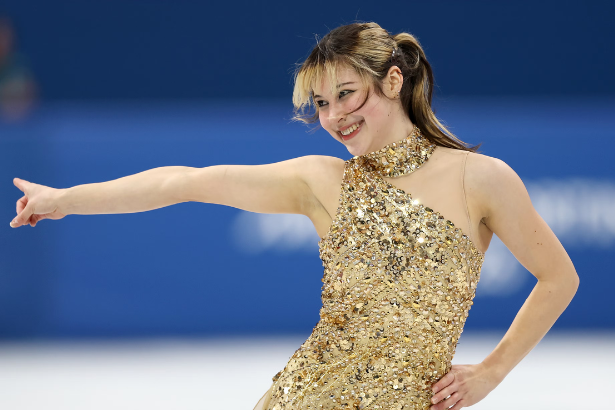
The Oakland figure skater delivers a joyful, flawless free skate that ends a 24-year American gold medal drought and crowns one of the great comeback stories in Olympic history
Introduction
Alysa Liu wins gold in women’s figure skating at the 2026 Winter Olympics, completing one of the most remarkable comeback stories in modern sports and ending a 24-year American drought on the Olympic podium’s top step.
The 20-year-old from Oakland, California, delivered a dazzling free skate Thursday in Milan, scoring a career-best 226.79 total to surge from third place after the short program and claim the Olympic crown. Liu is the first American woman to win individual figure skating gold since Sarah Hughes at Salt Lake City 2002 — and the first American woman to win any individual figure skating medal since Sasha Cohen’s bronze at Torino 2006.
It is a stunning arc for an athlete who retired from the sport at 16, stepped away for nearly two years, then returned in March 2024 to reclaim her career on her own terms.
Background and Context
Alysa Liu first rose to prominence as a teenage prodigy. At age 13 in 2019, she became the youngest U.S. women’s national champion in history. She won the title again in 2020. Known for landing triple Axels as a young teenager, she was considered the future of American figure skating — a once-in-a-generation talent whose ceiling seemed limitless.
She competed at the 2022 Winter Olympics in Beijing at age 16, placing sixth. Weeks later, she won bronze at the World Championships. Then she retired.
Liu cited burnout and a lack of joy. In interviews, she described her early career as one where she mostly followed direction — coaches picked her music, designed her costumes, choreographed her programs. She executed. She won. But it wasn’t hers.
“Take a break so it helps you figure out what you want,” Liu told The Oaklandside in 2025. “When you’re in your bubble, you can’t see it, so you have to take a step back to really figure out what you want to do.”
In March 2024, Liu announced her return. She wanted creative control. She wanted to skate for herself. She wanted joy back in the sport.
In 2025, she won the World Championships — breaking a 19-year U.S. drought on that stage. The 2026 Winter Olympics became the ultimate stage for that evolution.
Latest Update or News Breakdown
Alysa Liu won Olympic gold Thursday, February 19, 2026, at the Milano Ice Skating Arena in Milan, Italy. Here is what happened, based on verified reporting from NPR, Olympics.com, NBC Olympics, The Oaklandside, Washington Post, CNN, ABC News, and Yahoo Sports:
The Performance: Liu skated to Donna Summer’s “MacArthur Park Suite” — a program she repurposed from the 2024-25 season after facing music licensing issues with a planned Lady Gaga routine. Dressed in a gold sequined asymmetrical dress and sporting her signature raccoon-striped ponytail (horizontal blonde highlights in dark hair), Liu skated with visible joy.
Her free skate featured:
- Clean triple jumps with full rotation and secure landings
- Effortless-looking transitions between elements
- Sassy poses and an ear-to-ear grin throughout
- Only one minor deduction — a flying camel spin dinged for moving too much across the ice
The crowd grew progressively louder with every clean landing. By the time she finished, the Milano Ice Skating Arena was on its feet.
“I’m so happy with the way I skated today,” Liu said afterward. “The crowd was incredible, and the skate went exactly how I wanted it to.”
The Scores:
- Short program (Tuesday): 76.59 (3rd place)
- Free skate (Thursday): Highest score in the field
- Total: 226.79 (career-best)
The Podium:
- Gold: Alysa Liu (USA) — 226.79
- Silver: Kaori Sakamoto (Japan) — retiring after these Games
- Bronze: Ami Nakai (Japan) — 17 years old, debut senior season
International Olympic Committee President Kirsty Coventry presented the medals.
The Reaction: Liu exchanged long hugs with her coaches and the Japanese skaters, who were visibly emotional. She congratulated Ami Nakai, saying: “It’s amazing that you won a medal on your first Olympics.”
She also shared a sweet moment with teammate Amber Glenn, who finished fifth after a triumphant free skate that moved her from 13th place following a costly mistake in the short program.
When asked about the gold medal afterward, Liu doubled down on her philosophy. “I don’t need this,” she said, holding the medal. “But what I needed was the stage, and I got that, so I was all good no matter what happened.”
She later told reporters she felt “calm, happy and confident” on the ice.
Trending Detail: Liu’s lip piercing — which she calls “Smiley” — became a trending topic during the broadcast as viewers asked what was on her teeth.
Team Event Gold: This marks Liu’s second Olympic gold medal at the 2026 Games. She helped Team USA win the figure skating team event during the opening week in Milan.
Expert Insights or Analysis
Historic Significance: Liu’s gold medal ends a 24-year drought for American women in individual figure skating. Sarah Hughes was the last U.S. champion at Salt Lake City 2002. Liu also becomes the first American woman to win any individual figure skating medal — gold, silver, or bronze — since Sasha Cohen’s bronze at Torino 2006. That is a 20-year medal drought.
The Comeback Narrative: What makes Liu’s win extraordinary is not just the performance. It is the arc. She retired at 16 — an age when most prodigies are just hitting their peak. She stepped away for nearly two years. She returned in March 2024 — not because she needed redemption, but because she wanted to skate for herself.
Tara Lipinski, 1998 Olympic gold medalist, told NBC: “I’ve never seen someone withstand pressure like Alysa Liu … she’s all sunshine on the ice.”
Competitive Advantage: Figure skating analysts noted that Liu’s advantage was not merely technical difficulty. It was the balance between composure and expression. Olympic competition exposes small mistakes under maximum pressure. Liu’s skate appeared unforced. Her transitions were smooth. Her jumps showed full rotation and secure landings.
Psychologically, having previously stepped away from the sport meant Liu competed without the weight of teenage expectations. That shift likely improved performance stability.
The Joy Factor: Liu told NBC’s Andrea Joyce before her free skate: “I’m only here because I like it, so, I mean, it would be a problem if I didn’t have joy.”
NPR described her free skate as loaded with “sassy poses, effortless-looking triple jumps and an ear-to-ear grin.”
That visible joy is not just aesthetically pleasing. It signals confidence, comfort, and control — all of which judges reward in the performance component scores.
Broader Implications
For Team USA: Liu’s victory reinforces the United States’ continued competitiveness in women’s figure skating and provides a generational bridge between past champions like Sarah Hughes and Michelle Kwan and emerging talent. It also gives Team USA momentum heading into future Olympic cycles.
For Figure Skating: Liu’s gold medal signals that longevity and athlete-centered development may outperform early specialization alone. Her trajectory challenges traditional models that peak athletes too early, burn them out, and discard them before they reach 20.
The fact that Liu stepped away, reset, and returned stronger is a blueprint for sustainable athlete development.
For Olympic Culture: The 2026 Games have spotlighted resilience stories across disciplines. Liu’s win aligns with a larger narrative of athletes redefining success beyond medals — then ultimately winning them anyway.
Her philosophy of “I don’t need this” — referring to the gold medal — captures a healthier relationship with competition. She valued the stage, the experience, the performance. The medal was the byproduct, not the goal.
Related History or Comparable Moments
American women’s figure skating has produced defining Olympic moments over decades — Peggy Fleming (1968), Dorothy Hamill (1976), Kristi Yamaguchi (1992), Tara Lipinski (1998), Sarah Hughes (2002). But Liu’s comeback sets her apart.
Unlike prodigies who peak early and fade, Liu left the sport voluntarily at 16 and returned stronger at 20. That arc is rare at the Olympic level.
Her gold also follows a period of international dominance by Russia (before their ban) and Japan. Liu’s win is strategically significant for U.S. skating programs trying to rebuild American women’s dominance on the world stage.
The last American comeback story of this magnitude was Michelle Kwan — who won World Championships in 1996, 1998, 2000, 2001, and 2003 but never captured Olympic gold. Liu has now done what Kwan could not.
What Happens Next
With Olympic gold secured, Liu’s future options expand significantly:
- Professional skating tours — Stars on Ice, Champions on Ice
- Global endorsement opportunities — her marketability will surge following this high-visibility win
- World Championship appearances — she could defend her 2025 title
- Advocacy work around athlete mental health, creative autonomy, and sustainable sports development
- Coaching or choreography — if she decides to transition out of competition
Whether she continues competing or transitions into professional showcases, her Olympic victory guarantees lasting influence. She has already changed the conversation around athlete autonomy and joy in elite sports.
Industry observers expect her marketability to surge. Her story — teenage prodigy, retirement, comeback, Olympic gold — is built for documentaries, interviews, and inspirational keynote speeches.
Conclusion
Alysa Liu wins gold not just as a technical achievement but as a narrative triumph. Her Olympic victory represents resilience, autonomy, and evolution in modern sport.
From teenage phenom who landed triple Axels at 13 to youngest national champion to Olympic sixth-place finisher to retiree at 16 to World Champion to Olympic gold medalist at 20 — Liu’s journey reshapes expectations for American figure skating and provides one of the defining moments of the 2026 Winter Games.
She skated with joy. She skated for herself. And she won.
Her comeback is now complete. Her legacy is just beginning.
FAQ
Q1: What event did Alysa Liu win at the 2026 Winter Olympics? She won gold in women’s figure skating with a career-best total score of 226.79. She is the first American woman to win individual figure skating gold since Sarah Hughes in 2002 — a 24-year drought.
Q2: Is this Alysa Liu’s first Olympic medal? This is her second Olympic gold medal at the 2026 Games. She won team event gold during the opening week in Milan. It is her first individual Olympic gold.
Q3: Did Alysa Liu retire before the 2026 Olympics? Yes. She retired from competitive skating in 2022 at age 16 after finishing sixth at the Beijing Olympics. She stepped away for nearly two years before launching a comeback in March 2024.
Q4: Why is her win considered a historic comeback story? Because she became the youngest U.S. national champion at 13, competed at the Olympics at 16, retired citing burnout, stepped away for two years, returned in 2024, won the 2025 World Championships, and then won Olympic gold in 2026 — all while reclaiming creative control over her skating.
Q5: How did experts describe her performance? Analysts described it as joyful, technically clean, emotionally composed, and visibly unforced. Tara Lipinski said: “I’ve never seen someone withstand pressure like Alysa Liu … she’s all sunshine on the ice.”
Sources and References
NPR: U.S. figure skater Alysa Liu said she didn’t care if she medaled. She won gold.
Olympics.com: Winter Olympics 2026 – USA’s Alysa Liu storms to Olympic title, first American woman to claim gold in 24 years
NBC Olympics: 2026 Olympic figure skating women’s free skate live updates