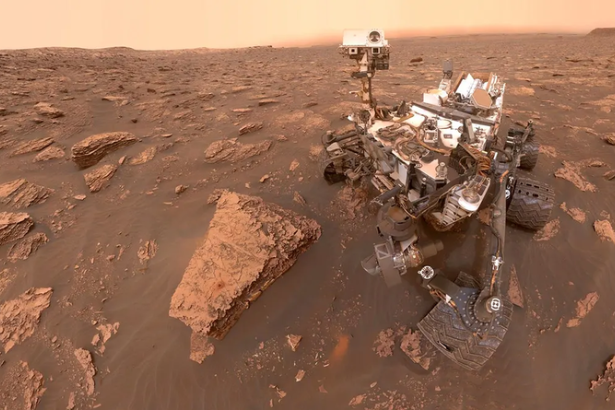
The NASA Curiosity rover is investigating some of the strangest rock formations recently observed on Mars. Scientists have identified unusual disk-shaped structures embedded in Martian bedrock that resemble tiny potato chips, raising questions about how these formations developed and what they reveal about the planet’s ancient environment.
The discovery has attracted attention because the formations may be crystals or mineral structures preserved within the surrounding rock. Rather than relying on photographs alone, NASA’s Mars Science Laboratory team has been using Curiosity’s drill, cameras and chemical analysis instruments to investigate them.
The rover recently completed a drilling campaign at an area informally named Nazca, where scientists collected material for examination inside its onboard laboratory.
NASA’s November 11, 2026 mission update, written by William Farrand of the Space Science Institute, described the investigation during Curiosity’s Sols 5063-5069 activities. The unusual formations remain under investigation, and their precise mineral identity has not yet been established. NASA’s official mission report provides the most direct account of the work. NASA Science+1
Tiny Crystal Shapes Get Close Look From Mars Rover | NASA Jet Propulsion Laboratory (JPL)
Background and Context: Why NASA Is Investigating These Strange Mars Rocks
Mars has preserved geological evidence of environmental conditions that existed billions of years ago.
Curiosity has spent years exploring Gale Crater and climbing the lower slopes of Mount Sharp, examining rock layers that record changes in the planet’s ancient environment.
The rover’s scientific mission goes beyond photographing interesting landscapes. It investigates the chemical composition, mineral structures and geological processes that shaped the Martian surface.
The latest investigation focuses on an area called Nazca.
Scientists observed bedrock containing unusual disk-shaped formations. Under close-up imaging, some structures appear remarkably thin and irregular, creating the potato-chip comparison used in NASA’s mission blog.
The shapes are scientifically interesting because crystal growth can preserve information about the environment in which minerals formed.
On Earth, certain minerals develop distinctive shapes when dissolved substances crystallize from water or other fluids. Similar processes may have occurred on ancient Mars.
However, scientists must determine whether the Martian formations are actual crystals, mineral replacements or another geological structure before drawing conclusions.
The investigation could provide another piece of evidence about the planet’s water-rich past. NASA Science+2
Latest Update: Curiosity Drills the Nazca Site to Investigate Possible Crystals
NASA mission update: November 2026
The latest drilling campaign represents an important step in understanding the unusual formations.
Curiosity returned to the Nazca area after identifying promising geological features during earlier observations.
NASA’s October 28 update described preparations for drilling, including close-up images showing abundant potential crystal forms.
The team selected a suitable rock block and conducted stability checks before extending the rover’s robotic arm.
The drilling campaign was designed to collect material that could reveal whether the unusual structures have a distinct chemical composition.
What the rover discovered
Curiosity Spots Fascinating Minerals on Mars | Mirage News
The formations are embedded in Martian bedrock and appear as small, flattened disks.
NASA’s mission team has informally compared their appearance to potato chips.
The unusual shapes attracted attention because they differ from the finely layered rock textures Curiosity had been examining in nearby areas.
The team identified several individual targets, including formations named:
- Nazca
- Ahi Veremos
- Colca
- Bermejo
These informal names help mission scientists organize their observations and analysis.
The 49th drill hole marks another milestone
Curiosity Blog: Success! Drill Sample Collected | Mirage News
The Nazca investigation also formed part of Curiosity’s 49th drilling campaign.
NASA’s November 9 update, titled It’s Nazca, Our 49th Drill Hole, described the selection of a rock containing abundant potential crystal structures.
The team wanted to examine both the visible surface formations and material collected from beneath the surface.
This distinction matters because surface weathering can alter minerals and make it difficult to understand their original composition.
By drilling into the rock, scientists can compare surface observations with material taken from inside the formation. NASA Science+2
NASA sends rock samples to Curiosity’s onboard laboratory
One of the most important developments involved delivering drill samples to the Sample Analysis at Mars instrument, commonly called SAM.
SAM is an onboard laboratory designed to investigate the chemical composition of Martian samples.
Its analysis can help scientists identify chemical compounds and investigate materials associated with the planet’s geological history.
NASA’s November 11 update confirmed that material from the Nazca drill hole had been delivered to SAM while analysis was underway.
The mission team also used ChemCam, which employs laser-induced breakdown spectroscopy, to investigate additional formations.
This allowed researchers to examine multiple geological targets rather than relying on a single drilled sample. NASA Science+1
Expert Analysis: What Could These Potato Chip-Shaped Formations Actually Be?
Sol 4842: Mars Hand Lens Imager (MAHLI) – NASA Mars Exploration
The biggest scientific question is whether these structures are genuine crystals or geological features that only resemble them.
There are several possibilities worth investigating.
1. Mineral crystals formed by ancient water
One possibility is that the formations developed when mineral-rich water moved through Martian rock.
As water evaporated or its chemical conditions changed, dissolved minerals could have crystallized into distinctive shapes.
If this explanation is correct, the structures could provide information about the chemical conditions that existed when the rocks formed.
Scientists could potentially use their composition and morphology to understand the availability of water and dissolved minerals in ancient Gale Crater.
2. Pseudomorphs preserving the shape of older minerals
Another possibility involves pseudomorphs.
These structures form when one mineral replaces another while retaining the original mineral’s external shape.
In other words, the material may have changed chemically while preserving the appearance of an earlier crystal.
If the Nazca formations are pseudomorphs, they could reveal multiple stages of geological activity on Mars.
3. Fragments of harder geological material
Scientists must also consider whether the disk-shaped structures represent fragments of a more resistant rock layer.
Erosion and weathering can expose harder materials while removing surrounding rock.
That process can produce unusual shapes without requiring the structures to have formed as crystals.
The chemical analysis will help researchers distinguish between these possibilities.
The important distinction: NASA has identified potential crystal forms, not confirmed a new mineral or discovered evidence of Martian life.
How NASA’s Curiosity Rover Is Investigating the Formations
The investigation demonstrates how several scientific instruments work together aboard a single robotic explorer.
Sol 1628: Mars Hand Lens Imager (MAHLI) – NASA Mars Exploration
Curiosity Science Instruments – NASA Science
Schematic diagram of Curiosity’s SAM… | The Planetary Society
6
MAHLI: Capturing extremely detailed images
The Mars Hand Lens Imager, or MAHLI, is mounted on the rover’s robotic arm.
It captures close-up images that allow scientists to examine rock textures and small geological structures.
NASA also planned nighttime imaging using white-light and ultraviolet LED lamps.
These observations could provide additional information about the formations’ appearance under different lighting conditions.
ChemCam: Investigating chemical composition
ChemCam uses a laser to examine the chemical composition of rocks.
The laser creates a small plasma from the target material, allowing scientists to identify elements through the light emitted.
NASA’s November 11 update described laser observations of the Colca and Bermejo formations, including a depth profile of Colca.
SAM: Analyzing collected samples
SAM is particularly important because it can investigate material collected by Curiosity’s drill.
Unlike photographs, chemical analysis can help identify compounds that are not visually distinguishable.
The Nazca samples were delivered to SAM, providing scientists with material for further investigation.
Mastcam: Building the geological picture
Mastcam captures broader images of the Martian landscape.
It helps scientists understand where unusual rock formations appear relative to surrounding geological structures.
Combining these observations creates a more complete picture of the area.
Broader Implications: What the Discovery Could Tell Us About Ancient Mars
Understanding the history of water on Mars
Depuis les flancs du mont Sharp, Curiosity nous envoie une carte postale grandiose | Ciel & Espace
One of the central questions in Mars exploration is how long liquid water existed on the planet’s surface and underground.
Curiosity has already documented geological evidence of ancient environments that could have supported microbial life.
The Nazca formations may provide another opportunity to understand how water interacted with Martian rocks.
If their shapes and chemistry are linked to mineral precipitation, scientists could reconstruct aspects of the environmental conditions that existed when they formed.
Understanding Mars’ changing climate
Minerals can preserve evidence of environmental changes.
Their chemical composition, structure and relationship with surrounding rocks can reveal whether conditions were wet, dry, acidic or chemically different at various stages.
The Nazca investigation could therefore contribute to a wider understanding of how Mars transitioned from a planet with ancient water-related environments to the cold, dry world observed today.
Why the discovery matters for future exploration
Understanding the geological history of Mars is important for future robotic and human exploration.
Identifying minerals that formed through interactions with water could help scientists select promising locations for further research.
It also helps researchers determine which geological environments deserve closer examination during future missions.
The findings are not yet a breakthrough in the search for life, but they contribute to the scientific foundation needed to investigate Mars more effectively.
Related History: Curiosity’s Other Unusual Mars Discoveries
The potato-chip-shaped formations are part of a much longer series of geological investigations.
Curiosity has repeatedly encountered unexpected structures while exploring Gale Crater and Mount Sharp.
The honeycomb-like polygons
NASA’s Curiosity rover finds mysterious honeycomb textures on surface of Mars | The Independent
In July 2026, NASA reported that Curiosity had discovered an extensive area covered with polygonal fractures.
These structures resembled a giant honeycomb and extended across the landscape.
Scientists considered several possible explanations, including mineral shrinkage, temperature changes and geological processes involving burial and exposure.
The discovery demonstrated how unusual geological textures can provide clues about Mars’ environmental history. NASA Jet Propulsion Laboratory (JPL)+1
The earlier disk-shaped formations
NASA had also documented similar disk-like structures during its September 2026 observations.
An update titled Fantastic Minerals and How To Detect Them discussed small disc-shaped features found in rocks named Yungay and Chiu Chiu.
Scientists considered whether these features could be related to minerals precipitating from evaporating fluids.
The newer Nazca investigation builds on those earlier observations by examining a promising rock through drilling and chemical analysis. NASA Science+1
Curiosity’s long scientific journey
Curiosity landed inside Gale Crater in August 2012.
Since then, it has examined sedimentary rocks, ancient lake deposits, mineral structures and geological layers across the Martian landscape.
Its mission has helped establish that ancient Mars once had environmental conditions that could have supported microbial life.
The current investigation continues that work, focusing on a different set of geological clues.
What Happens Next?
NASA’s investigation is moving beyond the initial discovery and drilling stage.
According to the November 17 mission update, Curiosity has completed its recent work involving the Nazca and Basque Lakes samples and has resumed its climb up Mount Sharp.
The next phase involves examining new geological textures and collecting observations as the rover progresses toward the Yardang unit.
The mission team plans to continue using instruments such as APXS, ChemCam, MAHLI and Mastcam.
Several questions remain:
- What minerals make up the potato-chip-shaped formations?
- Did the structures form through ancient water-related processes?
- Are they genuine crystals or pseudomorphs?
- What can their chemistry reveal about the ancient Martian environment?
- How do they relate to other geological features found around Mount Sharp?
NASA’s latest update also describes another unusual geological feature: polygonal patterns surrounded by raised ridges.
Scientists are investigating whether these structures formed through mineral shrinkage, temperature cycling or changes associated with burial and exposure.
Curiosity’s continuing observations could help connect these different geological discoveries into a clearer picture of Mars’ environmental evolution. NASA Science+1
Conclusion
The NASA Curiosity rover has uncovered another fascinating geological puzzle on Mars.
The potato-chip-shaped formations at the Nazca site may represent crystals or other mineral structures preserved within ancient Martian bedrock.
By combining close-up photography, laser spectroscopy and drilled rock samples, NASA scientists are attempting to determine how these formations developed and what their chemistry can reveal.
The discovery is especially interesting because mineral structures can preserve evidence of ancient environmental conditions, including interactions between water and rock.
However, the scientific investigation is still ongoing. Their exact composition and origin have not yet been confirmed.
Curiosity’s work at Nazca demonstrates why Mars remains such an important destination for planetary science. Even after more than a decade on the Red Planet, the rover continues to encounter geological features that challenge existing explanations and create new research questions.
The next answers may come from the tiny structures that currently look like nothing more than potato chips scattered across a Martian rock.
Frequently Asked Questions
1. What has NASA’s Curiosity rover discovered on Mars?
Curiosity has been investigating unusual disk-shaped rock formations at the Nazca site on Mars. Their appearance has been compared to potato chips, and scientists are examining whether they are crystals or other mineral structures.
2. Are the potato-chip-shaped rocks actually crystals?
Their exact identity has not been confirmed. NASA describes them as potential crystal forms, and further chemical analysis is needed.
3. Where did Curiosity find the unusual formations?
The formations were identified in an area informally named Nazca within Gale Crater on Mars.
4. Why is NASA drilling into the rocks?
Drilling allows scientists to collect material from inside the rock and investigate its chemical composition using the rover’s onboard laboratory.
5. What is the SAM instrument on Curiosity?
SAM stands for Sample Analysis at Mars. It is an onboard laboratory that investigates the chemical composition of collected Martian samples.
6. What is the purpose of Curiosity’s ChemCam instrument?
ChemCam uses laser-induced breakdown spectroscopy to investigate the elemental composition of rocks and other targets.
7. Could the formations provide evidence of ancient water on Mars?
Potentially. If the structures formed through mineral precipitation from ancient water, their chemistry could reveal information about past environmental conditions. This explanation remains under investigation.
8. How long has NASA’s Curiosity rover been exploring Mars?
Curiosity landed on Mars in August 2012 and has continued exploring Gale Crater and Mount Sharp for more than 14 years as of November 2026.
Sources & References
1. NASA Science: Curiosity Blog, Sols 5063-5069: Rocks and Chips
Primary source covering the potato-chip-shaped formations, Nazca drilling campaign, SAM sample delivery and ChemCam observations.
2. NASA Science: Curiosity Blog, Sols 5050-5055: It’s Nazca, Our 49th Drill Hole
Explains the selection of the drilling location and the potential crystal structures.
3. NASA Science: Curiosity Blog, Sols 5043-5049: Preparing to Drill at Nazca
Details the earlier close-up observations and preparation for drilling.
4. NASA Science: Curiosity Blog, Sols 5072-5076: The Return of the Polygons
Provides the latest mission update on Curiosity’s return to exploration and its investigation of polygonal geological formations.
5. Fox News: NASA Curiosity Rover Studies Odd ‘Potato Chip’ Formations on Mars
Mainstream news coverage explaining the unusual formations and scientific investigation.
6. NASA/JPL: NASA’s Curiosity Mars Rover Discovers Field of Honeycomb Textures
Background on another unusual geological discovery made by Curiosity in 2026.
7. NASA Science: A Collage Showing 49 Drill Holes Made by NASA’s Curiosity Mars Rover
Official imagery documenting Curiosity’s drilling work.