
By using this site, you agree to the Privacy Policy and Terms of Use.
Accept
The Tech MarketerThe Tech MarketerThe Tech Marketer
  • Home
  • Technology
  • Entertainment
    • Memes
    • Quiz
  • Marketing
  • Politics
  • Visionary Vault
    • Whitepaper
Reading: Rethink What’s Possible Pushing Computer Vision Boundaries Beyond 4K
Share
Notification Show More
Font ResizerAa
The Tech MarketerThe Tech Marketer
Font ResizerAa
  • Home
  • Technology
  • Entertainment
  • Marketing
  • Politics
  • Visionary Vault
  • Home
  • Technology
  • Entertainment
    • Memes
    • Quiz
  • Marketing
  • Politics
  • Visionary Vault
    • Whitepaper
Have an existing account? Sign In
Follow US
© The Tech Marketer. All Rights Reserved.
White Paper

Rethink What’s Possible Pushing Computer Vision Boundaries Beyond 4K

thetechmarketer
Last updated:
thetechmarketer 4 years ago
Share
SHARE

Computer vision and image processing algorithms are increasingly common to commercial and research-related
applications. These high resolution models perform complex computations to process image data in real-time and require rapid processing to yield analysis and results.

Contents
SURPASS THE LIMITS OF THE GPUADDING MORE GPUS ISN’T THE ANSWERTRAIN LARGE COMPUTER VISION MODELS WITH HIGH-RESOLUTION IMAGES

In the context of machine learning image processing and analysis, resolution is everything. An image’s resolution can enable a more detailed, meaningful analysis that results in greater understanding. To this end, a high-resolution image will contain more information and detail than a low-resolution image of the very same subject.

Today, higher-resolution image processing requires significant computational capabilities. So much so, in fact, that training models to use these high-resolution images have rendered current state-of-the-art
technologies unusable.

When it comes to high-resolution processing, legacy architecture constraints are holding back research and technology advances across numerous use cases, including in areas such as autonomous driving, oil and gas exploration, medical imaging, anti-viral research, astronomy, and more.

SURPASS THE LIMITS OF THE GPU

SambaNova Systems has been working with industry to develop an optimized solution for training computer vision models with increasingly growing levels of resolution – without compromising high accuracy levels. We take a “clean sheet” complete systems approach to enable native support for high-resolution images. Co-designing across our complete stack of so!ware and hardware provides the freedom and flexibility from legacy GPU architecture constraints and legacy spatial partitioning methods.

ADDING MORE GPUS ISN’T THE ANSWER

If you consider images in the context of AI/ML training data, the richer and more expansive your training information (i.e., images), the more accurate your results can be.

Using a single GPU to train high-resolution computer vision models predictably results in “Out of Memory” errors. On the other hand, clustering multiple GPUs brings all the challenges of disaggregation of the computational workflows onto each individual GPU in the cluster to aggregate GPU memory.

In this case, this is not merely clustering a few GPUs in a single system, but aggregating hundreds, if not thousands of GPU devices. In addition, conventional data parallel techniques that slice the input image into independent tiles deliver less accurate results than training on the original image.

TRAIN LARGE COMPUTER VISION MODELS WITH HIGH-RESOLUTION IMAGES

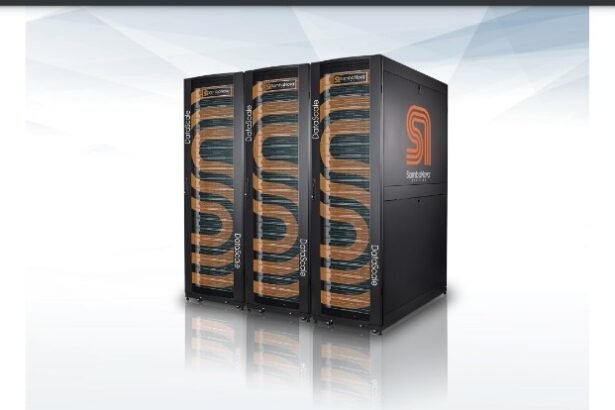
Massive Data: A single SambaNova DataScale™

Learn More

You Might Also Like

ERP Migration Is Not a Technical Project. It Is an Operational Reckoning: Migration Readiness Checklist for Manufacturers – SYSPRO

Your Microscope Measurements Are Only as Good as Your Last Calibration: Microscope Calibration for Measurements: Why and How You Should Do It – Leica Microsystems

Europe’s Aviation Fuel Mandate Is Already in Effect. Here Is What Every Stakeholder Needs to Know: ReFuelEU Aviation – Smart Freight Centre

Logistics Is Not the Differentiator. Operational Readiness Is: Turning Complexity Into Operational Readiness – Schnellecke Logistics

Seeing What’s Coming Before You Can React: Outlook 2026: The Agentic Transportation and Logistics Enterprise – Sutherland

Share This Article
Facebook LinkedIn Email Copy Link Print
Share
What do you think?
Love0
Sad0
Happy0
Sleepy0
Angry0
Dead0
Wink0
Previous Article Accelerated-Computing-with-a Reconfigurable-Data-flow-Architecture
Next Article Samba-Flow-A-Software-First-Approach

Latest News

  • Uber, Nuro, and Lucid kick off fully driverless robotaxi testing

    Uber's high-stakes robotaxi bet is officially ditching its human safety net. Nuro, Lucid, and Uber are starting fully driverless public road testing in the San Francisco Bay Area, with employee-only rides launching shortly after. First announced in July 2025, this three-way alliance represents Uber's aggressive comeback in autonomous ride-hailing, after having abandoned its own troubled

  • Google alternative Kagi launches an email service

    Kagi, which already offers a paid alternative to Google Search and its own Orion browser as a rival to Chrome, is taking on another Google service: Gmail. Today, Kagi announced a public beta of Kagi Mail, a new email service that has "no surveillance, no ads, open standards, and no lock-in." With Kagi Mail, you

  • The hacker behind early GTA VI leaks has been sentenced — and released

    Arion Kurtaj, who pleaded guilty last week to hacking Grand Theft Auto VI developer Rockstar Games and other companies, including Uber and Revolut, was sentenced to seven years in prison but released on license, the BBC reports. After hacking Rockstar, Kurtaj leaked 90 videos of GTA VI in 2022, years before the game's public release

  • The Verge’s 2026 holiday gift guide

    Gift-giving isn't just about grabbing something solid under a determined spending limit. It's an expression of love, a way to show someone how well you really know them. That doesn't mean you have to do it all on your own, though. Sometimes you just need a push in the right direction to get things rolling.

  • Ladybird, the first new browser engine in years, is now available to test

    Ladybird, an independent web browser with a built-from-scratch engine, is finally available for testing. On Monday, Ladybird developer Andreas Kling announced that the browser is launching in alpha on macOS and Linux following more than four years of development. The release makes Ladybird the first browser in years to arrive with an entirely new engine.

- Advertisement -
about us

We influence 20 million users and is the number one business and technology news network on the planet.

Advertise

  • Advertise With Us
  • Newsletters
  • Partnerships
  • Brand Collaborations
  • Press Enquiries

Top Categories

  • Artificial Intelligence
  • Technology
  • Bussiness
  • Politics
  • Marketing
  • Science
  • Sports
  • White Paper

Legal

  • About Us
  • Contact Us
  • Privacy Policy
  • Affiliate Disclaimer
  • Legal

Find Us on Socials

The Tech MarketerThe Tech Marketer
© The Tech Marketer. All Rights Reserved.
Welcome Back!

Sign in to your account

Lost your password?